If you searched "claw code" expecting a single coherent answer, you're not alone — the term routes to at least three different projects. This piece untangles them, then focuses on the two that matter most for developers: Claude Code (Anthropic's agentic coding CLI) and OpenClaw (an open-source general automation agent). They're not competitors. They solve different problems. Whether you need one, the other, or both depends on what you're actually trying to do.
What "Claw Code" Actually Refers To
Claude Code — Anthropic's Agentic CLI
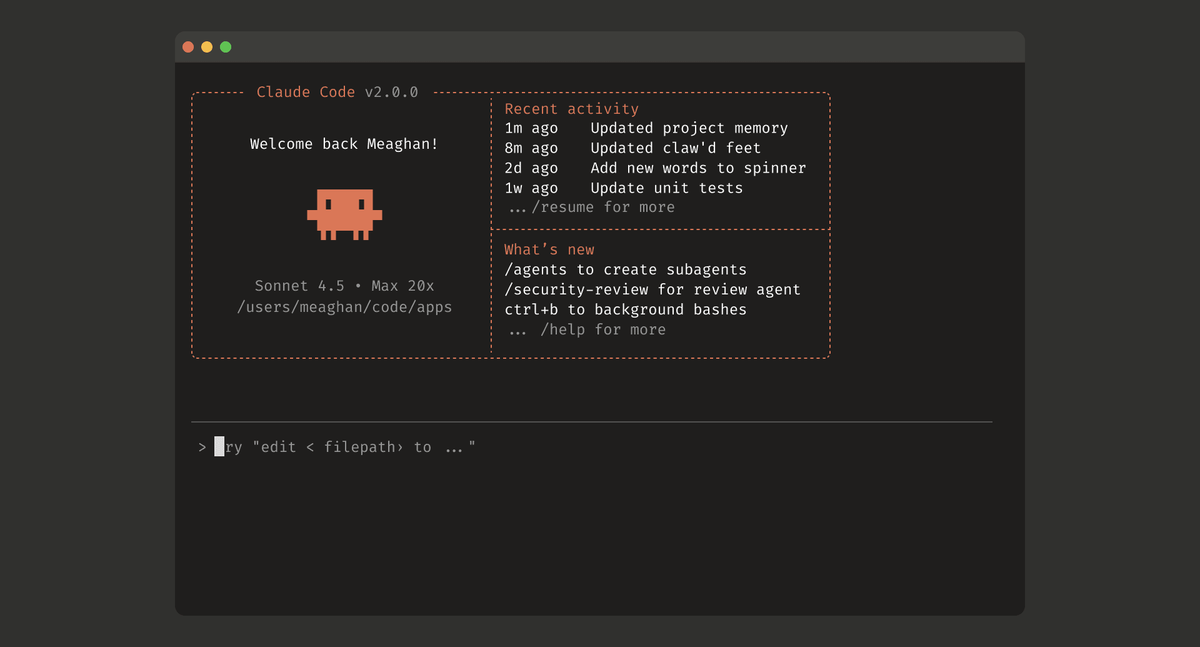
Claude Code is the official coding agent from Anthropic. It runs in your terminal, reads your repository, edits files, executes shell commands, and interacts with your IDE — all under your supervision or in automated pipelines. It's purpose-built for software engineering work: writing code, running tests, opening pull requests, and understanding large codebases across their full context. Claude Code is what Anthropic ships as its developer product.
OpenClaw — An Open-Source General Automation Agent
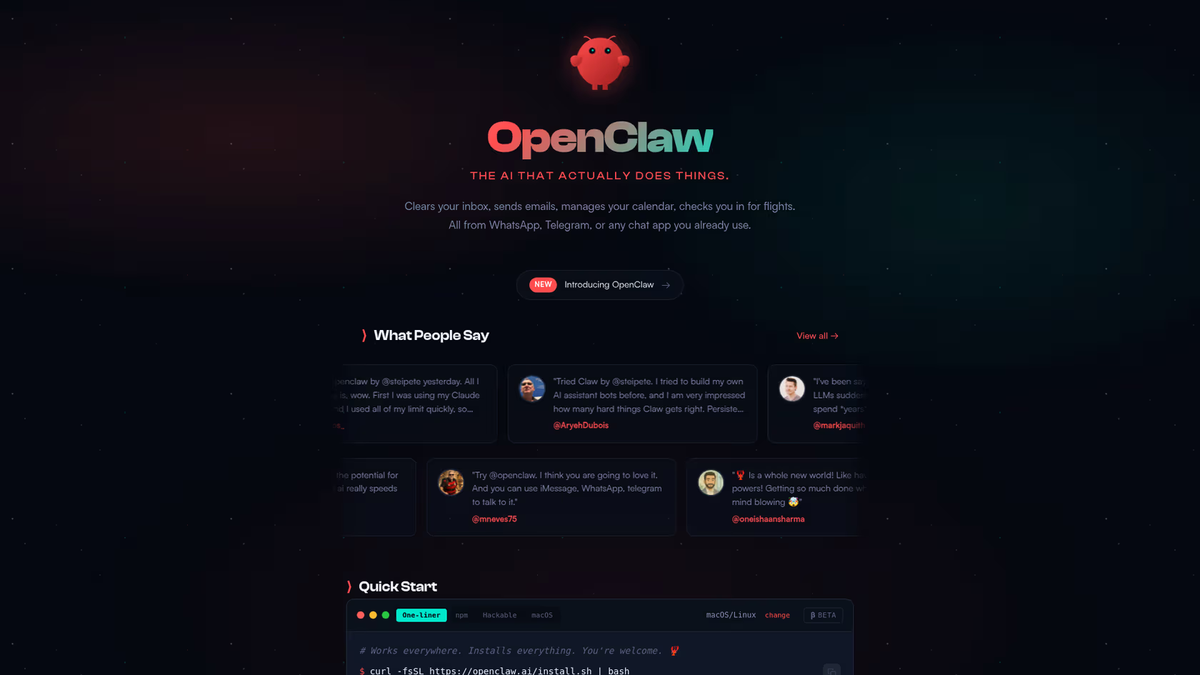
OpenClaw (formerly Clawdbot, briefly Moltbot) is an open-source framework for running a general-purpose AI agent that connects to your messaging apps — WhatsApp, Telegram, Discord, iMessage — and can take actions across your digital environment. It was created by Austrian developer Peter Steinberger and became the fastest-growing repository in GitHub history after its November 2025 release. It's not a coding tool by design. It's a personal automation layer: managing email, monitoring calendars, triggering workflows, responding to messages, and running custom skills from a community marketplace called ClawHub. Steinberger joined OpenAI in February 2026 and the project moved to a community foundation.
ClawCode — The Community Project
A separate, smaller project: ClawCode (github.com/iamAliAgha/ClawCode) is a community-built coding assistant that draws on Claude's API. It has no affiliation with Anthropic or the OpenClaw project. If you arrived here looking for it, that's the full picture — it's a third-party harness with limited adoption. The rest of this article focuses on Claude Code and OpenClaw.
Claude Code: What It Does and How It Works
Coding-First Design — Reads Your Repo, Edits Files, Runs Shell Commands
Claude Code understands your codebase as a whole, not just the file you're looking at. It reads directory structure, traces function calls across files, runs your existing test suite, executes git operations, and iterates based on results. Every file read, every tool call, every shell command is attributed back to your session with an explicit permission model — you decide which operations are allowed to run automatically and which require your approval.
The design assumption is that you're a developer who wants meaningful codebase-level work done, not just code completion. That's what separates it architecturally from autocomplete tools like GitHub Copilot, and it's why it can handle tasks like "refactor the auth module and open a PR" as a single instruction rather than a sequence of manual steps.
Where It Runs: Terminal, VS Code, JetBrains, Desktop App, Browser
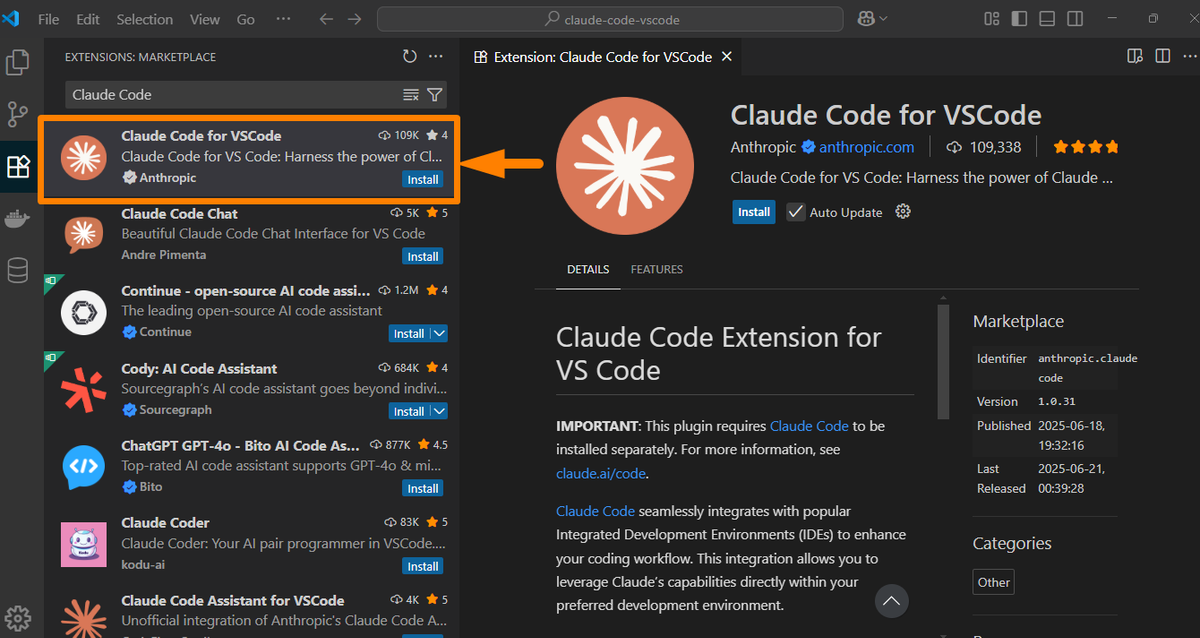
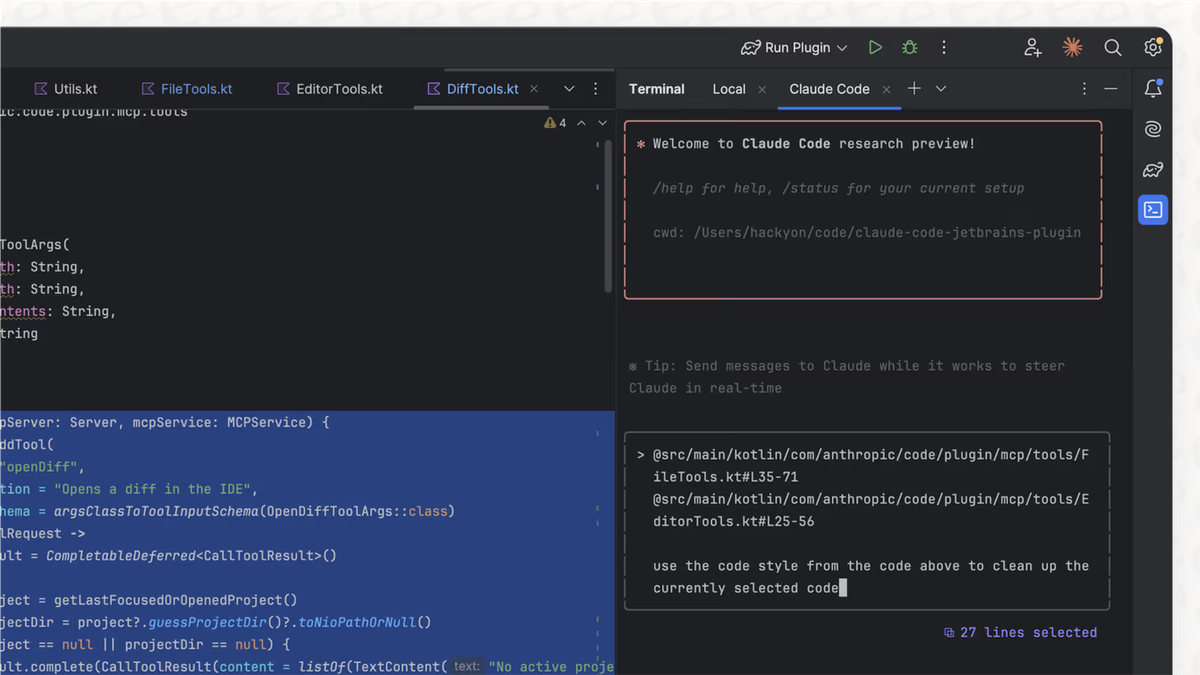
Claude Code is available as a terminal CLI (claude), a VS Code extension, a JetBrains plugin, a standalone desktop app for visual diff review and parallel sessions, and a web interface at claude.ai/code. Sessions are portable across surfaces — start in the terminal, check progress from your phone, pull the session into your editor. All of these run on Anthropic's infrastructure; nothing requires you to manage a server.
Pricing: Pro ($20/mo) vs Max vs Team vs Enterprise
Claude Code is not priced separately — it's included in Claude subscriptions. The tiers as of April 2026:
| Plan | Price | Best For |
|---|---|---|
| Pro | $20/mo | Individual developers, light-to-moderate daily use |
| Max 5x | $100/mo | Developers hitting Pro limits regularly; heavy sessions |
| Max 20x | $200/mo | All-day agentic work, multiple concurrent sessions |
| Team (Standard) | $20/seat/mo | Collaboration features; Claude Code requires Premium seats |
| Team (Premium) | $100/seat/mo | Development teams with Claude Code access |
| Enterprise | Custom | Large orgs; adds 500K context, HIPAA, compliance tooling |
For current prices, verify at Anthropic's pricing page — these have moved before and may move again.
OpenClaw: What It Does and How It's Different
General-Purpose Automation Agent — Not a Coding Tool by Design
OpenClaw is built around the idea that AI should act as an ambient assistant that can take actions across your apps, not a specialist tool within a single environment. It maintains persistent memory, runs scheduled tasks, monitors inboxes, and responds through messaging channels you already use. The use cases that OpenClaw's community gravitates toward — "draft and send my morning status update," "check if my flight is delayed and text me," "respond to routine Telegram messages based on my preferences" — are not what Claude Code is designed for.
This distinction is worth stating plainly: OpenClaw does not know your codebase. It's not built to understand file structure, run test suites, or produce pull requests. For software development tasks, it's the wrong tool.
Connects via WhatsApp, Telegram, Discord, iMessage
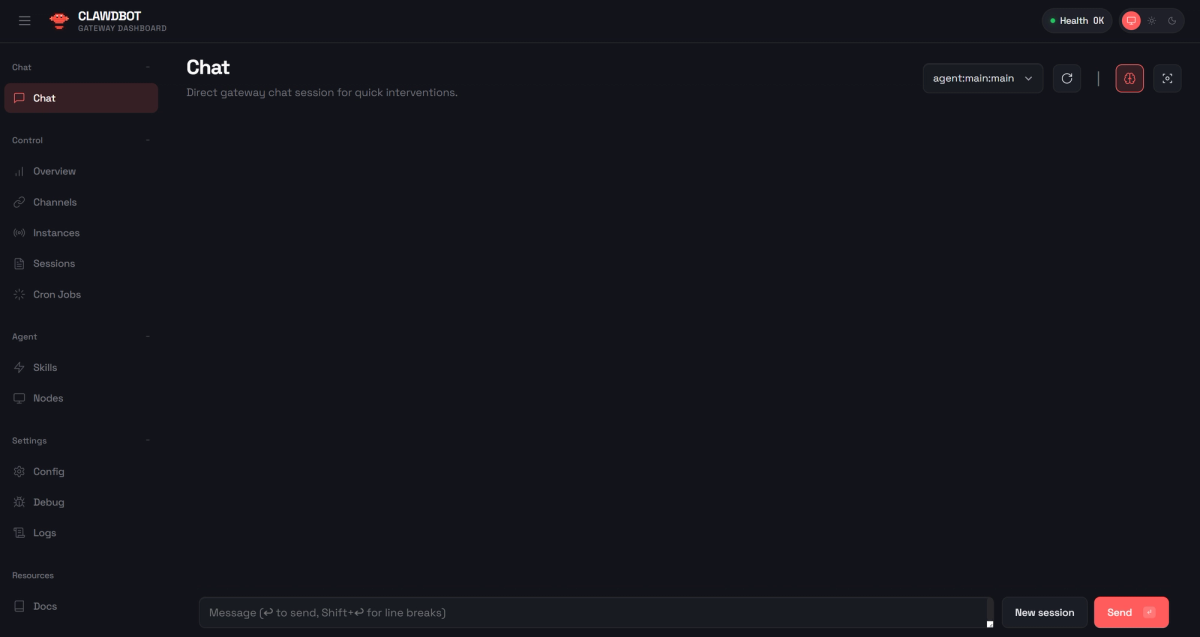
OpenClaw's value is that it meets you where you already communicate. You can interact with your agent from any device through your existing messaging apps, without opening a new interface. For non-technical workflows — operations, personal tasks, cross-app automation — this is a meaningful UX advantage over tools that require a dedicated terminal or browser tab.
BYOM Model: Software Is Free, You Pay for VPS + API Separately
OpenClaw is MIT-licensed and free to download. Operating it has three unavoidable cost components: infrastructure (a VPS to keep it running 24/7), LLM API calls (every agent action hits a model provider), and maintenance time (updates, security patches, incident response). The managed hosting option through OpenClaw Cloud removes infrastructure management at $59/month — but you still pay API costs on top of that, since all managed OpenClaw hosting uses BYOK (Bring Your Own Key).
Real Cost Range: $7–$200+/mo Depending on Usage and Model
The honest range for running OpenClaw, based on 2026 community data:
| Setup | Monthly Estimate |
|---|---|
| Light use, budget model (Kimi K2.5, MiniMax), Hetzner VPS | $7–25/mo |
| Moderate use, Claude Sonnet via API, managed hosting | $60–120/mo |
| Heavy use, Claude Opus or GPT-5, always-on automation | $150–300+/mo |
| OpenClaw Cloud (managed, BYOK) | $59/mo + API costs |
Note that running Claude Opus 4.6 through OpenClaw via the API at heavy usage can exceed $200/month in API fees alone, on top of infrastructure. Many active users have switched to lower-cost models precisely because of this.
Side-by-Side Comparison
Purpose — Specialized Coding Agent vs General Automation Agent
The most important row in any comparison of these tools is the first one: what problem does each solve?
| Dimension | Claude Code | OpenClaw |
|---|---|---|
| Primary job | Coding-specific agentic work | General-purpose automation across apps |
| Coding capability | Repo-aware, file editing, test-running, PR workflow | Not designed for coding tasks |
| Model access | Managed by Anthropic (Sonnet 4.6, Opus 4.6) | BYOM — any provider via API key |
| Cost structure | Flat subscription ($20–$200/mo all-in) | Infrastructure + API usage (variable) |
| Interfaces | Terminal, VS Code, JetBrains, desktop, web | WhatsApp, Telegram, Discord, iMessage, web UI |
| Infrastructure | Anthropic-managed, zero ops | Self-hosted or managed hosting (you maintain) |
| Security posture | Managed by Anthropic, SOC2-adjacent | Self-hosted responsibility; significant CVE history |
| Skill/extension ecosystem | Claude Skills (SKILL.md format) | ClawHub marketplace (security caveats apply) |
| License | Proprietary (Anthropic product) | MIT open source |
How They Handle Authentication Differently
Claude Code authenticates through your Claude subscription or API key. Anthropic manages the security boundary; you get a managed, audited service.
OpenClaw authenticates to each LLM provider separately via API key. Your key sits in OpenClaw's config files. Every action the agent takes uses that key under the permissions you've granted it.
Critical update as of April 4, 2026: Anthropic has blocked Claude Pro and Max subscription OAuth tokens from working in third-party tools including OpenClaw, effective immediately. If you had previously been using your Claude subscription inside OpenClaw, that path now requires Anthropic's "extra usage" pay-as-you-go billing (charged separately from your subscription) or a direct API key at full per-token rates. This is not a soft guidance — it's enforced server-side. OpenClaw's own documentation confirms the change. If you're evaluating OpenClaw with Claude as the model backend, budget for API-rate costs, not subscription-rate costs.
How They Handle Coding Depth Differently
Claude Code was engineered specifically to understand software projects. It indexes your codebase, traces imports and dependencies across files, and maintains codebase context across a session. The coding agent loop — plan, read files, edit, run tests, iterate — is the core design of the product.
OpenClaw's strengths are breadth and persistence across apps. It can run a script or call a tool that generates code as one action among many, but it doesn't understand your repository or reason about software architecture. For coding work, Claude Code is purpose-built; OpenClaw is not.
When Claude Code Is the Right Choice
You Need a Coding-Specific Agent with Repo Context
If your workflow involves reading large codebases, making multi-file changes, running test suites, handling PR workflows, or debugging across function boundaries, Claude Code is the right tool. It was built for this. No configuration, no infrastructure, no security incidents to patch — you install it and it works.
You Want Predictable Costs and Managed Security
A flat subscription with known monthly billing and Anthropic handling infrastructure, model updates, and security is the straightforward operational choice for development teams. There are no CVEs to patch, no VPS bills to reconcile, no ClawHub marketplace to vet. The tradeoff is that you're on Anthropic's model and pricing, without flexibility to route to alternative providers.
Your Team Is on VS Code or JetBrains
IDE integration is mature and first-party. Both the VS Code extension and JetBrains plugin support interactive diff review, parallel sessions, and real-time collaboration — without requiring developers to leave their existing environment.
When OpenClaw Makes Sense
You Want a General Automation Layer Across Messaging Apps
If your goal is an ambient AI agent that reads your email, drafts responses, monitors Telegram for specific messages, triggers calendar actions, or automates operational tasks through the apps you already use — OpenClaw is worth evaluating. Claude Code doesn't do any of that.
You Want Full Control Over Model Choice and Cost
OpenClaw works with any model that exposes an API: Claude (via direct API key), OpenAI, Gemini, Kimi K2.5, MiniMax, GLM, and others. You can route different tasks to different models based on cost and capability. For users who've moved to cheaper models after Anthropic's April 4 subscription change, the flexibility is the point.
Important: Security Checklist Before Deploying
This section is not optional reading. OpenClaw runs with persistent access to your messaging apps, files, and any tools you've granted it. The security picture as of early 2026:
CVE-2026-25253 (CVSS 8.8, fixed in v2026.1.29): A one-click remote code execution vulnerability via WebSocket hijacking. Even instances bound to localhost were exploitable through a victim's browser visiting a malicious page. If you're running any version prior to v2026.1.29, update immediately. The fix shipped January 29, 2026.
ClawHub supply chain attack (February 2026): Security researchers (Koi Security, Adversa AI) identified 341 malicious skills in the ClawHub marketplace, confirmed in a coordinated supply chain attack. Infected skills contained payloads delivering the Atomic Stealer (AMOS) infostealer targeting crypto credentials, SSH keys, and browser passwords. Palo Alto Networks subsequently called OpenClaw a potential significant insider threat vector for enterprise environments. Before installing any ClawHub skill, run openclaw security audit --deep and review the skill source manually.
Additional minimum hardening before any deployment: ensure v2026.1.29 or later is installed; restrict gateway binding to 127.0.0.1 with ALLOW_ORIGIN set; enable a strong authentication password; don't run with full "god mode" shell permissions unless specifically required; never browse untrusted sites while the Control UI is open in the same browser.
Can You Use Both?
Different Jobs — Coding Agent vs Ambient Automation
Claude Code and OpenClaw address genuinely different needs, which means using both in the same workflow isn't redundant — it's complementary. A development team might use Claude Code for the engineering work (code review, refactoring, PR generation) while individual developers use OpenClaw for the surrounding operational context (monitoring CI status through Telegram, summarizing meeting notes into a shared doc, managing task reminders through iMessage). These workflows don't overlap. To get OpenClaw running on your machine, follow Install OpenClaw.
Practical Workflow: Claude Code for Engineering, OpenClaw for Ops
The practical split: Claude Code is your dedicated coding environment with deep repo context. OpenClaw is your ambient layer that keeps you connected to the broader context — what's happening in your project's Slack mirror, what deadlines are approaching, what needs your attention before you start the next Claude Code session. For teams running multi-agent parallel coding workflows where multiple agents need to coordinate across different repo workstreams, purpose-built tools like Verdent offer parallel isolated execution that neither Claude Code nor OpenClaw is designed for — worth considering if parallel agent coordination is a specific requirement.
What No Longer Works: OAuth Token Bypass
For completeness: for several months in early 2026, a subset of OpenClaw users routed their Claude Pro or Max subscription through OpenClaw's OAuth flow, effectively using subscription-priced compute to power automated agent workloads. Anthropic blocked this progressively — first with server-side enforcement in January 2026, then with a Terms of Service update in February, and finally with hard enforcement on April 4, 2026. As of that date, using Claude subscription OAuth tokens in OpenClaw is blocked at the server level and constitutes a Terms of Service violation. This path is closed. If you were using it, you'll need to either use a direct Claude API key (at per-token billing) or switch OpenClaw to a different model provider.
FAQ
Can OpenClaw Use Claude Models?
Yes, via a direct Anthropic API key — not via subscription OAuth tokens. As of April 4, 2026, Claude Pro and Max subscriptions cannot be used to power OpenClaw sessions. API-key usage at Anthropic's standard per-token rates is still permitted. OpenClaw also supports OpenAI, Gemini, MiniMax, Kimi K2.5, GLM, and others — many users have migrated to these after the April 4 change to maintain affordable automation costs.
Is It Safe to Use OpenClaw for Professional Coding Work?
Leaving aside the security concerns around self-hosting an always-on agent — OpenClaw is not designed for professional coding work. It lacks codebase awareness, file editing capabilities designed for software projects, test integration, and the PR workflow tooling that makes Claude Code useful for software development. Using OpenClaw for coding tasks is working against the grain of what it was built for.
Can I Use My Claude Pro or Max Subscription with OpenClaw?
No, as of April 4, 2026. Anthropic has blocked third-party tool access to Claude subscription allowances. Using Claude through OpenClaw now requires either Anthropic's "extra usage" pay-as-you-go billing (charged separately from your subscription at API rates) or a separate Anthropic API key at full per-token rates. This is server-enforced, not just a policy statement.
What Is the ClawCode Community Project by @iamAliAgha?
ClawCode (github.com/iamAliAgha/ClawCode) is an independent community project — a lightweight coding assistant built on Claude's API. It has no affiliation with Anthropic, OpenClaw, or the official Claude Code product. It's one of several community harnesses that emerged during the early OpenClaw period. If you need it for a specific project, review the source independently; it's not part of the official ecosystem.
Which Tool Is Better for a Development Team?
For software development: Claude Code. It's purpose-built for the job, has managed infrastructure, a flat team pricing model, and native IDE integration. The security posture is Anthropic's responsibility, not yours.
For general operational automation across messaging channels: OpenClaw, with appropriate security hardening and a realistic operational budget. Run the security checklist before deploying in any team environment, and evaluate whether the ClawHub skill marketplace represents an acceptable supply chain risk for your context.
Related Reading
- Claude Code Pricing 2026: Plans, Token Costs, and Real Usage Estimates — Full breakdown of Claude Code subscription tiers and when each makes financial sense.
- Best Claude Code Alternatives for Agentic Workflows in 2026 — If you're evaluating Claude Code against other purpose-built coding agents.
- Claude Code vs Verdent: Multi-Agent Architecture Compared — For teams that need parallel agent execution across isolated workstreams, not covered by either Claude Code or OpenClaw.
- What Is Model Context Protocol? — The protocol layer that connects agents like Claude Code to external tools and services.
- Claude Code Auto Mode: How Cloud Auto-Fix Changes PR Workflows — Claude Code's autonomous PR automation, relevant if you're evaluating it for CI/CD workflows.