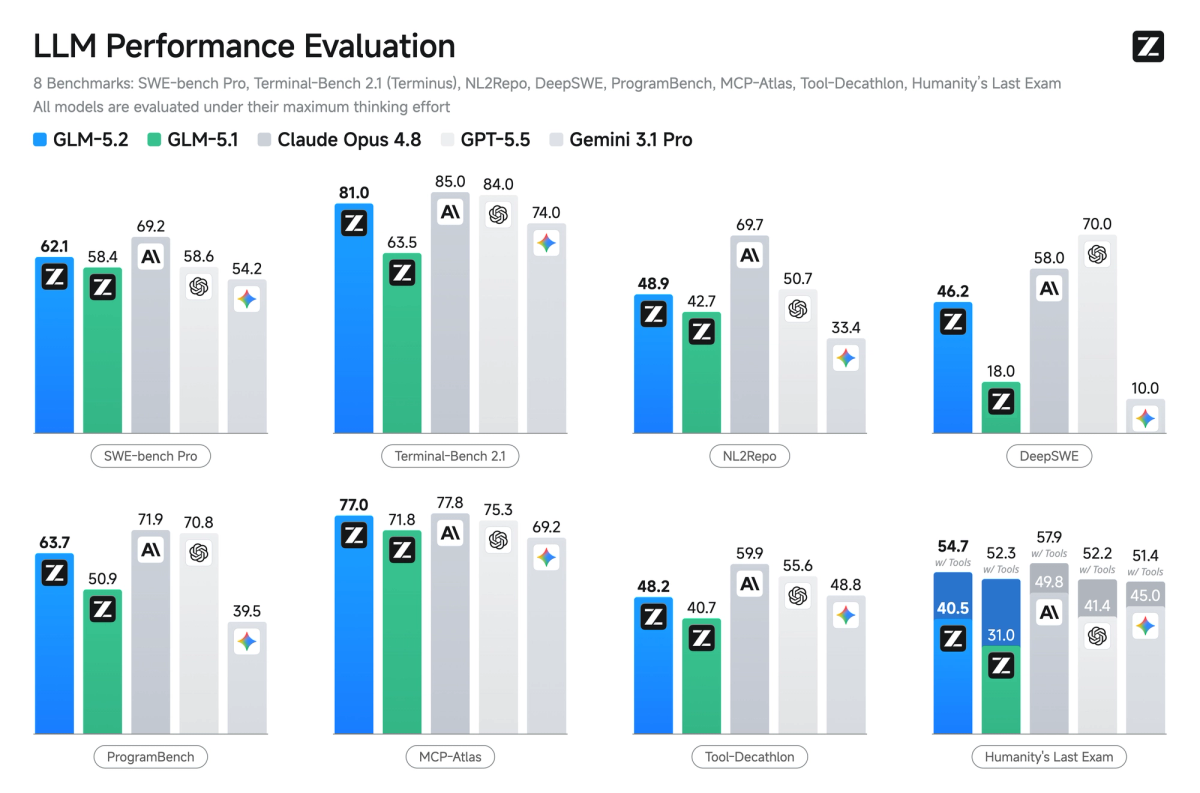
GLM-5.2's 62.1 on SWE-bench Pro is enough to earn a pilot. It is not enough to earn the default slot in your coding agent.
A model can score well and still fail where engineering teams spend time: touching unrelated files, weakening tests, looping on tools, or handing reviewers a plausible diff that costs too much to trust. The real GLM-5.2 coding question is whether it can beat your current model on your repositories, permissions, acceptance tests, and review budget.
The checklist below is designed to answer that before you switch.
What GLM-5.2 Means for Coding
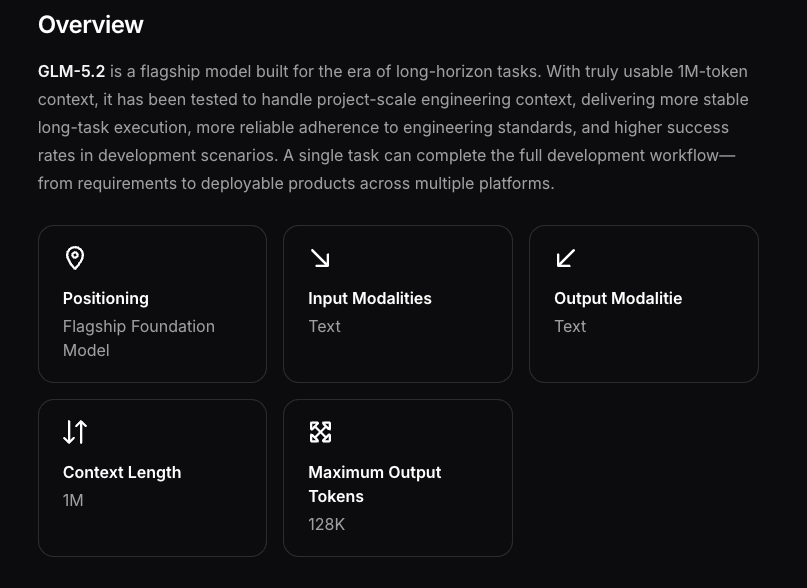
GLM-5.2 combines a 1M-token context window with a 128K maximum output, function calling, context caching, structured output, and multiple reasoning-effort levels for project-scale engineering.
The published coding benchmark results are strong enough to justify a pilot. They are not strong enough to justify a migration by themselves.
| Vendor-reported test | GLM-5.2 result | What it can justify |
|---|---|---|
| SWE-bench Pro | 62.1 | Include real bug fixing in the pilot |
| NL2Repo | 48.9 | Test repo-level implementation, not just snippets |
| Terminal-Bench 2.1 (Terminus-2) | 81 | Stress terminal use and command recovery |
| MCP-Atlas public set | 76.8 | Include multi-tool agent loops |
The published evaluation harness details matter as much as the scores. Tests used different context windows, timeouts, resource caps, prompts, and runners including Terminus-2, Claude Code, OpenHands, and mini-swe-agent. Treat each score as a reason to test that capability, not as a universal ranking.
What Developers Should Test First
Start with 12 tasks from one real, non-production repository: three in each test category below. Freeze the commit, task text, runner, tool policy, reasoning level, and acceptance tests. A model with broader permissions or a better prompt is not winning the same test.
Record outcomes at the task level:
| Vendor-reported test | GLM-5.2 result | What it can justify |
|---|---|---|
| SWE-bench Pro | 62.1 | Include real bug fixing in the pilot |
| NL2Repo | 48.9 | Test repo-level implementation, not just snippets |
| Terminal-Bench 2.1 (Terminus-2) | 81 | Stress terminal use and command recovery |
| MCP-Atlas public set | 76.8 | Include multi-tool agent loops |
Code generation and bug fixing
Use tasks that require the model to read before it writes. A good set includes one bounded feature, one known defect with a failing reproduction, and one underspecified request where the correct behavior is to ask or state an assumption.
Score the patch, not the response. Check whether it reused existing abstractions, added unnecessary dependencies, or changed public behavior outside the task. Count first-pass success, regressions, reviewer corrections, and unnecessary diff lines.
Include the original failure and a nearby regression check. A hard-coded fix fails even when the supplied test turns green.
Multi-file repo edits
Long context matters only if the model preserves relationships across files. An API change touching schema, implementation, client, tests, and documentation is more informative than renaming ten files.
Write down stable API signatures, dependency directions, protected files, and completion commands. Then check those constraints after several tool turns, watching for duplicated types, partial migrations, stale imports, forgotten fixtures, and edits to generated files.
Do not reward a large diff for looking comprehensive. The better repo edit is the smallest coherent change that passes the same acceptance gate.
Tool use and agent loops
An AI coding model becomes an engineering risk when it can call a shell, browser, package manager, or deployment tool. Test command failures, missing files, rate limits, malformed results, and a permission rejection. It should revise its plan or request a narrow exception—not keep trying variants until one slips through.
Z.ai says GLM-5.2 supports function calling and MCP, while its own coding surface exposes confirmation modes for commands, file changes, scripts, and network calls. That is the right shape for a pilot: begin with confirmation before every change, log each request, and measure how often the model asks for unnecessary authority.
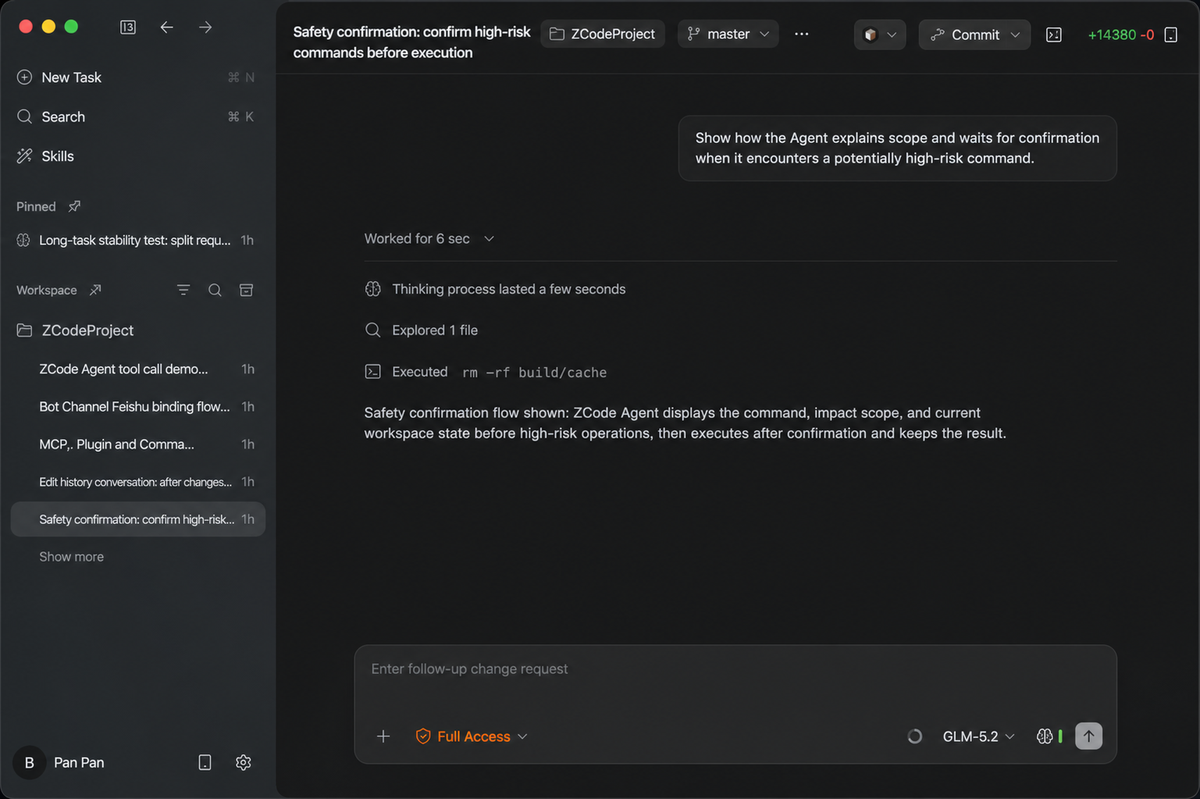
Add loop limits outside the model. Cap tool calls, wall-clock time, output tokens, and repeated identical failures. The model should never decide its own permission ceiling.
Debugging and test repair
Seed one code defect, one incorrect fixture, and one environment problem. Give the model normal logs, not the answer. It should form a hypothesis, make a constrained change, and rerun the smallest meaningful test before widening the suite.
Existing assertions may not be deleted, skipped, or weakened without approval. Archive both test versions: “all tests pass” is meaningless if the agent rewrote the contract to match its patch.
How to Compare It With Current Models
A search for a Claude Code alternative often mixes two layers. Claude Code is an agent product and runner; GLM-5.2 is a model that can sit behind a compatible endpoint or inside another coding environment. Changing the model while keeping Claude Code is a model comparison. Moving to a different runner at the same time is a stack comparison.
Use two stages:
- Run GLM-5.2 and your current model through the same runner, tools, prompt, and permission profile.
- Only then compare a GLM-native or differently tuned agent surface against your current full stack.
Apply the same separation to Kimi K3 coding. Put Kimi K3, GLM-5.2, and the current baseline behind the same compatible harness where possible. If one model requires a different runner or message format, record that as part of the result rather than attributing every difference to the model.
Rank accepted tasks, not responses. I would track completion rate, median reviewer minutes, prohibited actions, retries, elapsed time, token cost, and rollback completeness. Keep the winner task-specific: a model can be the better debugger and the worse multi-file editor.
Do not turn a public coding benchmark into one weighted internal score. Your framework, tests, tool policy, and failure costs define the weights.
Limits, Cost, and Verification Notes
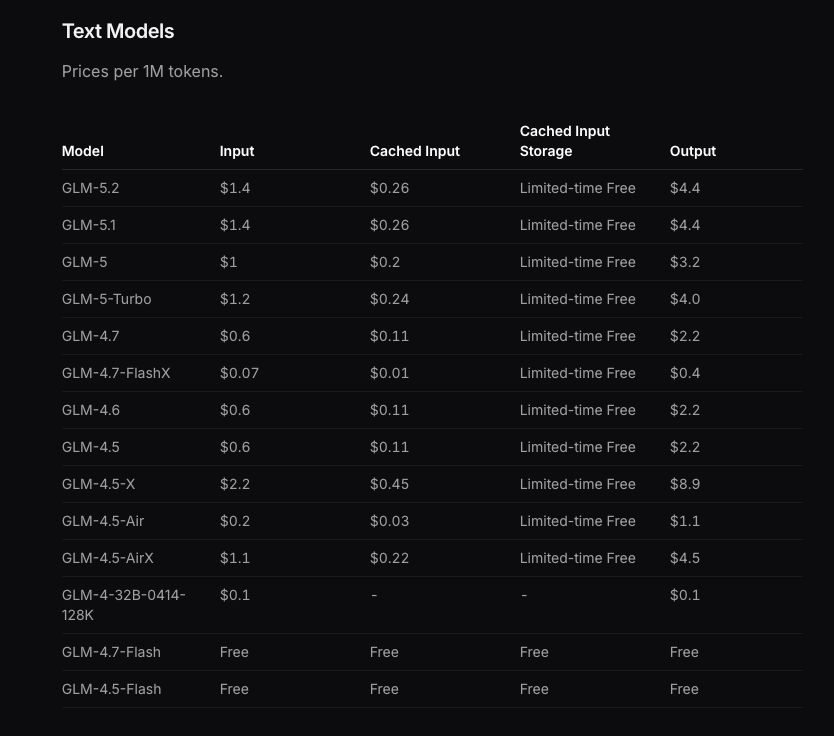
The 1M context window is capacity, not proof of perfect recall. Test whether early constraints still govern the final patch. The hosted API and self-hosted weights are also separate products: the model card lists an MIT license and a 753B-parameter checkpoint, but serving stack, quantization, kernels, and system prompts can change behavior. A local result is not automatically identical to Z.ai’s hosted result.
As checked on August 4, 2026, GLM-5.2 costs $1.40 per million input tokens, $0.26 per million cached input tokens, and $4.40 per million output tokens. Record the access route and invoice basis for each run.
Cost per accepted task is more useful than cost per token:
(model spend + CI cost + reviewer time + recovery time) / accepted tasks
Verification needs an adversarial layer too. Z.ai warns that coding-agent training and evaluation can attract reward-hacking behavior such as reading protected artifacts or fetching target solutions, and says its own process used an online anti-hack guard. For an internal pilot, that creates a clear boundary: keep hidden tests unreadable, block outbound network access initially, and review every attempt to inspect evaluation infrastructure.
My switching threshold would be simple: GLM-5.2 must beat the current baseline on your highest-volume task class without increasing permission violations, escaped defects, or reviewer time. Until then, it is a candidate model, not a new default.
FAQ
Who should own GLM-5.2 pilot results?
Name one engineering owner, not a vendor champion. They should version the tasks, runner configuration, permission policy, logs, costs, and acceptance decisions. Security owns permission exceptions; maintainers own merge quality. Report workload-specific winners and unresolved risks.
How should failed coding runs be archived?
Preserve the starting commit, prompt, model endpoint, runner version, reasoning setting, permissions, transcript, commands, patch, test output, token usage, and reviewer diagnosis. Store runs as immutable pilot artifacts and label failures such as scope drift, test weakening, tool loop, hallucinated API, or permission breach.
What repo permissions should stay disabled first?
Disable production credentials, deployment access, secret stores, destructive database operations, unrestricted network calls, package publishing, branch protection changes, and autonomous merge or commit. Start in a disposable branch or worktree with confirmation required for edits and commands. Add one permission at a time only when a task needs it and the audit trail is clear.
When should teams retest after model updates?
Retest when the model version, hosted serving stack, system prompt, agent runner, tool schema, reasoning controls, context handling, or pricing changes. Keep a small canary subset for every update and rerun the full matrix before changing the team default.
Related Reading
What Is ZCode? A Developer Guide to Z.ai's Coding Agent
Kimi K3 API Guide (2026): Pricing, Context, and Examples