For years the lever for getting good output from an AI was the prompt — phrase the request well and you got a better answer. Coding agents broke that model. When an agent runs for an hour, correcting itself against test results and reworking its own code across dozens of steps, the quality of your single prompt stops being the thing that determines the outcome. What determines it is the system around the agent: the goal it's checking against, the tools it can use, the validator that decides whether it's done, and the rules for when it stops. Designing that system is loop engineering — and it's a system-design discipline, not a prompting trick. Here's what it means, why prompting alone isn't enough, and what a loop is actually made of.
What Loop Engineering Means
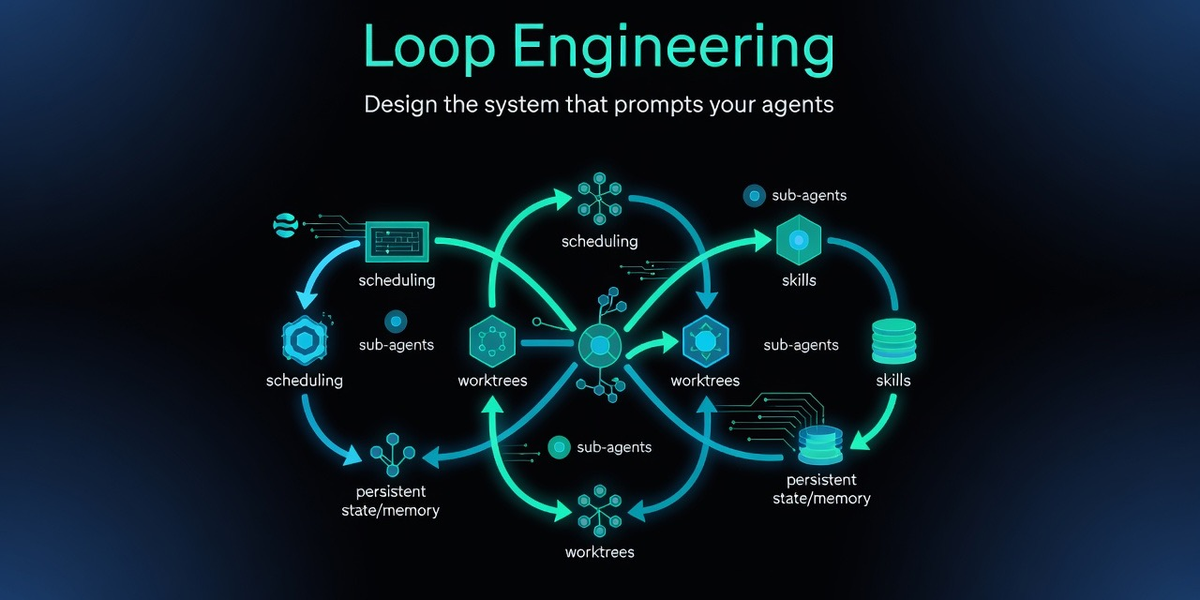
Loop engineering is the practice of designing the repeating cycle in which an AI coding agent operates — the structure that lets it act, check its own work, and decide what to do next, over and over, until a goal is met. Where prompt engineering optimizes a single exchange (you ask, the model answers), loop engineering governs an ongoing process: the agent takes an action, observes the result, reasons about it, and acts again, with you having designed the goal, the feedback, and the stopping rules that shape the whole cycle.
The term gained currency in 2026 as engineers described how their work had shifted: instead of writing each instruction, they were building the systems that issue instructions and respond to results. It sits a layer above prompting, context-shaping, and the agent's harness — the loop is what puts those underlying pieces into repeated, self-correcting motion. The point isn't a new vocabulary word; it's that the engineering leverage moved from the prompt to the cycle, and designing that cycle well is a distinct skill.
Why Prompt Engineering Is Not Enough for Coding Agents
Prompt engineering still matters — the loop issues prompts, and better prompts help. But it's no longer sufficient on its own for coding agents, for a structural reason: a single prompt governs a single turn, while a coding agent's work spans many turns it takes autonomously. You can write a perfect prompt and still get a bad outcome if the loop around it has no way to verify the work, no memory across steps, or no condition that makes it stop.
Consider what a long agent run actually needs that a prompt can't provide. It needs a definition of "done" the agent can check against repeatedly — not a one-time instruction but a standing criterion. It needs to remember what it already tried, so it doesn't repeat failed approaches across a long task. It needs a real check on its output, because an agent left to grade its own homework will confidently call broken work finished. And it needs a stopping rule, or it can run indefinitely, burning resources without converging. None of those live in the prompt; they live in the loop. That's why prompting alone leaves the hardest parts of agent reliability unaddressed — the parts that only a designed loop can handle.
The Anatomy of a Loop as a Mental Model
The useful way to think about a loop is as a small set of components, each answering a question the prompt can't. This is a mental model, not a configuration guide — the point is to understand the parts so you can reason about what a loop needs, not to set specific values.
Goal and task state
At the center is the goal: a definition of what the loop is trying to achieve, expressed so the loop can check whether it's there yet. A goal the loop can verify ("the test suite passes") gives the cycle a floor and an exit; a goal it can't ("make the code better") leaves it running without a way to know it's done. Alongside the goal is task state — what the loop remembers across its many steps. Because a loop runs over a long sequence, it needs continuity: what's been tried, what worked, where it is in the plan. Without preserved state, a long loop forgets and repeats itself; with it, the loop makes progress rather than spinning. The planning-first structure that tools like Verdent formalize (turning a fuzzy objective into a verifiable plan before execution) is one way the goal and state get defined cleanly at the start.
Tools and environment access
A loop that can't touch the real environment is just guessing. Tools are how the agent acts on the world — running code, reading and writing files, executing tests, working in a terminal. The loop's feedback is only as honest as these tools: an agent that can actually run the test suite gets real results, while one that can only predict what tests would say is reasoning from imagination. This is also where isolation matters — running an agent's changes in a separate space (the Git worktree pattern, where each agent works in its own checked-out branch) keeps its actions contained, so a tool that edits files does so safely rather than on your main branch. The tools define what the loop can do; the isolation defines how safely it can do it.
Validators and retries as feedback signals
The validator is what checks the agent's work, and it's the component that most determines whether a loop is trustworthy. Ideally the validator is separate from the agent that did the work — a verification step (running tests, checking outputs) that confirms the result rather than taking the agent's word for it. This is the multi-round generate-test-fix idea that approaches like Code Verification build on: the agent produces something, an independent check evaluates it, and the failure feeds the next attempt. Retries are how the loop responds to a failed check — but only sensibly when each retry has new information. A loop that feeds back a structured failure ("this test failed with this error") lets the agent diagnose and adapt; a loop that just says "try again" invites the same failure. The validator and the retry logic together are the loop's feedback signal, and a weak validator — one that passes work that's actually wrong — corrupts everything downstream.
Review gates and exit conditions as governance
The last components are about governance: where humans stay in control and how the loop ends. Review gates are points where the loop pauses for a person to inspect before proceeding — the place human judgment enters an otherwise autonomous cycle, especially for high-stakes changes. Exit conditions are the rules that stop the loop: success (the goal's criteria are met), or a limit (a maximum number of attempts, a budget cap, an escalation to a human after repeated failure). Together these are what keep a loop bounded and accountable rather than an autonomous process that runs unchecked. A loop without exit conditions can spin forever; a loop without review gates can ship high-stakes changes no human ever looked at. Governance isn't an add-on to the loop — it's a core part of designing one responsibly. (Running several such governed loops at once is the multi-agent-parallel pattern, where each agent works a bounded part under the same review discipline.)
How Loop Engineering Changes Team Work
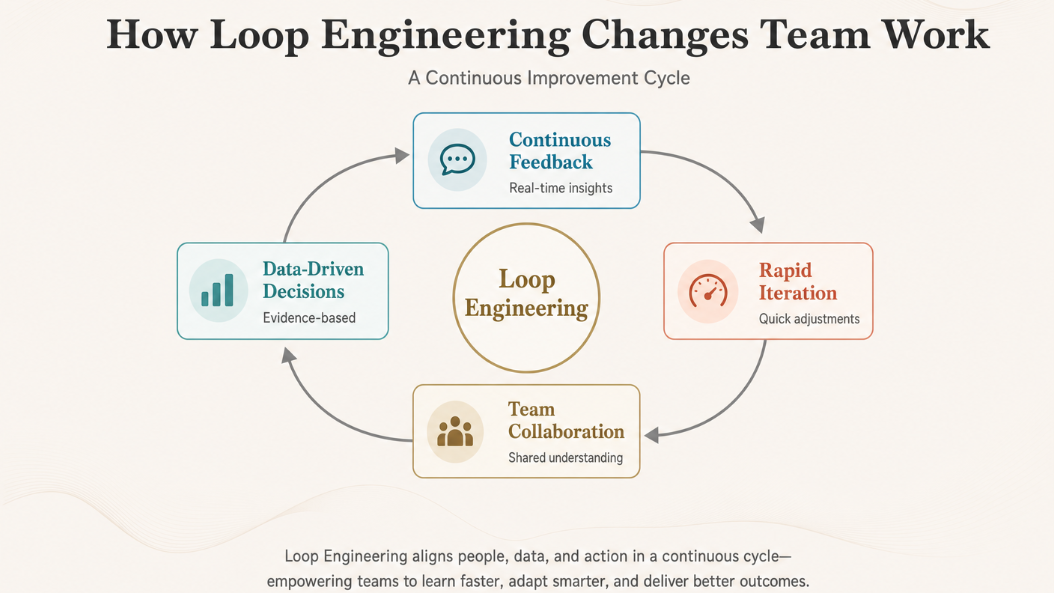
When loops become the unit of work, what a team designs changes. The skill shifts from writing the best prompt to designing the best cycle — defining verifiable goals, building honest validators, and setting the gates and limits that govern autonomous runs. A team that's good at loop engineering spends its effort on the system: what does "done" mean here, how do we check it, where does a human review, when does it stop?
Ownership shifts too. When a loop (or several loops) runs autonomously, someone still owns the goal, the validation standard, and the result — the agents execute, but a person remains accountable for what the loop produces and ships. This is why loop engineering is a leadership-relevant skill, not just an individual-contributor one: it's about designing the systems and standards under which autonomous coding happens across a team, and keeping accountability clear when the work is increasingly done by agents under human-designed governance.
Benefits, Limits, and Risks
The benefit of treating loops as something you engineer is reliability at scale. A well-designed loop turns an autonomous agent from an unpredictable generator into a system that pursues a verifiable goal, checks its own work, and stops safely — which is what lets you trust it to run while you're not watching. Done well, loop engineering is what makes long-running agents a genuine multiplier rather than a liability.
The limits and risks are concentrated in the parts teams are tempted to skip. A loop is only as good as its validator: a weak check means the loop confidently produces wrong work, which is worse than no loop because it ships mistakes unattended. A loop without real exit conditions can run away, consuming resources without converging. And the governance — the review gates — is what stands between autonomous code generation and unreviewed code reaching production. The risk isn't that loop engineering is hard in the abstract; it's that the unglamorous components (the honest validator, the firm stopping rule, the review gate) are exactly the ones that get under-built, and they're the ones that determine whether the loop is safe. The discipline's whole value is taking those seriously.
FAQ
Is loop engineering a formal job title?
Not in any standardized sense. Loop engineering describes a practice and a skill — designing the cycles that govern AI coding agents — that emerged as a named concept in 2026, but it isn't an established, credentialed job category you'd find on a standardized list of titles. It's better understood as a competency that's becoming part of senior engineering and technical leadership work, not a separate profession with a defined certification. You'll see it discussed as an emerging skill rather than a formal role, and treating it that way (a way of working that matters, not a box on an org chart) is the accurate framing.
How is loop engineering different from workflow automation?
Workflow automation runs predefined steps in a fixed sequence — if this, then that — with the logic specified in advance and the system following it deterministically. Loop engineering designs a cycle around an AI agent that reasons about results and decides its own next steps within the goals and guardrails you set: adaptive rather than scripted. The agent isn't following a fixed flowchart; it's pursuing a goal, responding to feedback, and choosing actions, while your loop design constrains and verifies that autonomy. So the distinction is between automating a known sequence and governing an adaptive, self-correcting agent — the latter has to account for an actor that makes its own decisions, which is why validators, review gates, and stopping rules are central to it and largely absent from simple automation.
Why do coding agents need human review gates?
Because an autonomous agent can produce changes that look complete and pass surface checks while being wrong, poorly designed, or risky in ways automated validation doesn't catch — and some decisions shouldn't be made without human judgment at all. Review gates put a person in the loop at the points that matter: high-stakes changes (security-sensitive code, production-affecting edits, architectural decisions) where the cost of a bad autonomous change is high. The validator catches what's mechanically checkable; the review gate catches what needs human judgment, including whether a passing-the-tests change is actually something you'd accept. Without gates, a loop can ship code no human reviewed, which is exactly the risk that grows as agents do more work autonomously. The gates are how you keep human accountability over autonomous output.
Can loop engineering reduce bad AI code?
It can reduce the bad code that reaches your codebase, by adding the checks a raw agent lacks — but it doesn't make the underlying model better. A well-engineered loop catches more bad output before it lands: an honest validator rejects work that fails real tests, retries route failures back for correction, and review gates stop questionable changes for human judgment. That's a meaningful reduction in bad code shipped, because the loop filters and corrects what the agent produces. What it can't do is prevent the agent from generating flawed work in the first place — that depends on the model. So loop engineering reduces bad code reaching production by building in verification and governance, not by improving the agent's raw generation; it's a system that catches and corrects, which is precisely why the validator and gates matter so much.
Conclusion
Loop engineering is the discipline of designing the self-correcting cycle an AI coding agent runs in — the goal it checks against, the state it carries, the tools it acts through, the validator that confirms its work, and the review gates and exit conditions that govern it. It exists because prompting alone can't handle agents that run autonomously across many steps: the hardest parts of reliability (verification, memory, stopping, human oversight) live in the loop, not the prompt. The mental model to keep is that a loop is a small set of components, each answering a question a single instruction can't, and that the unglamorous ones — the honest validator, the firm exit condition, the review gate — are what determine whether the loop is trustworthy. As coding agents take on more, loop engineering is becoming the skill that separates teams who deploy them reliably from teams who ship their mistakes faster. Understanding what a loop is made of is the first step toward designing one that works.
Related Reading