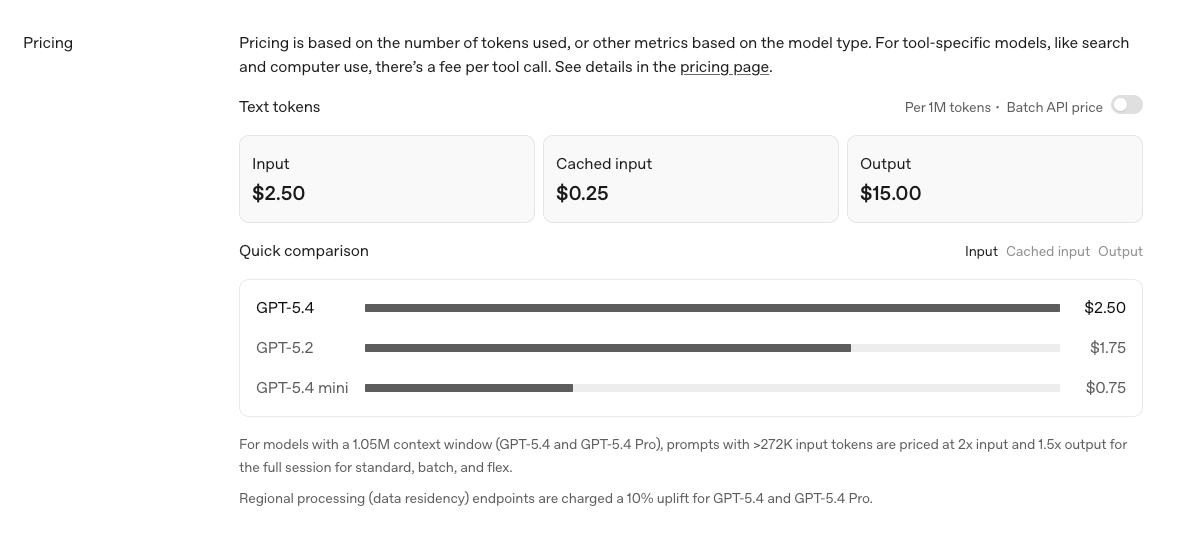
The headline number for GPT-5.4 Mini is $0.75 per million input tokens — but the headline number is rarely what you actually pay. With prompt caching, the input rate on repeated context drops by 90%. With the Batch API, everything drops by half. With data residency, it goes up 10%. So the real question for a cost-conscious developer isn't "what's the rate" — it's "what does Mini cost on my actual coding workload after the discounts that apply, and where does stepping up to the full model pay for itself?" Here's the math.
Pricing verified against OpenAI's official documentation as of June 2026. Rates and discount tiers change — confirm current numbers at the official OpenAI pricing before budgeting.
GPT-5.4 Mini API at a Glance
Model ID gpt-5.4-mini
GPT-5.4 Mini is the cost-efficient variant of GPT-5.4, accessed via the model ID gpt-5.4-mini through the OpenAI API. It was released March 17, 2026, and is available to all developers (and to free-tier ChatGPT users). It retains tool use, vision, and reasoning capability at a fraction of the full model's cost — the profile of a model you route high-volume work to.
$0.75 / $4.50 per 1M
Standard API pricing is $0.75 per million input tokens and $4.50 per million output tokens. For context, that's well below the full GPT-5.4 ($2.50/$15) and a fraction of flagship GPT-5.5 ($5/$30). On input specifically, Mini is one of the more competitive mid-tier rates available — cheaper than comparable models from other providers. But the standard rate is the starting point, not the effective cost; the discounts below are where the real economics live.
Context Window and Output Limits
400K context
GPT-5.4 Mini has a 400K-token context window. (Some aggregator sites list a larger figure, but the correct context window is 400K — verify against OpenAI's official model documentation, which is authoritative.) For coding work, 400K is substantial — enough to hold a large set of files, a long conversation history, or significant repo context in a single call. It's smaller than the full GPT-5.4's window, but for the high-volume routed work Mini is built for, 400K is rarely the binding constraint.
128K max output
Maximum output is 128K tokens. For most coding tasks (generating a function, a file, a diff, an explanation) this is far more than you'll use, but it matters for tasks that generate large outputs — extensive code generation, long documents, big refactors emitted in one response. Output tokens are the expensive side of the bill ($4.50/M versus $0.75/M input), so large outputs are where Mini's cost concentrates — worth keeping in mind when you design prompts that produce lots of generated code.
Cost in Real Coding Workflows
Repo assistant, code review, agent loops
Where Mini's economics shine is high-volume, input-heavy coding work:
- Repo assistant — answering questions about a codebase, where you load substantial context (input-heavy) and get focused answers (output-light). Mini's low input rate, plus caching, makes this cheap.
- Code review — reading diffs and flagging issues; again input-heavy, output-light, and highly cacheable if the codebase context repeats.
- Agent loops — the many routine calls in an agent (read file, run test, read result), where call volume is high and per-call complexity is moderate. Mini handles the volume at a fraction of the full model's cost.
The common thread: Mini is most economical where you're processing a lot of input relative to output, and where context repeats (enabling caching). That describes a large share of real coding-assistant work.
Cached input and Batch savings
This is where effective cost diverges sharply from the headline rate. Two discounts apply to the GPT-5.4 family, Mini included:
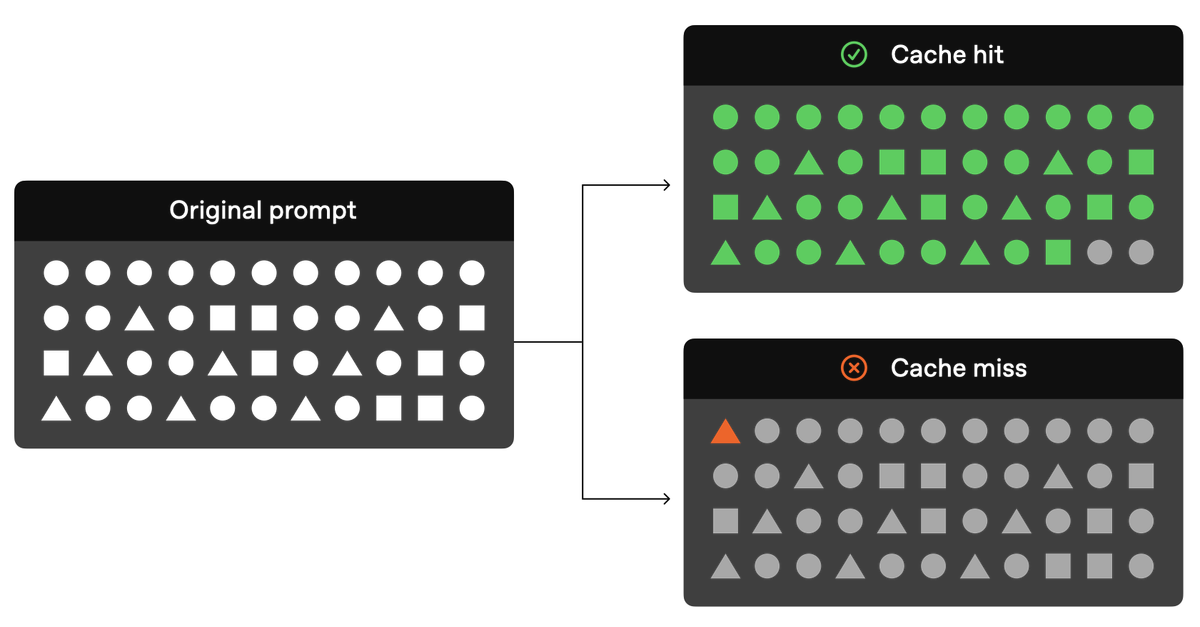
- Prompt caching — cached input tokens are billed at roughly 10% of the standard input rate (a ~90% discount), applied automatically when the start of your prompt repeats across requests. For coding work with a stable system prompt and repeated codebase context, this routinely cuts input cost dramatically — put the static context first, the variable query last.
- Batch API — a flat 50% discount on both input and output for asynchronous work (submit a batch, get results within a window). Ideal for bulk code review, evaluation runs, or any coding work that doesn't need a real-time response.
Stacked, these can cut a workload's effective cost to a fraction of the headline rate — a heavily-cached, batched coding pipeline pays far less than the $0.75/$4.50 sticker. (Confirm the exact cached and Batch rates apply at the Mini tier in your account, since rates can vary — the GPT-5.4 family documentation is the source of truth.)
Codex ~30% quota = ~1/3 cost
A concrete proxy for Mini's cost advantage: within Codex (OpenAI's coding agent), Mini reportedly consumes roughly 30% of the quota that the full GPT-5.4 would for comparable work — roughly a third of the cost for the same task category. For quota-bound or budget-conscious coding, that ratio is the practical case: you get a large share of the capability for about a third of the spend, which is the difference between a tool you run continuously and one you ration.
When Mini Is Worth It vs Stepping Up
Cost-per-completed-task, not per-token
The right metric isn't the per-token rate — it's cost-per-completed-task. A cheaper model that completes the task is better value than an expensive one; but a cheap model that fails and forces a redo on the full model costs more than just using the full model first. So the calculation is: does Mini reliably complete this category of task? If yes, its lower rate makes it the cheaper choice per completed task. If it fails often enough on a task type that you redo the work on GPT-5.4 or GPT-5.5, the apparent savings reverse — you've paid for Mini's attempt plus the full model's completion. Route by where Mini reliably succeeds, not just by rate.
Data-residency +10% uplift
One cost modifier to factor if it applies to you: data residency (keeping data processing in a specific region) adds roughly a 10% uplift to the rate. For teams with data-residency requirements, that's a real addition to the effective cost — Mini at $0.75/$4.50 becomes about $0.825/$4.95 with the residency uplift. It doesn't change the relative economics (Mini is still far cheaper than the full model), but it's a line item to include when you model the actual bill. Verify the current residency pricing for your region and the Mini tier.
Limits to Plan Around
A few constraints to keep in mind when budgeting and architecting around Mini:
- Capability ceiling — Mini is a smaller model; on the hardest reasoning and longest-horizon tasks it hits a ceiling the full model doesn't. Don't route your hardest work to it to save cost; the redo cost erases the savings.
- Output cost dominates — at $4.50/M output versus $0.75/M input, tasks that generate a lot (large code generation) concentrate cost on the output side. Design prompts to produce the output you need, not more.
- Long-context pricing — for the GPT-5.4 family, very long contexts can trigger higher rates above a threshold; confirm how this applies at Mini's 400K window before relying on the flat rate for large-context calls.
- It's not the frontier — GPT-5.5 (April 2026) is the current flagship; Mini is a budget variant of the now-superseded GPT-5.4. Capable for its role, but not the top of the lineup if you need maximum capability.
FAQ
How much does GPT-5.4 Mini actually cost to use?
The standard rate is $0.75/M input and $4.50/M output, but effective cost is usually lower: prompt caching cuts repeated input ~90% (to ~$0.075/M cached), and Batch cuts everything 50% for async work. A well-architected workload — stable cached context, batched where possible — pays a fraction of the headline rate. Data residency, if needed, adds ~10%. Real cost depends on your input/output mix and how much you cache; the more input-heavy and repetitive the workload, the cheaper Mini gets per task.
What is the real context window for GPT-5.4 Mini?
400K tokens, with a maximum output of 128K tokens. Some aggregator sites list a larger number, but 400K is the correct context window for GPT-5.4 Mini — verify against OpenAI's official model documentation, which is the authoritative source. For coding work, 400K is ample to hold substantial repo context, a long history, or many files in one call. As always, a large window is only worth using when the task needs it — filling it with irrelevant context just raises cost, so send focused context rather than the maximum the window allows.
When does it make sense to use GPT-5.4 Mini instead of the full model?
When the task is within Mini's capability and you're cost- or volume-sensitive. Mini fits high-volume, input-heavy, moderate-complexity coding work — repo assistants, code review, the routine calls in an agent loop — where its low rate (plus caching) makes it far cheaper per completed task. Step up to the full GPT-5.4 or GPT-5.5 for the hardest reasoning and longest-horizon tasks, where Mini's ceiling would cause failures (and redo costs that erase the savings). The clean rule: route by cost-per-completed-task — Mini where it reliably succeeds, the bigger model where it doesn't.
Does GPT-5.4 Mini get the same caching and batch discounts as other models?
It gets the discounts that apply to the GPT-5.4 family: prompt caching at roughly 10% of the standard input rate (~90% off) and the Batch API's flat 50% discount on input and output. These are documented for the GPT-5.4 family, which includes Mini — but because exact rates can differ by tier and change over time, confirm that the cached-input and Batch rates apply at the Mini level in your own account and the current pricing page before modeling costs on them. The discount structure is the same in kind; verify the exact Mini-tier rates rather than assuming.
How do I work out if GPT-5.4 Mini is actually cheaper for my coding workflow?
Model your actual token mix, not the headline rate. Estimate input/output tokens per task, apply the discounts that fit (caching if context repeats, Batch if work can be async), and compute cost-per-completed-task — including the redo cost if Mini fails a share of tasks and you fall back to the full model. Then compare to running the full model directly. Mini wins when work is input-heavy, repetitive, and within its capability; the full model wins when Mini's failure rate is high enough that redos cost more. Run a small A/B on real tasks to get that failure rate — it's the number that decides it.
Conclusion
GPT-5.4 Mini's API economics come down to one idea: the $0.75/$4.50 headline rate is the ceiling, not the bill. With caching (~90% off repeated input) and Batch (50% off everything), a well-architected coding workload pays a fraction of that — which is why Mini is genuinely cheap for input-heavy, repetitive work like repo assistants, code review, and agent-loop volume. The honest boundary: it's a smaller model, so route your hardest reasoning to the full GPT-5.4 or GPT-5.5 and keep Mini for the work it reliably completes, measuring cost-per-completed-task rather than per-token rate. Model your real token mix with the discounts that apply, factor the 10% residency uplift if you need it, and Mini earns its place as the cost-efficient workhorse in a multi-model coding setup.
Related Reading