Automated code review is most useful when it makes the pull request queue easier to reason about. It is least useful when a team treats bot comments as approval.
For a Tech Lead, Engineering Manager, or senior developer carrying review load, the goal is not to remove humans from PRs. The goal is to separate repetitive checks, risk signals, and first-pass triage from the judgment that still belongs to maintainers. Pull request automation only reduces drag when the team is explicit about what the AI reviewer may flag, what CI must prove, and where a person still signs off.
What Automated Code Review Can Do
Automated code review sits between static checks and human review. It can read a diff, summarize what changed, compare the change against known patterns, and leave comments where the risk is specific enough for a reviewer to inspect.
In practice, I would ask an AI reviewer to spot risky surfaces, translate a large diff into a short review map, flag missing tests or rollout notes, and group repeated policy issues so humans do not write the same comment every week.
The output should not be "LGTM" or "reject this PR." It should be a review packet: changed surface, suspected risk, evidence from the diff, suggested owner, and next action.
Where It Fits in the PR Workflow
The cleanest rollout treats automated PR review as a queue-shaping layer after the author has a coherent PR, before final human approval, and beside deterministic checks such as tests, lint, type checks, and code scanning.
Diff Triage and Risk Signals
Start with diff triage. The AI reviewer should answer a narrow question: "What should a human reviewer inspect first?"
Useful signals include changed paths owned by another team, large deletions in stable modules, schema or dependency changes, permission logic, and behavior changes without matching tests or docs.
This is where CODEOWNERS and path ownership still matter. On GitHub, CODEOWNERS can automatically request review from the owners of changed code, and admins can require code-owner approval before merge. The AI reviewer can add context around why a change looks risky, but ownership routing should remain a repository rule, not a bot preference.

Keep triage comments short. "This PR changes the authorization boundary and cache invalidation path; ask the auth owner to inspect canManageTeam()" is useful. A list of every function name in the diff is not.
Test, Lint, and Policy Checks
Automated code review should not replace checks that can be executed. If a test, linter, type checker, dependency scanner, or code scanning rule can prove something, run the check and show the result.
GitHub status checks show whether commits meet repository conditions, including results from builds, tests, code scanning, or deployment checks. The AI layer can explain a failure or suggest which test to add. It should not convert "the bot thinks this is fine" into a substitute for a required check.
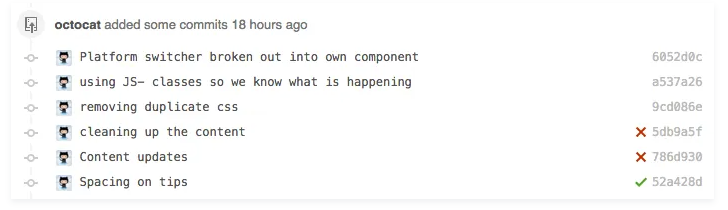
This split keeps the workflow honest: CI and policy owners run objective checks, AI comments guide inspection, and humans own architecture, product fit, rollout risk, and merge approval.
Human Review and Approval
Human review is where intent, maintainability, and responsibility meet. GitHub makes the boundary unusually clear: Copilot code review submits a Comment review rather than Approve or Request changes, so its feedback does not satisfy required approvals or block a merge. That is a useful model even outside GitHub. The AI reviewer can comment and recommend escalation; it should not own approval unless your organization has deliberately made a bot a policy actor, with auditability to match.

For most teams, the better rule is simple:
- AI can label risk.
- CI can block on objective checks.
- Code owners can approve owned surfaces.
- Maintainers own the merge decision.
That keeps the code review workflow legible when something fails later. The question after an incident should not be "Why did the AI allow this?" It should be "Which human-owned gate accepted this risk, and what signal was missing?"
Where AI Reviewers Still Miss Context
AI reviewers are good at local suspicion. They are weaker at organizational context.
They may miss why a strange-looking compatibility shim exists for one customer, why a migration is split across releases, or why a cleaner abstraction would break a support playbook. They also over-comment on style because style is visible in a diff, while product risk may live in a roadmap, incident review, or contract clause the model cannot access.
The failure mode I worry about most is not a missed semicolon. It is a plausible comment that drains reviewer time without changing risk. Once developers learn that bot comments are usually cosmetic, they stop reading the serious ones.
So the first boundary is noise. Every automated comment should have one of three destinations:
- accepted as a code change
- closed as intentionally not applicable, with a reason
- converted into a rule, test, or suppression so it does not reappear forever
If a comment cannot reach one of those destinations, it probably should not be posted.
Rollout Boundaries for Engineering Teams
Do not start by turning on automated review for every repository and every PR. Start with a bounded surface where review pain is real and the failure cost is tolerable.
My default rollout is narrow: pick one repository and two PR classes, run the AI reviewer in shadow mode for one sprint, track which comments humans acted on or closed, and expand only after the team agrees on escalation rules for high-risk changes.
Some vendors expose useful scope controls. CodeRabbit lets teams scope automatic reviews by target branch, draft status, labels, and exclusions. Those are governance handles: skip drafts, exclude bots, or run only on protected branches.
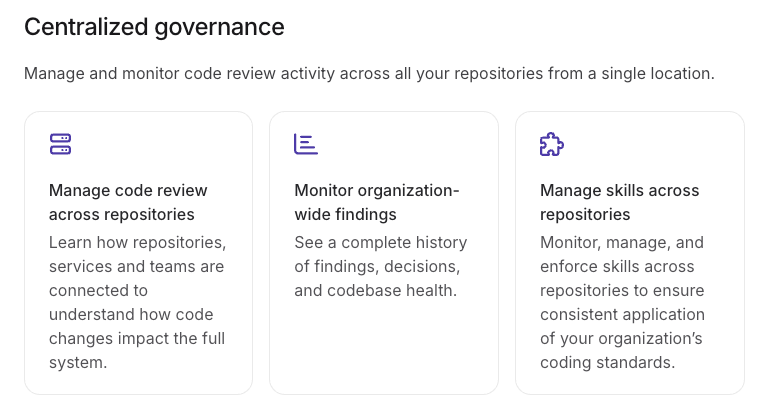
For organization-wide systems, rule ownership matters even more. Qodo's centralized governance applies organization standards during pull request review; without a named owner, that system becomes a second, undocumented style guide.
Use a clear escalation table:
| PR type | AI role | Human rule |
|---|---|---|
| Docs-only or test-only PR | summarize and check policy drift | normal reviewer approval |
| Small feature PR | flag missing tests and risky touched paths | code owner approval when owned paths change |
| Auth, billing, privacy, migration, infra | triage only, no autonomous resolution | required senior owner review |
| Emergency hotfix | optional summary after merge | incident owner decides the review path |
This is also where data handling belongs. Before rollout, ask vendors whether customer code, prompts, PR comments, reviewer feedback, and generated suggestions train shared models; how long review data is retained; which subprocessors process it; and whether enterprise controls differ from individual accounts. The NIST AI Risk Management Framework Core treats context, roles, oversight, monitoring, and privacy risk as governance work, which is the right lens here.
Metrics That Show Review Automation Is Working
The ROI of automated code review is not "the bot left 300 comments." That is probably a problem.
Track metrics that show review load moved to better places:
| Metric | What it tells you |
|---|---|
| Time to first useful human review | Whether triage helps reviewers start faster |
| AI comment action rate | Whether developers accept, fix, or learn from comments |
| Duplicate AI comment rate | Whether rules are being tuned or spam is accumulating |
| High-risk PR escalation rate | Whether risky changes reach the right owners |
| Reviewer load distribution | Whether review work is less concentrated on a few seniors |
Also track a negative metric: comments closed as noise. If that number rises, pause expansion. Tuning noisy rules is part of the product, not cleanup after the product.
The best signal is qualitative but visible: human reviewers spend less time writing obvious comments and more time on design, ownership, and release risk. That is team ROI.
FAQ
Who tunes noisy review rules after rollout?
Assign one review automation owner, usually a senior or platform engineer, and pair them with representatives from busy code-owning teams. App teams can propose suppressions or new rules, but one owner should maintain the global rule set, changelog, and rollback path.
Can AI comments affect performance reviews?
Raw AI comment counts should not feed performance reviews. They are too sensitive to PR size, repository area, reviewer configuration, and bot noise. Use them for process improvement, not individual scoring.
What should vendors disclose about training data?
Vendors should state whether customer code, prompts, PR comments, review feedback, and generated suggestions train shared models; whether opt-out or enterprise isolation exists; retention periods; subprocessors; data regions; deletion mechanics; and how model or rule updates are announced.
How should teams handle duplicate AI comments?
Treat duplicates as a workflow defect. Resolve the current PR thread once, then suppress the rule, narrow its trigger, or convert the issue into a deterministic lint/test check.
Who communicates review-policy changes?
The engineering owner should publish the change, and team leads should translate it for their repositories. A useful update includes the reason, affected PR types, examples, escalation path, and review date.
Related Reading
- Use agentic engineering patterns for plan gates, isolation, and verification when review automation is part of a broader AI rollout.
- Build a coding-agent loop that stops safely before human review if agents also write code.
- Separate repeated review behavior from one-off prompts with loop engineering for AI coding work.
- Inspect parallel work with AgentsView as an observability layer when multiple agent sessions feed PRs.