In the GLM 5.3 vs GLM 5.2 decision, the first migration trap is not a benchmark score. Under the current GLM Coding Plan, requests for GLM 5.2 are automatically routed to GLM 5.3, so many teams cannot run a true side-by-side test on that subscription path. For an existing coding agent, I would give GLM 5.3 a controlled pilot—not an automatic promotion—only when you can pin both versions and compare one long-running repository task under the same constraints.
The Upgrade Decision in Brief
GLM 5.3 keeps the GLM 5.2 base model and changes the post-training. That makes the upgrade promising for recovery, tool use, and long-horizon execution, but it does not prove that your agent will produce a smaller diff or require less review.
| Evidence class | What is known | Upgrade implication |
|---|---|---|
| Official product fact | Both models expose a 1M-token context window and 128K maximum output. GLM 5.3 is text-only and always reasons; GLM 5.2 can disable thinking. | Existing context capacity is not the reason to migrate. Parameter behavior is. |
| Z.ai-reported benchmark | On Z.ai Code Bench at Max effort, GLM 5.3 reached 34.5% at about 75K output tokens per task; GLM 5.2 reached 23.4% at 96K. | Strong pilot evidence, not a production acceptance result. |
| Team-controlled test | Not completed for this article. | Keep the current default until a matched repository trial passes. |
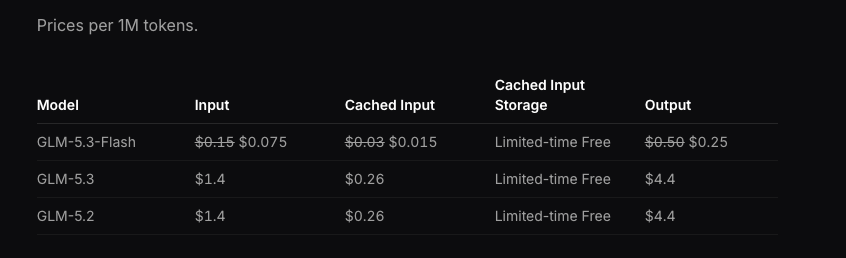
Pay-as-you-go pricing is currently identical: GLM 5.3 and GLM 5.2 each cost $1.40 per million input tokens, $0.26 per million cached input tokens, and $4.40 per million output tokens. Both versions now have weights listed in Z.ai's official Hugging Face organization, although teams should review each model card and license separately.
What Changed for One Long-Horizon Coding Workflow
Use one workflow that is long enough to expose drift: a multi-file dependency migration that requires planning, implementation, a failed test diagnosis, repair, and a review-ready patch. Short code-generation prompts will not test the behavior Z.ai says it improved.
Planning and Recovery Behavior
The GLM 5.3 launch says the base model is unchanged and the gains come from scaling post-training across more executable, long-horizon environments. The earlier GLM 5.2 release established the 1M-context architecture and long-task training stack. In other words, the upgrade claim is about how the agent works through a trajectory, not how much context fits in the request.
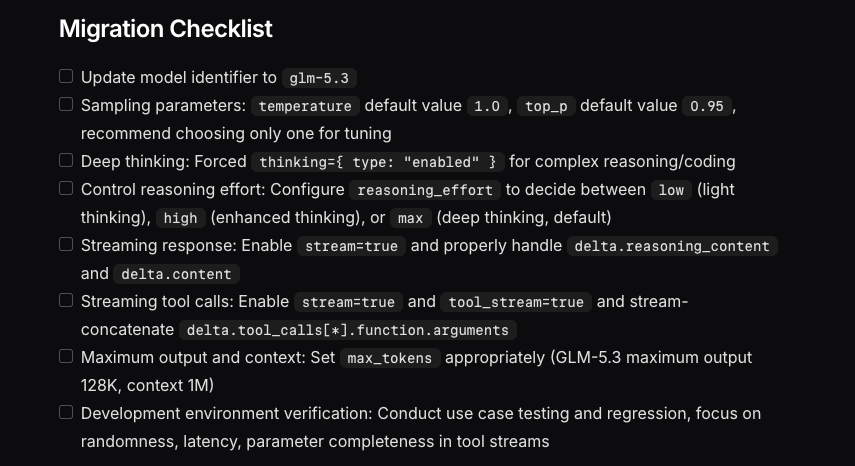
There is one breaking control change. GLM 5.2 accepts thinking.type: "disabled"; GLM 5.3 rejects it and supports low, high, or max reasoning effort, with max as the default. A useful recovery test should therefore compare both at the same supported effort, inject the same failing test midway, and score whether each model revises its plan, limits the repair, and reruns the required checks.
Output Efficiency and Vendor-Reported Evidence
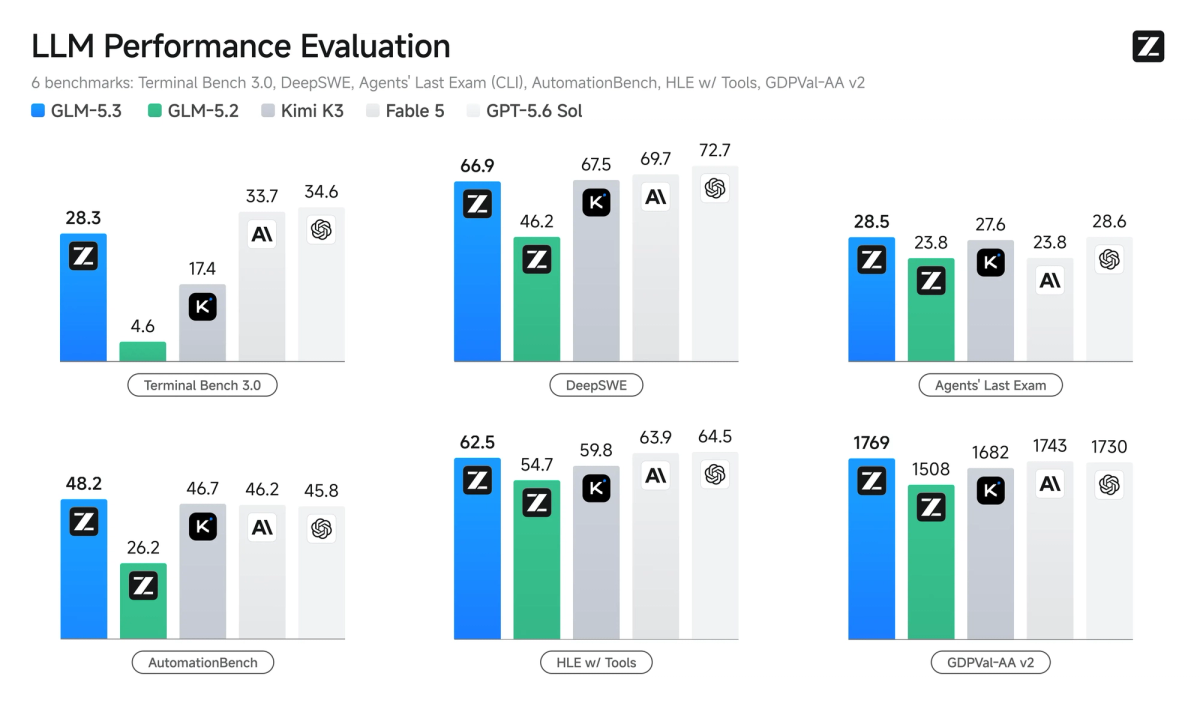
Z.ai reports three large coding deltas: Terminal-Bench 3.0 rises from 4.6 to 28.3, DeepSWE v1.1 from 46.2 to 66.9, and its private Code Bench from 23.4% to 34.5% at Max effort. The last result also uses fewer output tokens.
These are vendor-reported results under published evaluation setups. They support testing GLM 5.3, but they do not measure your repository conventions, tool permissions, flaky tests, or reviewer time. Token efficiency matters only when it survives the patch acceptance gate; a shorter run that produces an over-broad diff is not cheaper.
A Controlled Upgrade Test
Same Repository, Prompt, Tools, and Budget
Create two clean worktrees from the same commit and pin the exact API model IDs. Give both runs the same system prompt, repository instructions, allowed tools, network policy, environment variables, timeout, retry count, reasoning effort, and maximum output budget. Use the same cold-cache or warm-cache condition on both sides.
Do not use the Coding Plan aliases for this comparison: its current supported-model policy routes GLM 5.2 requests to GLM 5.3. Record the requested model, model field returned in the API response, endpoint, harness version, and full usage fields for every run.
Patch Quality, Tests, and Human Review
Score the completed artifacts, not the agent's explanation. The acceptance sheet should include task completion, files changed outside scope, unauthorized dependencies, build/lint/test results, regressions, retry count, total and cached tokens, wall time, and reviewer minutes. Archive the final diff and test logs even when a run fails.
Promote GLM 5.3 only if repeated runs improve accepted-patch rate or reduce review effort without exceeding the fixed budget. A benchmark lead does not compensate for weaker constraint adherence in your repository.
When to Keep GLM 5.2 During the Pilot
Keep GLM 5.2 as the rollback target when your current harness depends on disabled thinking, when tool-call streaming or response parsing has not passed regression, or when GLM 5.3 expands patch scope without reducing review time. The migration checklist specifically requires changing disabled thinking to enabled before switching the model ID and recommends testing randomness, tool streams, latency, and long-context cost.
Also pause the comparison if you cannot prove which model actually served the request. A mislabeled alias test creates cleaner charts and worse evidence.
Frequently Asked Questions
Can both versions run under one project quota?
Not as a true Coding Plan A/B test today. The plan shares one quota across supported tools, but GLM 5.2 requests are routed to GLM 5.3. For a version-pinned comparison, use an API path that still returns both exact model IDs and apply one team-controlled budget.
Do existing GLM 5.2 API keys require replacement?
Z.ai's migration guide does not instruct teams to rotate the API key; it focuses on the model ID and request parameters. Keep the existing key only if it is authorized for the selected endpoint and project; Coding Plan and general API endpoints are not interchangeable.
Can teams reuse cached prompts across both versions?
Reuse the prompt text, but do not assume a cache artifact transfers across model IDs. Z.ai describes automatic context caching for repeated content, yet it does not document cross-version cache portability. Warm each version separately and compare cached_tokens in the response.
How should version labels appear in pull request metadata?
Use immutable, machine-readable fields such as model_requested=glm-5.2, model_resolved=glm-5.2, reasoning_effort=max, endpoint, and harness_commit. This is a team governance recommendation, not a Z.ai metadata standard, and it prevents aliases from corrupting pilot results.
Does Z.ai publish end-of-support dates for GLM 5.2?
No end-of-support date appears in the current launch, model, migration, pricing, or Coding Plan pages reviewed on September 1, 2026. The signals differ by channel: pay-as-you-go documentation still lists GLM 5.2, while the Coding Plan already routes it to GLM 5.3. Monitor both separately.