The interesting thing about GLM 5.3 is what did not change. Z.ai says it runs on the same base model as GLM 5.2, with every reported gain coming from post-training. That framing is more useful than the headline numbers because it tells you which layer moved.
This is a documentation-driven read on one question: how GLM 5.3 fits a long-running coding workflow. It is not an independent Verdent evaluation. I have not benchmarked the model. Facts and linked pages were checked on August 25, 2026.
GLM 5.3 at a Glance
GLM 5.3 is text-only, with a 1M-token context window, a maximum output of 128K tokens, and always-on reasoning. Its three effort levels are low, high, and max, with max as the default.
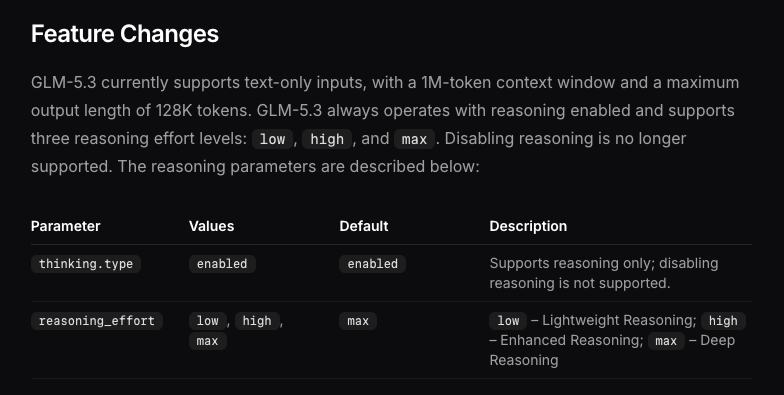
That reasoning change is a migration trap. If your integration sends thinking.type: "disabled", Z.ai's GLM 5.3 migration checklist says to enable thinking and set reasoning_effort to low before changing the model ID; otherwise, the request returns an error.
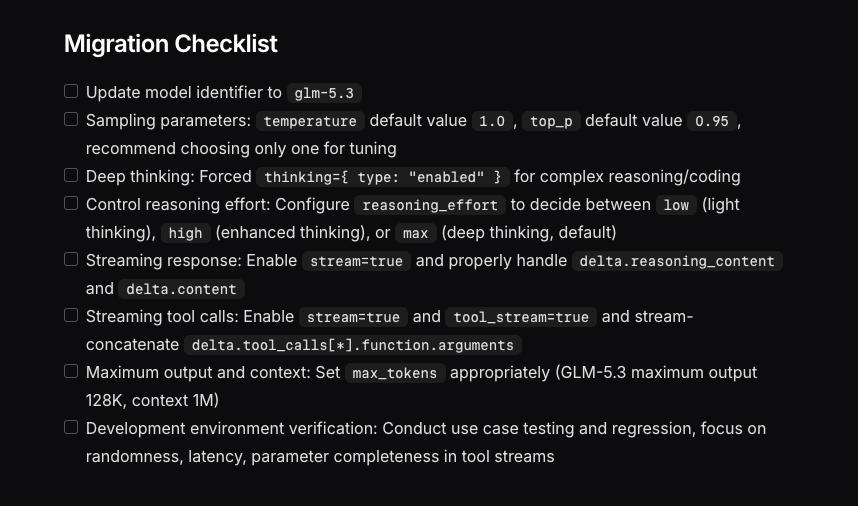
Access spans OpenAI Chat Completion, OpenAI Response, and Anthropic Message-compatible protocols, plus the GLM Coding Plan. API token prices and Coding Plan points are separate cost models.
What Changed From GLM 5.2
Post-Training and Long-Horizon Coding
Z.ai describes scaling the environments rather than the base model. Some tasks represent several days of expert work. Its ML infrastructure example supplies compute, storage, internal documentation, codebases, and experiment results, then asks the model to diagnose bottlenecks, optimize the system, and preserve correctness.
The verification detail is the substantive part. Verifiers are synthesized without the reference solution, while solver trajectories expose reward shortcuts. Passing oracle, no-op, and unsolved-state checks produces the binary training reward.
Whether this helps in your repository is a separate question. But it explains why the reported gains cluster on long-horizon tasks rather than short completions.
Vendor-Reported Benchmarks and Their Limits
Z.ai reports Terminal-Bench 3.0 moving from 4.6 to 28.3, DeepSWE v1.1 from 46.2 to 66.9, and Agents' Last Exam from 23.8 to 28.5. On its private Code Bench, GLM 5.3 reaches 34.5% at roughly 75K output tokens per task, versus GLM 5.2's 23.4% at 96K. The private benchmark cannot be reproduced from the published material.
One public coding result supports the direction of the gain. The DeepSWE v1.1 leaderboard runs model configurations through mini-swe-agent for consistency and lists GLM 5.3 Max at 69% ±3% across 113 tasks, versus 44% ±2% for GLM 5.2 Max. But its average costs are $3.99 and $3.92, with about 80K and 78K output tokens. On this harness, the resolution-rate gain is clearer than the token-efficiency gain.
The improvement also does not transfer automatically to every long-running task. Andon Labs' Vending-Bench 2, which measures year-long business-agent coherence rather than coding, places GLM 5.3 at $8,163.61 ±787 and GLM 5.2 at $8,313.78 ±1,084 across five runs. The ranges overlap, so this is not evidence of regression. It is a boundary: public evidence supports a targeted coding improvement, not a universal agent upgrade.

Where GLM 5.3 Fits One Long-Running Coding Workflow
Planning Across a Large Repository
The documented workflow analyzed here is ZCode, Z.ai's own agent. It keeps workspace state, file references, execution mode, and Git branch context inside one task and is closely adapted to GLM 5.3.
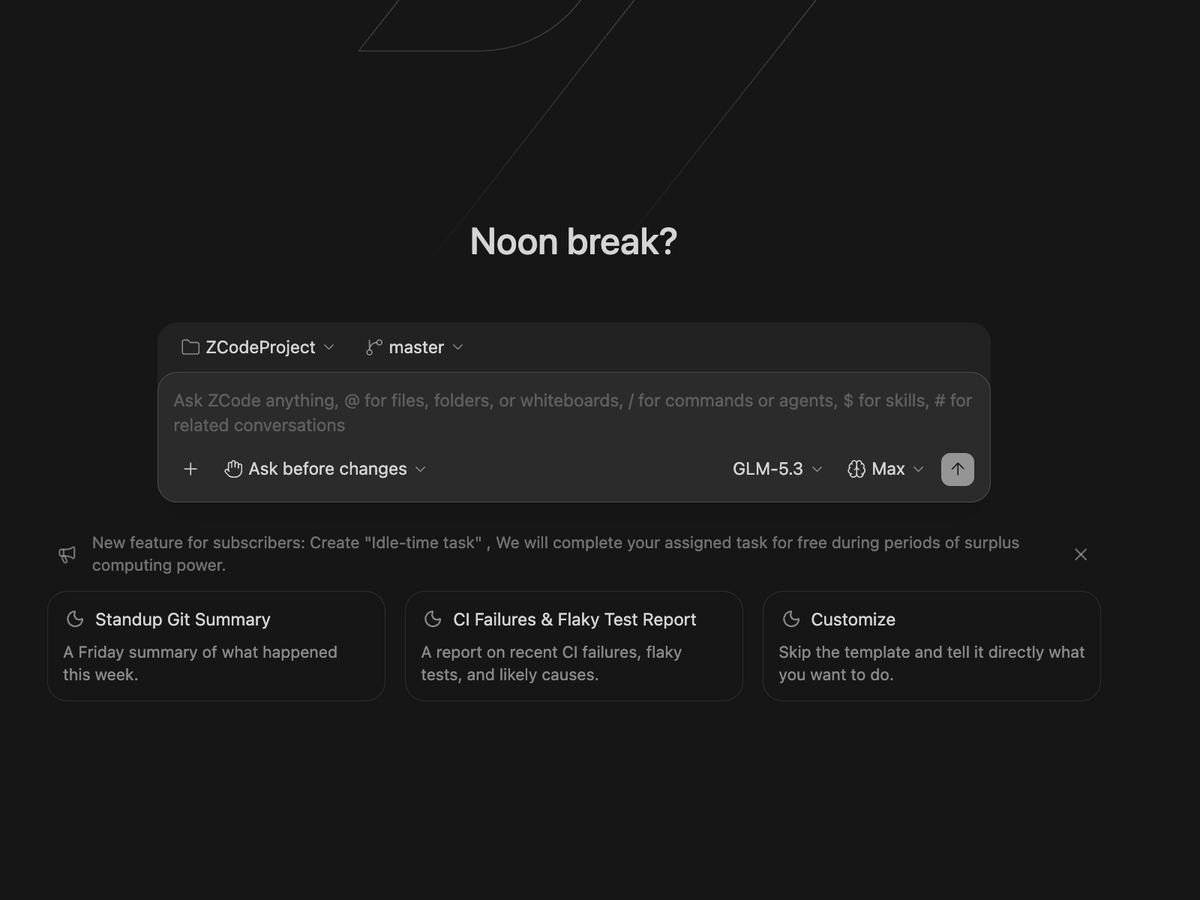
That is the right pairing for a model whose reported gains are on long-horizon tasks. A 1M-token context is only useful when the harness keeps the relevant state inside it.
Human Checkpoints Before a Patch Lands
Longer autonomous runs do not reduce review; they concentrate it. ZCode's four execution modes change which edits and commands require confirmation: Ask before changes gates every edit and command, Edit automatically still gates commands, Plan waits before implementation, and Full access reduces interruptions.
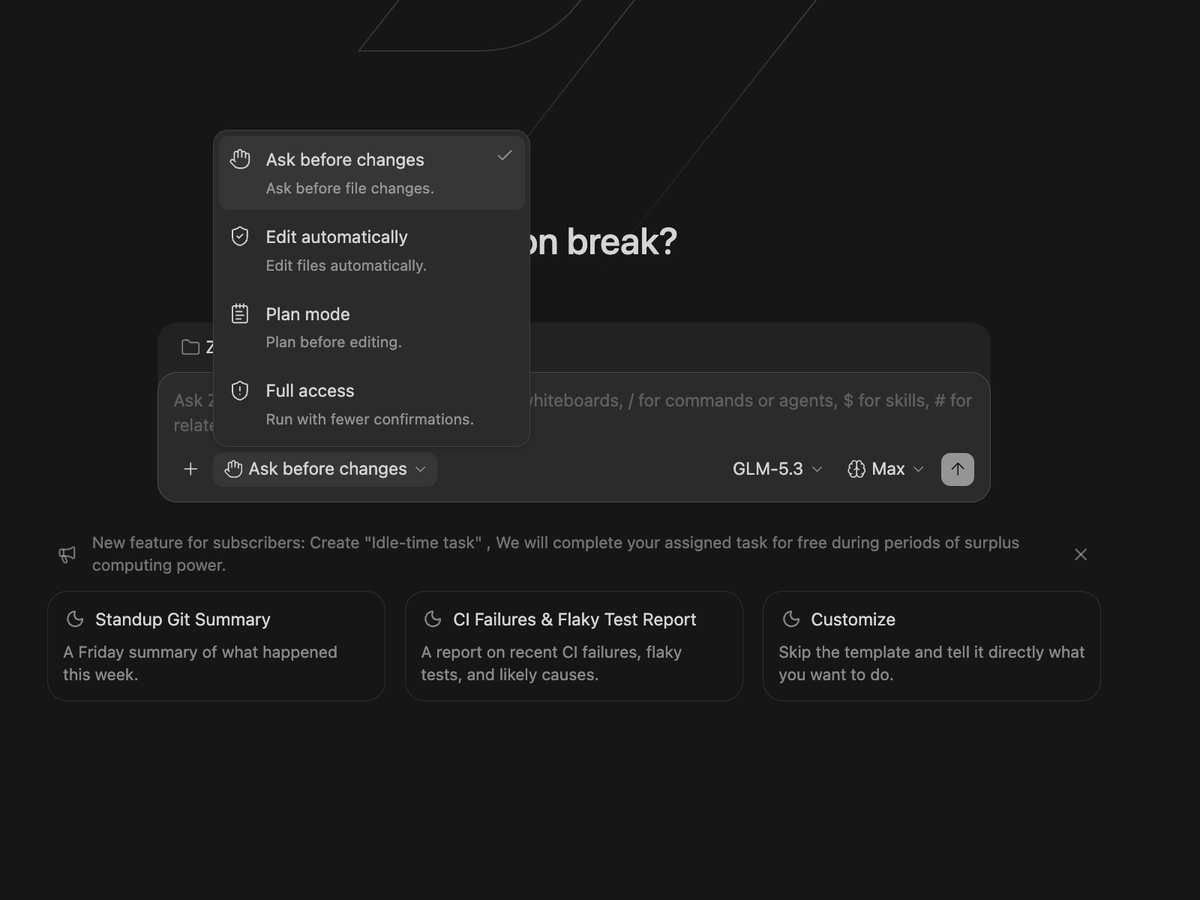
For an hours-long task, decide who reviews and where before starting the run. A bounded goal, acceptance tests, and a final diff review matter more than whether the agent can continue without another prompt.
What Teams Should Verify Before Adoption
Access, Model Identifiers, and Published Weights
Check four things against current pages rather than launch coverage: the model ID (glm-5.3), the protocol your plan can use, the reasoning-parameter migration, and weight availability.
Z.ai said weights would follow roughly two weeks after launch, after more safety evaluation. On August 25, Z.ai's public Hugging Face model list did not show GLM 5.3. Treat local deployment as pending, not delivered.
Usage Controls and Operational Evidence
For pay-as-you-go access, the current GLM 5.3 API price is $1.40 per million input tokens, $0.26 per million cached input tokens, and $4.40 per million output tokens. Coding Plan points are a separate quota system, so do not mix the two cost models in an adoption estimate.
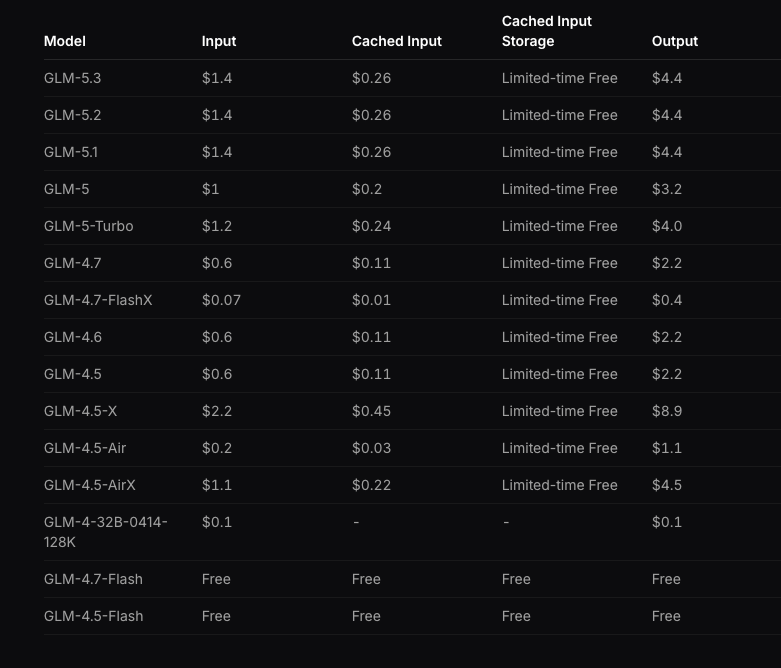
Then test the model on a failing build, bounded migration, or cross-file bug in your own repository. Hold the harness, tools, time budget, and acceptance tests constant; preserve the final diff and failure transcript. Vendor benchmarks tell you where to look, while the public results show why one harness cannot settle the production decision.
Frequently Asked Questions
Can ZCode Remote Control intervene during GLM 5.3 long runs?
Yes, within a boundary. Remote Control opens the current desktop window to a phone; execution remains on the connected machine.
Does ZCode's cache claim apply to other GLM 5.3 integrations?
Context caching is a model-level capability, not a ZCode exclusive. Measure cache hits and billed cached input on your own request structure.
Which mobile channels can steer active GLM 5.3 ZCode sessions?
The current Bot Channel documentation names WeChat and Feishu. DingTalk, Discord, and WeCom are later additions; Telegram is not named.
Which ZCode approvals remain mandatory during GLM 5.3 Goal mode?
Goal mode does not override execution mode. ZCode separates the completion loop from the approval policy: Ask before changes still gates every edit and command, and Edit automatically still gates commands.
Can teams disable GLM 5.3 reported cyber capabilities for ordinary coding?
No capability-class switch is documented. The reported cyber behavior comes from post-training; control sits around the model. Restrict tools, repositories, network access, credentials, and execution permissions before giving a long-running session shell access.
Related reading
- For the predecessor this release is measured against, see our read on GLM 5.2 for coding.
- When a launch leads with benchmark numbers, what SWE-bench Pro can and cannot tell you is the right lens for reading them.
- Before running a new model against a real repository, work through this pre-adoption checklist.
- Longer autonomous runs concentrate review rather than removing it — who owns an agentic workflow across a team is the question that follows.
- And for the review gate itself, automated review works better as queue triage than as an approval bot.