Both models launched in August 2026 with the same pitch: long-running agent work. Both vendors report gains on DeepSWE. And at their headline short-context API rates, both list lower uncached input and output prices than GPT-5.6 Sol, which appears in both vendors' comparison tables.
That is where the useful comparison starts, not ends.
This page answers one question: for a task that runs for many steps against a repository, what do the documented properties of each model imply about continuity, change quality, and cost control? It does not declare a winner. I have not run both models on the same repository task with the same prompt, tools, budget, and human scoring rubric — and without that, any performance verdict would be assertion. Everything below is documentation-level, verified on 2026-08-27.
The Decision for Long Coding Tasks
Long tasks fail differently from short ones. A short task fails visibly: wrong answer, obvious. A long task fails by drifting — the agent stays fluent, keeps producing plausible steps, and slowly stops working on what you asked.
So the decision variables are not "which model is smarter." They are:
Continuity   does it hold the task across many steps and failed attempts
Scope        does it change only what the task requires
Verification does it check its own work before proceeding
Cost control can you predict what a long run costs before starting it
Both models are positioned against exactly this problem, which is why they are worth comparing at all — and why a benchmark row is a poor proxy for the answer.
Task Continuity Under Multi-Step Work
Planning and Recovery After Failed Steps
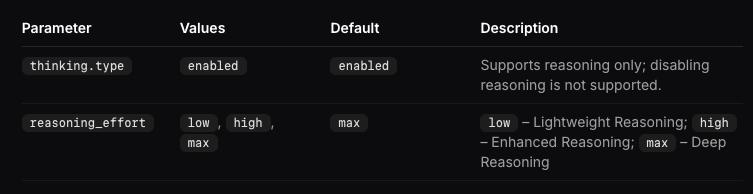
GLM 5.3 has reasoning permanently enabled, with low, high, and max effort levels, defaulting to max. For long tasks that removes a failure mode where a cost-saving config silently turns off the deliberation you were relying on. It also removes the option to cheapen a long run by dropping reasoning, which cuts both ways.
Z.ai describes training on task environments built to resemble real units of expert work, some representing several days of an engineer's time, with verifiers synthesized without access to the reference solution.
Grok 4.6 is positioned by xAI around the same failure: it builds on Grok 4.5 with a focus on long-running agents, and xAI states the model self-tests and verifies its own work more often before proceeding. xAI also describes a longer supplemental training run than 4.5, with a mix that included agentic reinforcement-learning tasks.
Both claims are vendor descriptions of training intent. Neither is an independently reproducible account of recovery behavior in your repository.
Context Retention Across Repository Changes
This is where the documented specs diverge most, and where the difference is concrete rather than rhetorical.
| GLM 5.3 | Grok 4.6 | |
|---|---|---|
| Context window | 1M tokens | 500K tokens |
| Max output | 128K tokens | documented as no text output limit |
| Input modality | text only | text and image |
| Caching | context caching listed as a capability | cached input priced separately |
The window difference matters less than it looks. A long agent run rarely fails because the window ran out; it fails because the relevant state was pushed out of attention while irrelevant history stayed in. Window size sets a ceiling, not a retention strategy. What actually governs retention is how your harness compacts, re-injects, and prunes — a harness property, not a model property.
Where the difference does bite: Grok 4.6 accepts image input, while GLM 5.3 does not. If your long task involves screenshots, design references, or visual diffing, that is a hard constraint rather than a preference.
Repository Change Quality
Choosing Files and Limiting Patch Scope
Neither launch table I checked publishes a metric for patch-scope discipline, and that absence is worth naming: the thing most likely to make an agent's output unusable in a real repository — a correct fix delivered as an over-broad diff — is not on either scoreboard.
What the reported numbers do cover is task completion. Both vendors report DeepSWE:
- Z.ai reports GLM 5.3 at 66.9 on DeepSWE v1.1, up from 46.2
- xAI reports Grok 4.6 at 65.9 on DeepSWE v1.1, up from 54
Do not read those two numbers against each other. Both are vendor-reported results on the same benchmark version, but the published materials do not document a matched configuration sufficient to treat them as a head-to-head. Z.ai discloses run parameters for its number — mini-swe-agent, 400K context, a six-hour timeout — and I did not find an equivalent parameter set in xAI's launch materials. Reading a 1.0-point gap across two undocumented setups is the most likely misuse of this page.
If you want a comparison run under one configuration, the DeepSWE v1.1 leaderboard uses a single mini-swe-agent setup and lists GLM-5.3 Max at 69%±3% and Grok-4.6 xhigh at 67%±2%. Note that those figures differ from both vendors' headline numbers — which is itself the point: the harness is part of the result. The confidence intervals also overlap, so treat that ordering as inconclusive rather than as a ranking.
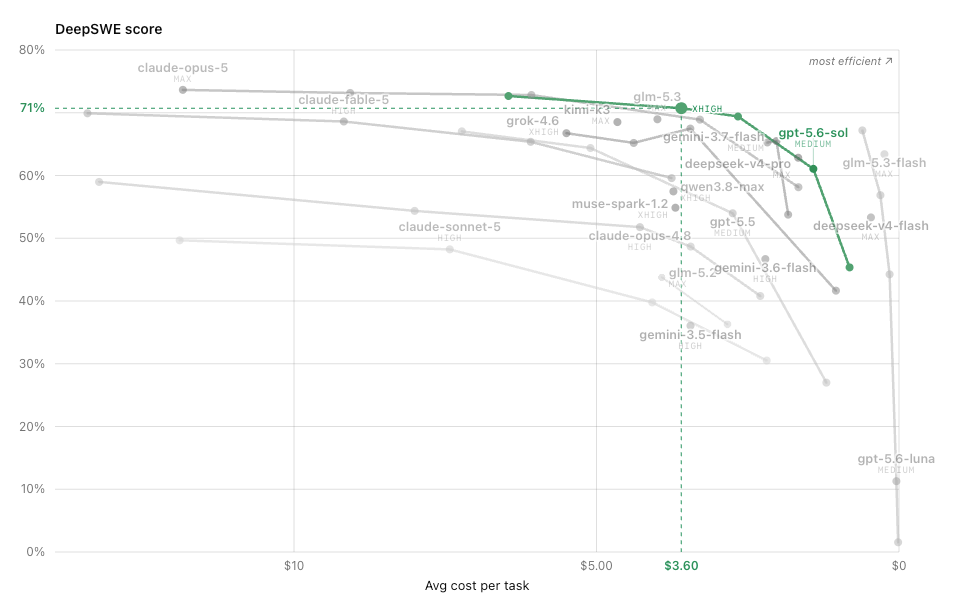
The within-vendor deltas remain the more defensible signal: each company reports a substantial improvement over its own predecessor on its own setup. That tells you both lines moved. It does not tell you which one lands a cleaner patch in your codebase.
Both companies also publish rows where they trail. xAI's own launch table shows Grok 4.6 behind the best comparison score on CursorBench, DeepSWE, FrontierCode, APEX-Agents, Terminal-Bench, and APEX-SWE. Z.ai's own table shows GLM 5.3 at 34.5% on its private Code Bench against Claude Fable 5 at 39.5%. Neither vendor is claiming a clean sweep, and you should not claim one on their behalf.
Tests, Verification, and Human Review
xAI's stated emphasis on self-verification and Z.ai's described verifier-synthesis training point at the same goal from different directions. Both are training-time claims.
At run time, the property that determines review burden is not the model. It is whether your harness stops at checkpoints, whether tests run between steps, and who reads the diff. More self-verification may reduce bad intermediate steps, but the vendor materials here do not quantify that effect — and it does not remove the review either way.
The practical consequence for a long run is the opposite of what people expect: longer autonomous execution concentrates review rather than reducing it. Five hours of unattended work arrives as one large surface to inspect.
Usage Constraints That Affect the Choice
Current Access and Model Versions
GLM 5.3 is reachable through three protocols — OpenAI Chat Completion, OpenAI Response, and Anthropic Message — plus the GLM Coding Plan. One documented caveat: existing GLM Coding Plan subscribers, including expired ones, can currently reach the model API only through the OpenAI Chat Completion-compatible protocol.
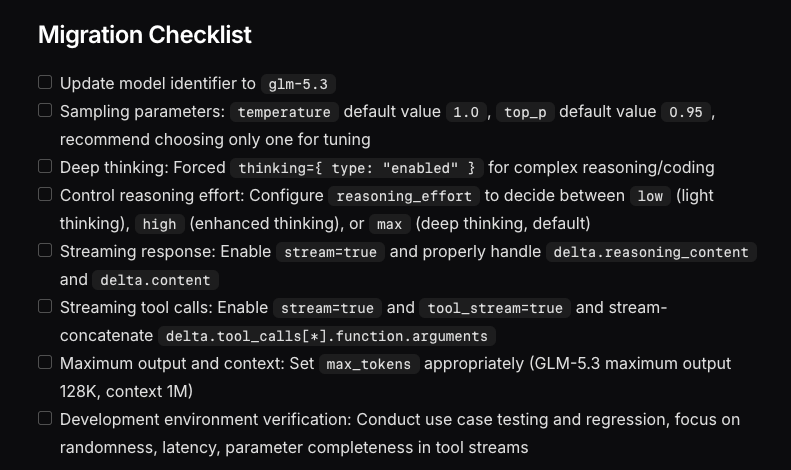
There is also a migration trap worth checking before you switch. If your integration currently sends thinking.type: "disabled", Z.ai's GLM 5.3 migration checklist instructs you to set it to enabled and reasoning_effort to low before changing the model ID, or the request fails.
On weights: Z.ai stated they would follow additional safety evaluation, roughly two weeks after launch. As of 2026-08-27, GLM-5.3-Flash weights are visible while the base GLM-5.3 weights are absent from Z.ai's Hugging Face organization. If reproducible weights or local deployment of the base model are requirements, treat that as pending.
Grok 4.6 is available as grok-4.6 through the xAI API and partners including Cursor, Grok Build, OpenRouter, Vercel, and Cloudflare. Knowledge cutoff is documented as February 1, 2026. The launch also mentions a faster variant at twice the price, but public sources do not establish a stable API model ID or a complete price table for it — verify in the current catalog before designing around it.
Token Cost and Run Controls
This section is where the two differ most in kind, not degree.
**Grok 4.6 **is priced at $2/M input, $0.50/M cached input, and $6/M output — but only while the prompt stays below 200K tokens. At or above that threshold, xAI bills the entire request at $4/M input, $1/M cached input, and $12/M output. There is no batch discount.
Read that carefully against the 500K window. The headline rate covers roughly the first two-fifths of the advertised context. For long agent runs — the exact workload the model is positioned for — a prompt that grows past 200K flips the whole request to double rates, not just the tokens above the line. Cached input also rose from $0.30 to $0.50 per million versus the previous generation.
GLM 5.3 has two access economics, and conflating them is easy. Under the GLM Coding Plan it uses a points-based quota, with off-peak hours and all day on weekends consuming half the standard points — that rewards scheduling. On the pay-as-you-go API it is priced at $1.40/M input, $0.26/M cached input, and $4.40/M output, where the levers are volume and cache hit rate rather than the clock.
So the disciplines differ by access path, not simply by model. With Grok 4.6's API pricing, one key lever is prompt size around the 200K threshold. Under the GLM Coding Plan, one key lever is timing. On GLM's pay-as-you-go API, token volume and caching remain the levers, as they would anywhere else.
Frequently Asked Questions
Does the faster Grok 4.6 option preserve standard long-task behavior?
Two things exist here and the mapping between them is not documented. xAI's launch mentions "a fast variant" at twice the price. Separately, the current API docs expose Priority Processing for grok-4.6 via service_tier: "priority", billed at 2× standard rates across input, output, cached, and reasoning tokens. The docs I checked do not state that Priority Processing is the launch's fast variant, so verify that mapping before designing around it — and note that a serving-tier change is not documented as a behavioral change on long tasks. If it matters to your decision, run your own task on both paths rather than assuming equivalence.
Does ZCode expose the same GLM 5.3 behavior as its direct API?
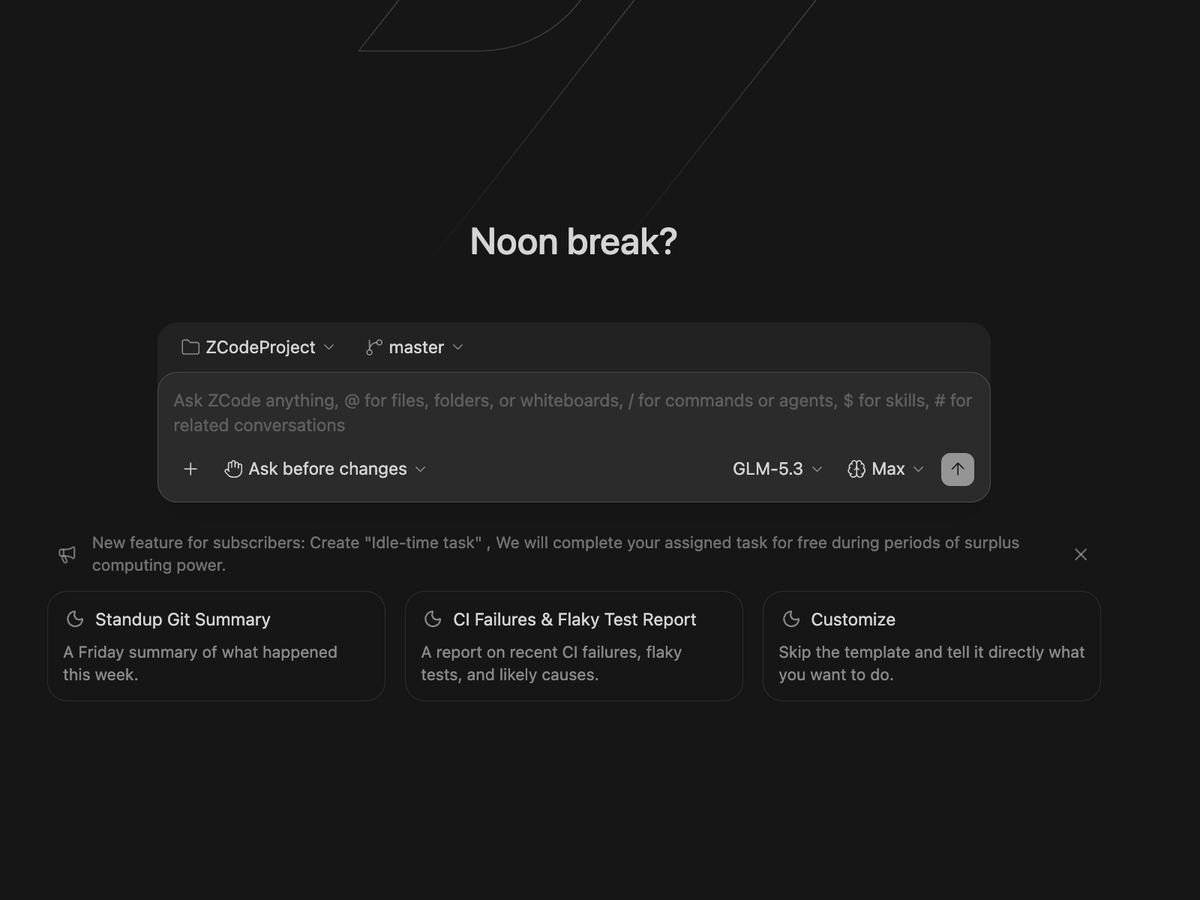
Not identically, and the difference is the harness rather than the model. ZCode is documented as tuned specifically around GLM 5.3, and it adds goal continuity, execution modes with different confirmation defaults, and workspace state that the raw API does not have. Those change what the model does over a long run without changing the model. If your evaluation compares ZCode against a direct-API integration of Grok 4.6, you are comparing two harnesses as much as two models — hold the harness constant or state that you did not.
Can Cursor and ZCode results support one cross-model conclusion?
No, not on their own. Cursor and ZCode differ in context assembly, tool sets, retry behavior, and stopping rules, and each is tuned around different assumptions. A result produced in Cursor with Grok 4.6 and a result produced in ZCode with GLM 5.3 differ in at least two variables. To support a cross-model conclusion you need the same repository task, prompt, tool set, time and token budget, and human scoring rubric on both sides — or an explicit statement that the comparison is conditional on the harness.
Which repository size limits this GLM 5.3 versus Grok 4.6 conclusion?
There is no documented size threshold that flips the answer, and I would distrust anyone who names one. What changes with repository size is which constraint binds first: on larger repositories the prompt is more likely to cross Grok 4.6's 200K long-context threshold, which changes cost rather than capability; and larger repositories put more pressure on harness-level context management than on window size. Measure the prompt sizes your own tasks actually produce before treating either window as the deciding factor.
Would shorter tasks reverse the GLM 5.3 versus Grok 4.6 recommendation?
This page does not issue a recommendation to reverse — that is the honest answer. But the reasoning would shift. Most of what is compared here (continuity across steps, recovery after failures, long-context billing) is specific to long runs. On short tasks the deciding factors are usually latency, per-call price at small prompt sizes, and integration convenience, none of which this comparison optimizes for. If your workload is mostly short, run that evaluation separately rather than inheriting this one.
Related reading
- The launch-level read on one of these models, including its migration traps: GLM 5.3 review for coding agents
- Before running either model against a real repository, work through this pre-adoption checklist
- When a launch table leads with benchmark numbers, what SWE-bench Pro can and cannot tell you is the right lens
- Longer autonomous runs concentrate review rather than removing it — who owns an agentic workflow across a team
- And for the review gate itself, automated review works better as queue triage than as an approval bot