There is no single product called "Grok for Coding." There is a collection of models, an API, a browser workspace, seven IDE integrations, and a set of announced-but-not-yet-shipped tools that have generated more coverage than they probably deserve. This article separates what you can use today from what xAI has teased but not delivered.
What "Grok for Coding" Actually Means in 2026
Why the answer is not a single product
xAI's coding stack in April 2026 has three distinct components that get conflated constantly:
- grok-code-fast-1 — a dedicated agentic coding model, API-available, with IDE integrations
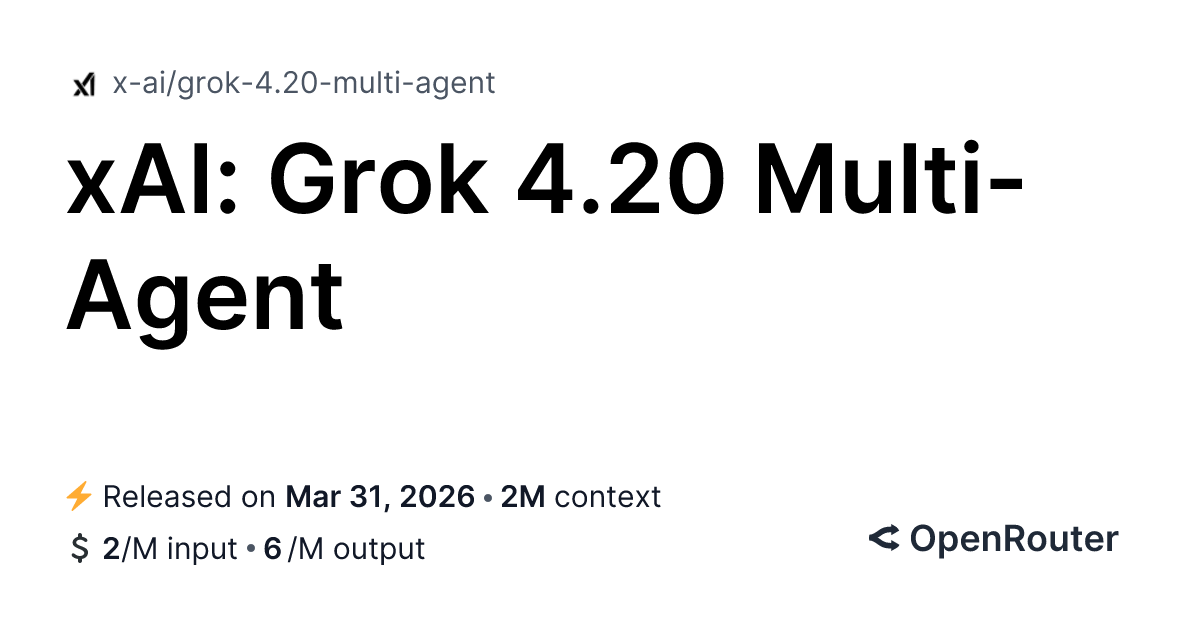
- Grok 4.20 and its multi-agent variant — the flagship reasoning model with parallel agent architecture, accessible via API and chat
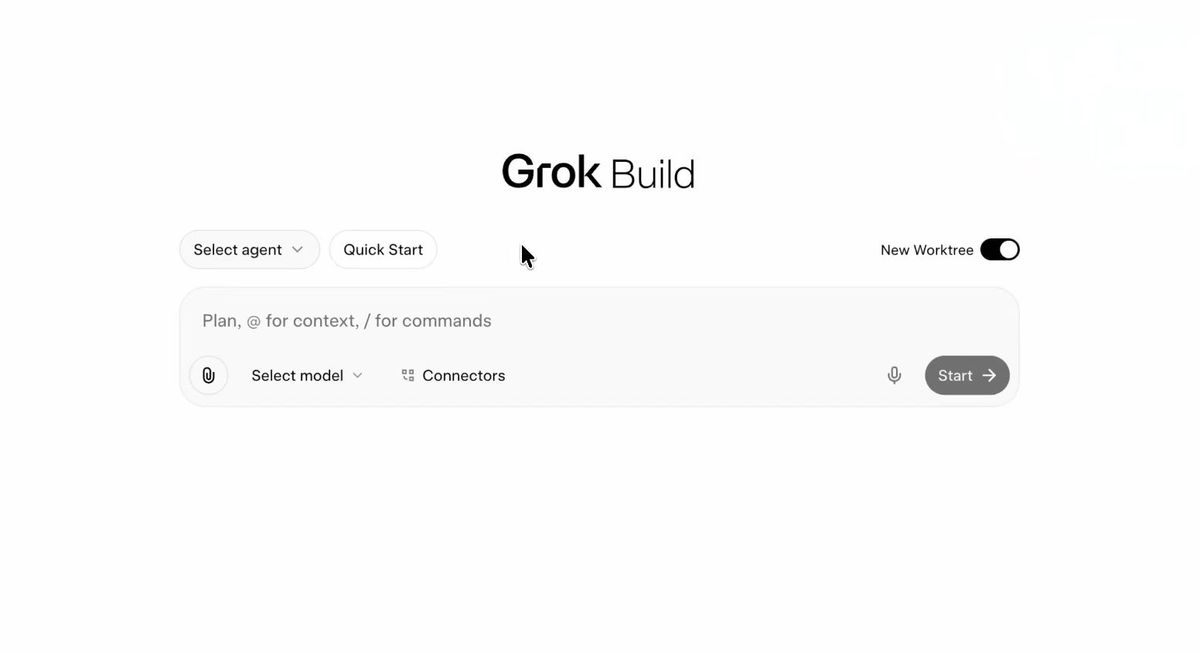
- Grok Build / Grok CLI — a local-first coding agent tool, announced in January 2026, still on a waitlist as of late April
Asking "is Grok good for coding?" is like asking "is Anthropic good for coding?" — the answer depends entirely on which piece of the stack you're evaluating.
Chatbot coding vs API coding vs agent stacks
| Mode | What you use | Best for |
|---|---|---|
| Chat-based | grok.comor X app with Grok 4.20 | Quick code questions, prototyping, ad-hoc debugging |
| IDE extension | grok-code-fast-1 via Cursor, Copilot, Cline, et al. | Agentic inner loop: read → edit → test → repeat |
| API | xAI API (api.x.ai) with grok-code-fast-1 or grok-4.20 | Building coding agents, CI automation, custom pipelines |
| Agent tool (pending) | Grok Build (waitlist) | Local-first agent: plan → search → build |
What xAI Officially Ships Today
grok-code-fast-1 — the agentic coding model
Released August 28, 2025, grok-code-fast-1 is xAI's purpose-built coding model. It was developed with a new architecture from scratch — separate from the Grok 4 lineage — with a pretraining corpus heavy on programming content and posttraining focused on real-world pull requests and coding tasks.
What it is: A reasoning model optimized for the inner development loop — file reading, editing, test running, and tool calling at speed. Reasoning traces are visible in the response, which lets you steer mid-task.
Specs:
- Context: 256K tokens
- Pricing: $0.20/M input, $1.50/M output, $0.02/M cached input (xAI official)
- SWE-Bench Verified: 70.8% on xAI's internal harness — not independently replicated at launch, and xAI explicitly notes benchmarks "don't fully reflect nuances of real-world software engineering"
- Speed: ~150 tokens/second, which is meaningfully faster than frontier reasoning models
What it is not: A replacement for a full reasoning model on complex architecture decisions, deep refactors spanning many files, or tasks requiring strong general knowledge. xAI's own documentation frames it as economical and fast for common tasks, not as a general-purpose flagship.
Grok 4.20 Beta and Heavy — the multi-agent system
Grok 4.20 launched in beta on February 17, 2026, introducing a four-agent architecture where distinct agents handle different cognitive roles simultaneously. The agents have names: Grok (coordinator), Harper (research), Benjamin (logic and math), Lucas (contrarian analysis). They work in parallel and cross-verify outputs before surfacing a response.
Beta 2 shipped March 3, 2026, with five targeted fixes: better instruction following, reduced hallucinations, enhanced LaTeX support, more accurate image search, improved multi-image rendering.
The API variants became available starting March 31, 2026 on OpenRouter, under model names like grok-4.20-0309-reasoning and grok-4.20-multi-agent-0309.
Specs (Grok 4.20 API):
- Context: 2,000,000 tokens
- Pricing: $2/M input, $6/M output (verified via xAI API docs)
- Reasoning: can be enabled or disabled per request via API parameter
Heavy: xAI's Heavy tier is marketed as 16 specialized agents for deeper analysis. It's available under the SuperGrok Heavy subscription (~$30/month) but the internal architecture details — how those agents are structured and what they specialize in — are not publicly documented by xAI. Treat the 16-agent figure as xAI's marketing claim, not independently verified.
For coding specifically: Grok 4.20 is a general-purpose reasoning model, not a coding-specialized one. It can write and review code, but it's competing with Claude Opus 4.7, GPT-5.4, and Gemini 3.1 Pro at a similar tier — not differentiated for coding the way grok-code-fast-1 is positioned.
Grok Studio — the browser workspace
"Grok Studio" is the community name for a split-screen workspace within grok.com. xAI calls it Projects or Workspaces in official documentation. It launched around April 2025 and provides a dual-pane interface where Grok generates or edits content in one pane while you interact in the other.
It supports code execution across Python, JavaScript, TypeScript, C++, and Bash, with sandboxed preview. Google Drive integration (Docs, Sheets, Slides) is included. It's available to both free and paid users on web — mobile support is limited and user reports note inconsistency.
Be cautious about the domain grokai.studio — this is not an official xAI site. The official surface is grok.com.
Tool calling and code execution in the xAI API
The xAI API supports both server-side and client-side tool calling. Server-side tools include web search, X search (real-time data from the X platform), code execution, and file search. These are available on grok-code-fast-1 and Grok 4.20.
X Search is the most distinctive capability here. Other coding stacks can do web search via MCP or custom tools, but Grok's integration with X gives it live access to X posts, discussions, and developer conversations as a native tool call — not an add-on. Whether that matters for coding tasks depends on the workload.
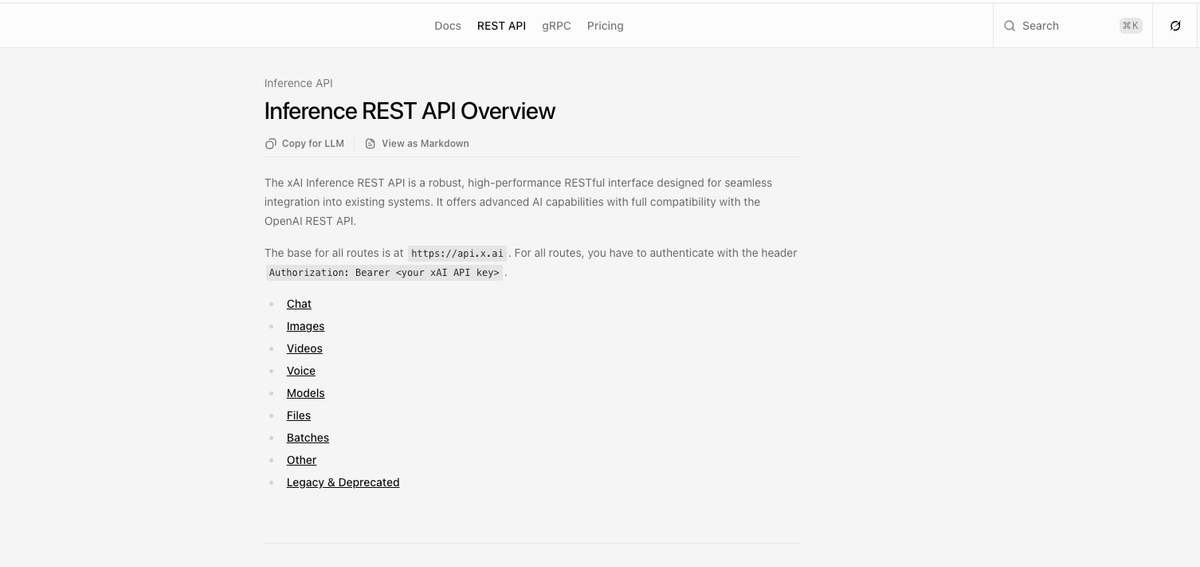
Tool calls via the API are priced at ~$5 per 1,000 invocations for server-side tools on top of token costs. Code execution is included in tool call pricing. The Responses API and Agents API both support tool use; the xAI API is OpenAI-SDK-compatible (change the base URL, generate an API key).
Editor integrations
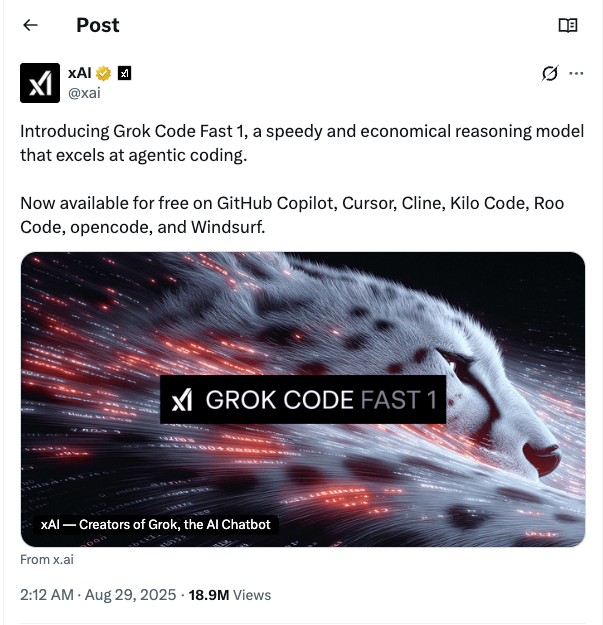
At grok-code-fast-1 launch, xAI partnered with seven IDE-adjacent tools for a free period: GitHub Copilot, Cursor, Cline, Roo Code, Kilo Code, opencode, and Windsurf. All seven appear in xAI's official announcement.
The original free period was framed as limited-time. OpenRouter lists grok-code-fast-1 at the same $0.20/$1.50 pricing for teams that want to route through a unified API layer. As of early 2026, free access via some partners continues on an extended basis, but this varies by platform. Do not assume free access is permanent — check current pricing in each tool before building a workflow around it.
What Is Teased but Not Actually Shipping
Grok Build and Grok CLI — waitlist only
Grok Build was first spotted in code traces in January 2026 and publicly teased by xAI in January 2026. The pitch: a local-first coding agent (CLI-first, with an optional web UI) where all code executes on your machine, nothing transmits to xAI's servers, with GitHub integration and up to eight parallel agents per session.
As of April 2026, Grok Build has not been publicly released. On April 16, 2026, reports indicated Elon Musk had set a "next week" timeline for launch, but this had not materialized as of writing. xAI has not published an official release date.
The waitlist is real. The product's capabilities as described — eight concurrent agents, Arena Mode for algorithmic ranking of agent outputs, local-first execution — are not confirmed as final features. What has shipped are code traces, teaser screenshots, and a signup form.
grokai.build is not an official xAI website. Do not use it as a source for Grok Build information.
Grok Code Fast 2 and Grok 5 — no confirmed date
xAI has not announced grok-code-fast-2 or given it a release date. The naming pattern implies it's coming, but there is no official information.
Grok 5 is confirmed to be in training on xAI's Colossus 2 supercluster in Memphis (1 gigawatt, operational January 2026). xAI's $20 billion Series E funding mentions Grok 5 training as an active priority. Beyond that, there is no confirmed release date. Q2 2026 is the community consensus estimate; Polymarket prediction markets as of early April gave a 33% probability of a June 30 release. Musk has made ambitious statements about Grok 5's capabilities. Treat all of this as speculation with high uncertainty.
How the Pieces Fit in a Real Workflow
For a senior dev evaluating Grok right now, the practical picture is:
Model layer: Two real options. For fast, agentic inner-loop coding tasks — bug fixes, scaffolding, test generation, routine refactoring — grok-code-fast-1 at $0.20/$1.50 is cheap and fast enough to use aggressively. For deeper reasoning, research-heavy tasks, or multi-step planning, Grok 4.20 at $2/$6 competes with frontier models.
Agent layer: Grok 4.20's multi-agent system is available via API and chat. It's Grok's native parallel-agent capability — relevant if you want agent-level coordination without building orchestration infrastructure yourself. For custom orchestration (LangGraph, CrewAI, custom harnesses), grok-code-fast-1 slots into the same tool-call patterns as any other OpenAI-compatible model. Multi-agent platforms like Verdent work with the xAI API as a model backend, treating Grok as one of several available engines.
Interface layer: IDE integrations (Cursor, Cline, etc.) for grok-code-fast-1; grok.com Projects/Workspaces for browser-based work; Grok Build when and if it ships.
Where Grok Fits Against Claude / GPT-5 / Gemini Stacks
What Grok has that others don't
X Search as a native tool. Claude, GPT-5.4, and Gemini all have web search via plugins or MCP integrations. Grok's X Search is a first-party, native tool call. For tasks where real-time developer discussion, issue reports, or community knowledge is relevant, this is a structural difference, not just a feature parity check.
Aggressive token pricing. grok-code-fast-1 at $0.20/$1.50 undercuts Claude Sonnet 4.6 ($3/$15) on input by 15× and output by 10×. Even Grok 4.20 at $2/$6 is cheaper on output than Claude Opus 4.6 ($25) or GPT-5.4 ($15). For high-volume agent workloads, the cost gap is large enough to change which retry strategies are financially viable.
Fast iteration cadence. xAI ships checkpoint updates to grok-code-fast-1 frequently. The model you use in May may be meaningfully better than what shipped in August 2025 at the same price point.
What Grok still lacks vs mature coding agents
Ecosystem depth. Claude Code, GitHub Copilot, and Cursor have tighter IDE integrations, more third-party extensions, and longer production histories than xAI's API. Claude Code Routines, Anthropic's agent scheduling system, has no Grok equivalent. The xAI Enterprise API launched in January 2026 — its track record for large-scale production deployments is short.
A first-party coding agent. Grok Build has been announced but not shipped. Claude Code and Codex CLI are available today. If you need a CLI-first, local coding agent right now, xAI does not have one yet.
Smaller context on the coding model. grok-code-fast-1's 256K context window trails Claude Opus 4.6/4.7 and GPT-5.4 (both 1M+) for tasks that require loading large codebases in a single pass. Grok 4.20 has 2M context but is a general model, not a coding-specialized one.
Who Should Try Grok Today—and Who Shouldn't
Try it if:
- You're running high-volume agentic coding loops where per-token cost matters — grok-code-fast-1 is hard to beat at $0.20/$1.50 for scoped tasks
- You want real-time X Search as a native capability in a coding agent
- You're already using one of the seven launch partners (Cursor, Cline, Copilot, etc.) and can experiment at no additional cost
- You want a 2M-token context window for non-coding research tasks at a competitive price
Skip it (for now) if:
- You need a first-party CLI coding agent — wait for Grok Build to actually ship
- Your team has compliance or enterprise requirements that need a longer track record
- Your primary workload is complex architecture decisions or deep multi-file refactors — grok-code-fast-1 is optimized for speed and scope, not depth
- You need context windows above 256K on a coding-specialized model
FAQ
Is Grok a coding tool or a chatbot?
Both and neither. grok-code-fast-1 is a purpose-built agentic coding model. Grok 4.20 is a general-purpose reasoning model that happens to be capable at coding. The grok.com interface is a chatbot surface. xAI doesn't have a dedicated coding product equivalent to Claude Code or GitHub Copilot yet — that's what Grok Build is supposed to be, and it hasn't shipped.
Is Grok Build out yet?
No, as of late April 2026. xAI has teased it since January 2026 and Musk indicated a "next week" timeline as of April 16, 2026, but it has not been publicly released. The waitlist exists. grokai.build is not an official xAI website. When Grok Build ships, it will be announced on x.ai and the official xAI X account.
Is Grok Code Fast 1 still free in Cursor?
The original launch offered free access through seven partners for a "limited time." As of early 2026, some partners continue to offer extended free access, but xAI has not made a permanent free access commitment. Check the current pricing or model access page in your specific tool before building a workflow that depends on it.
Can I use Grok in VS Code?
Not through an official xAI VS Code extension. You can use grok-code-fast-1 in VS Code through third-party extensions that support custom API endpoints — Cline, Roo Code, and opencode all support the xAI API. VS Code itself doesn't have a native Grok integration.
Is Grok safe for enterprise repos?
xAI offers SOC 2 Type 2, GDPR, CCPA, and Zero Data Retention options on its Enterprise API, launched January 2026. For Grok Build's local-first architecture (when it ships), no source code is transmitted to xAI servers by design. For API usage today, review xAI's current data handling documentation and verify Zero Data Retention is available for your plan before sending proprietary code. The Enterprise API's track record is shorter than Anthropic's or OpenAI's — that matters for some procurement processes.
Bottom Line
xAI has built a capable, cheap agentic coding model in grok-code-fast-1 and a multi-agent general model in Grok 4.20. The integration surface is real: seven IDE partners, an OpenAI-compatible API, and a browser workspace. The price-per-token advantage over Claude and GPT-5.4 is large enough to matter for high-volume agent workflows.
What xAI has not shipped is a first-party coding agent tool. Grok Build has been in preview and waitlist mode since January 2026. Until it ships, the Grok coding stack is a model-plus-API story, not a product story. Whether that's enough depends on your workflow: if you have an existing agentic coding stack and want to evaluate a cheaper, faster model backend, Grok is worth testing today. If you're looking for a complete, polished coding agent out of one vendor, the stack is not there yet.
Related Reading