The demo works. Then a customer asks for a different permission rule, a teammate fixes a bug, and the next release must preserve existing data. That is where an AI app builder comparison becomes useful. Replit vs Lovable is less a contest over the first prompt than a choice about where your team wants to make, test, review, and operate subsequent changes.
This documentation-based comparison was checked on September 24, 2026. It uses one hypothetical app; no matched build, benchmark, or production deployment was performed.
Replit vs Lovable in Brief
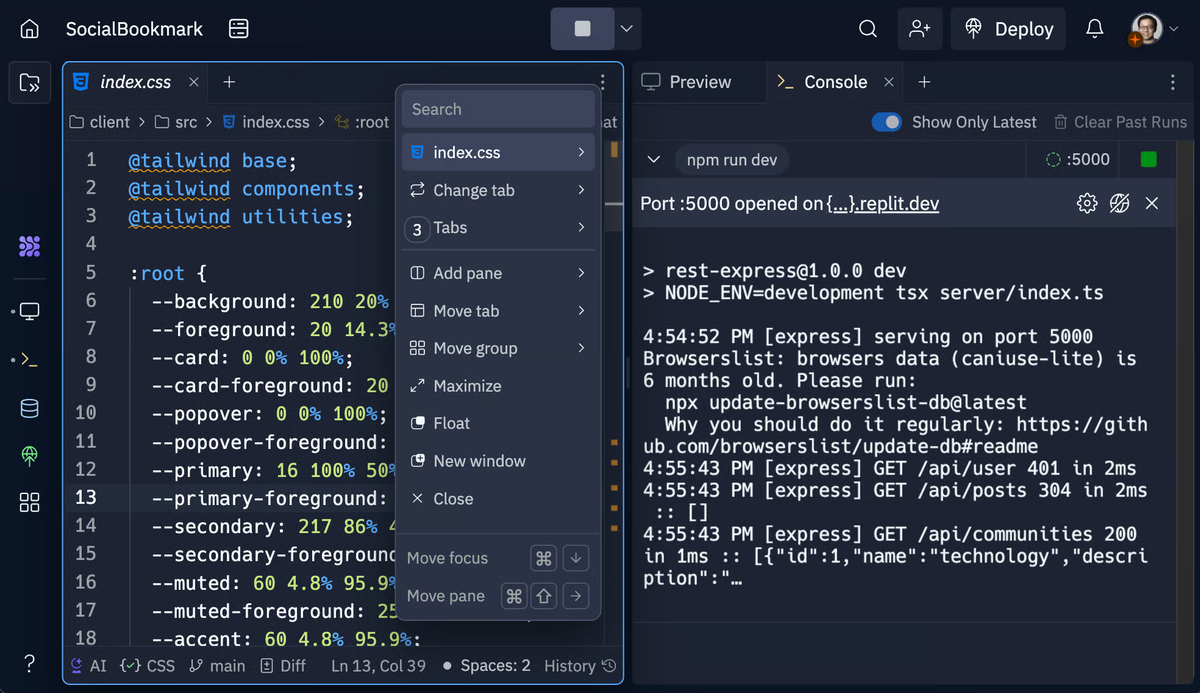
Choose Replit when developers want the browser workspace itself to be the main engineering environment: code editor, shell, Git, database, Agent, and publishing tools in one place.
Choose Lovable when a founder or product-led team wants to keep describing and visually adjusting a web app while a developer works from a synced Git repository. Both now offer code access and Git paths. The difference is the center of work, not whether source code exists.

| After-demo question | Replit | Lovable |
|---|---|---|
| Where does a developer make a precise fix? | Project editor and shell, with Git pane or CLI | Paid-plan code editor, or an external editor through Git sync |
| How does code reach a team repository? | GitHub import, pull, push, and branches | Two-way Git sync; one active branch syncs at a time |
| How is a live version released? | Publish through Replit's deployment workflow | Publish a project snapshot through Lovable, or deploy synced code elsewhere |
| Who carries a future change? | The team can continue in Replit's development workspace or its repository | The team can continue in Lovable chat or hand a synced repository to developers |
These are documented options, not a code-quality verdict. Replit's Git-backed version control and Lovable's two-way GitHub sync allow repository handoff. Data, secrets, deployment settings, and ownership need separate work.
The Decision Scenario
Use one scenario to decide Replit or Lovable: a two-person team has a demo of a customer portal with sign-in, a request form, and a staff-only queue. It now needs a role change, an email integration, a regression check, and a release that preserves existing requests. Assume a founder defines the product behavior and a developer will maintain the code. This is a proposed evaluation, not an account of an app built on either platform.
Write four acceptance checks: a customer cannot see another customer's request; staff can update only permitted fields; a failed email leaves the request intact; and a bad release is recoverable. Record what you had to do manually.
Building and Iterating the First Version
Prompting, Editing, and Debugging
Replit Agent can create and modify a project, while the editor and shell give a developer direct access to files, commands, and runtime output. Its documented Agent modes make effort and cost a setting for each kind of task. A small, scoped correction can stay close to the code; a cross-file authentication change still needs a requirement and an independent check.
Lovable keeps prompts and visual preview near the product conversation. Its code editor lets project editors inspect files; paid plans allow manual edits and a full codebase download. Lovable saves manual edits as versions but does not review them. Developers who work mainly in a shell may need the extra step through Git.
Try a staff-only button rendered for the wrong role. Inspect each diff and run the same unauthorized-user check. Count accepted fixes and review effort, not prompts alone. An Agent explanation does not prove server-side access control.
Code, Data, and Integration Access
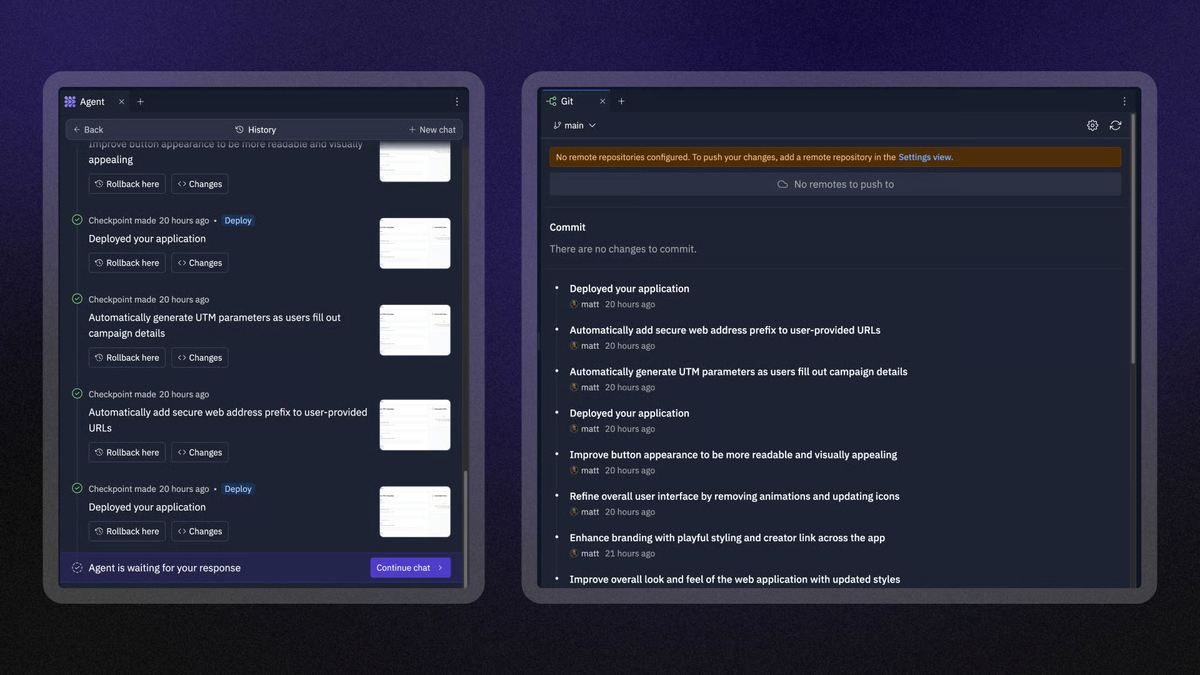
Replit's Git pane and CLI work on the same underlying repository, and GitHub connectivity supports normal branch-based collaboration. Agent checkpoints can restore project state, including connected database state at captured milestones, but Replit itself recommends ordinary Git commits for longer-term history and external collaboration. Treat a checkpoint as a recovery aid, not a replacement for the team's repository and data-backup policy.
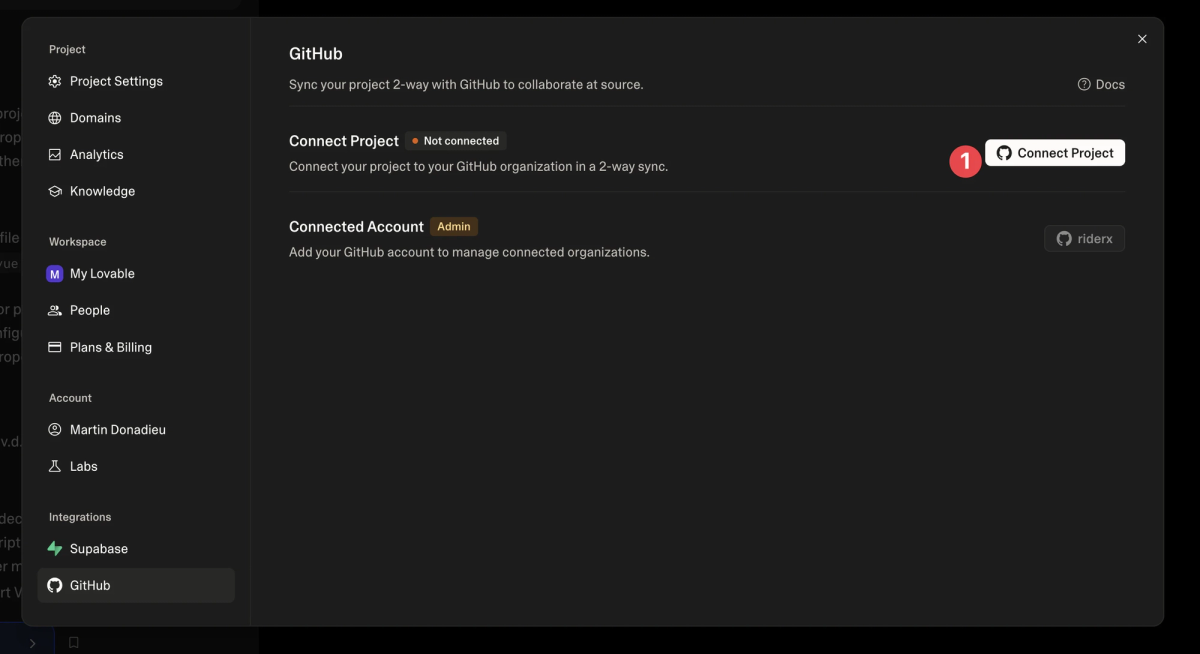
Lovable can sync changes in both directions: edits in Lovable go to GitHub, and changes pushed to the active branch return to Lovable. Its docs say it edits and syncs one branch at a time. A developer can review a feature branch and deploy outside Lovable, but should verify which branch is active before assuming a merge will appear in the editor. Code ownership does not answer whether a particular backend service, stored data, or secret can move with the same ease. Inventory those separately.
For the email change, record the credential owner, API contract, failure behavior, and per-send costs. The developer should be able to reproduce it from the repository, environment-variable inventory, and a failed-email test rather than a prompt transcript.
Maintaining the App After the Demo
Testing and Deployment Workflow
Both platforms can publish an app. Replit pairs the project editor with publishing options and Agent-assisted app testing. Lovable publishes a snapshot and provides testing guidance before release. Those features help execute checks, but they do not certify the customer portal's authorization, migration safety, or rollback procedure.
Trial one data-affecting change in a disposable portal. Capture the revision, acceptance results, deployment settings, and rollback path. If a generated test only checks rendering, add the cross-customer access assertion. The release owner must identify the live revision and explain what happens to new requests after rollback.
Replit publishes from its workspace; Lovable hosts a published app and allows deployment of synced code elsewhere. Moving code does not automatically migrate a database or hosted authentication.

Ownership and Team Handoff
The handoff risk is that nobody owns behavior outside the original chat. Pass the maintainer a repository and branch, setup steps, data schema and export path, credential owners, role rules, tests, deployment settings, and known failures. Name the release approver.
Replit's editor favors a developer who will operate the project there; GitHub still supports external review. Lovable can keep the founder involved while a developer works in GitHub. Confirm that active-branch changes sync and the published snapshot matches the reviewed revision.
Verdent can be an optional place to plan and review later repository changes after a team has a usable Git handoff. It is not evidence that either Replit or Lovable produces better apps, and it does not replace the release owner's tests.
Pricing and Usage Trade-Offs
On September 24, 2026, Replit pricing listed Starter as free, Core at $25 monthly or $20 with annual billing, and Pro at $100 monthly or $95 with annual billing. Core included $25 monthly credits and five collaborators; Pro listed $100 credits and 15 collaborators. Agent, published compute, databases, transfer, and AI calls can affect total cost.
Lovable's current pricing model uses a workspace credit balance for building, Cloud hosting, and AI features inside apps; consumption depends on the action and plan. Its free plan has a daily build grant, while paid plans add shared credits and included grants. Lovable says workspaces can have unlimited members without a per-seat charge. Do not compare one Lovable credit to one Replit dollar: they measure different things.
Estimate a billing cycle with separate rows for build iterations, hosting, app AI, external providers, and maintenance. Use usage screens after a controlled trial; a login-rule repair and a button-color edit are not interchangeable prompts.
Which Tool Fits Which Team
Choose Replit if the developer expects to edit and debug directly in the hosted workspace, use shell tools regularly, and publish from that environment. The founder can still use Agent, but the continuing owner should be comfortable with code and operating costs.
Choose Lovable if the founder expects to shape the product through chat and preview while the developer keeps an external repository as the durable handoff. Its current Git sync and code editor make that a real workflow, provided the team tests branch behavior, data portability, and release ownership before relying on them.
If both sound plausible, trial the same change in disposable projects. Reject a path that cannot show the final diff, prove access control, identify data ownership, and recover a bad release.
FAQ
Can Replit and Lovable Exclude Private Code from Model Training?
Lovable says Business and Enterprise customer prompts, code, and workspace data are excluded from its model training; Free and Pro users can turn off training in privacy settings. Its policy says that opt-out applies going forward, not retroactively. Replit's public material reviewed here did not establish a blanket, self-service training opt-out for all private Replit Agent code. Its AI Integrations rules cover a different surface: paid OpenRouter endpoints have training disabled, while free endpoints may permit training or public datasets. Ask Replit for the exact Agent and provider terms for your plan before uploading restricted code.
Do Replit and Lovable Offer Data Processing Agreements?
Yes. Replit publishes a Data Processing Agreement, and Lovable publishes a Data Processing Agreement. Check the contracting entity, plan, subprocessors, transfer terms, and whether your intended app data and development content fall under the agreement. A public DPA page is a procurement starting point, not proof that a particular customer has executed it.
Where Does Each Platform Process and Store Project Data?
Replit separates workspace geography from publishing geography; the development location and published compute, database, and storage can differ, and geographic choices depend on plan. Lovable says Lovable Cloud supports EU, US, and Asia-Pacific hosting, with customer data hosted in the selected region by default. For either platform, confirm the exact region of the editor, model provider, backups, and connected services before promising end-to-end residency.
Can Billing Usage Be Exported by Project on Each Platform?
Both expose usage views, and Lovable says its Plans & credit usage page breaks spend down by member and project. In the public pages reviewed for this article, a guaranteed project-level CSV or API export for both vendors was not established. If finance needs monthly chargeback, request a sample export or API schema from each vendor and confirm whether build, hosting, AI, and third-party charges share the same project identifier.
How Long Does Each Platform Retain a Deleted Project?
Replit's help FAQ says a deleted Replit App becomes permanently deleted and unrecoverable 30 days after its original deletion date. That describes app recovery, not every backup or legal retention obligation. Lovable's privacy policy says Customer Content is kept while an account is open and deleted or de-identified after closure or a verified deletion request, subject to legal requirements; it does not give a universal number of days for a deleted individual project. Obtain a written project-deletion and backup-retention schedule before treating deletion as a compliance control.
Conclusion
The right post-demo platform is the one on which your actual maintainer can deliver the second change safely. Put a role fix, failed integration, data-preserving release, and handoff through the same acceptance checks. Choose Replit if the integrated development workspace is where that team works best; choose Lovable if product-led iteration plus a synced repository gives the team a clearer continuing path. Keep the repository, data owner, test evidence, and release decision visible either way.