Most Tabnine evaluations stall because the buyer is asking one product question and one operating-risk question at the same time.
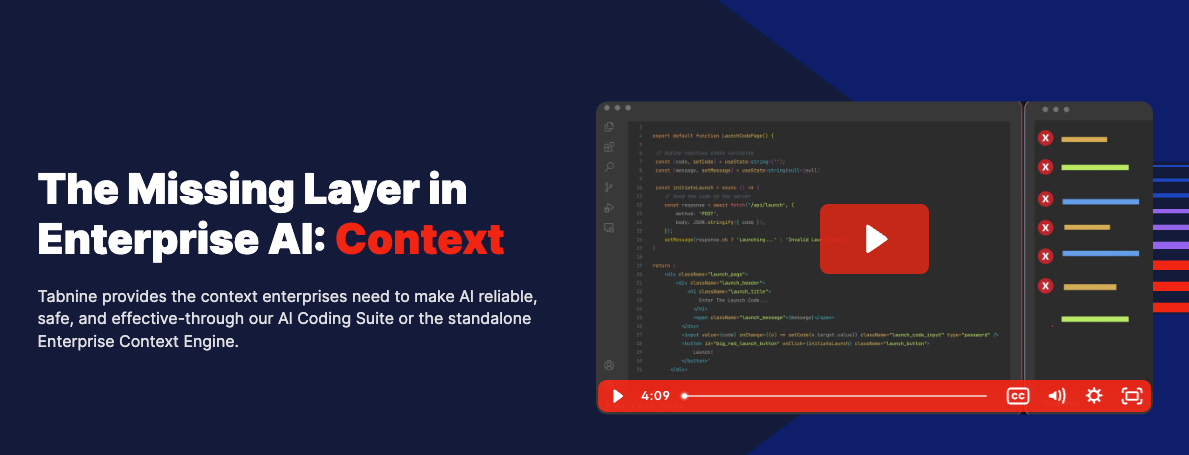
The shortlist says "AI coding assistant." Tabnine still sells a Code Assistant Platform, but it now sits beside a broader Agentic Platform with different prices, different governance surfaces, and a larger execution boundary. Only the agentic tier explicitly publishes agent and CLI capabilities that extend into CI pipelines.
That distinction, not completion quality alone, is what usually decides whether a Tabnine pilot survives security review.
Tabnine AI Coding Assistant in 2026
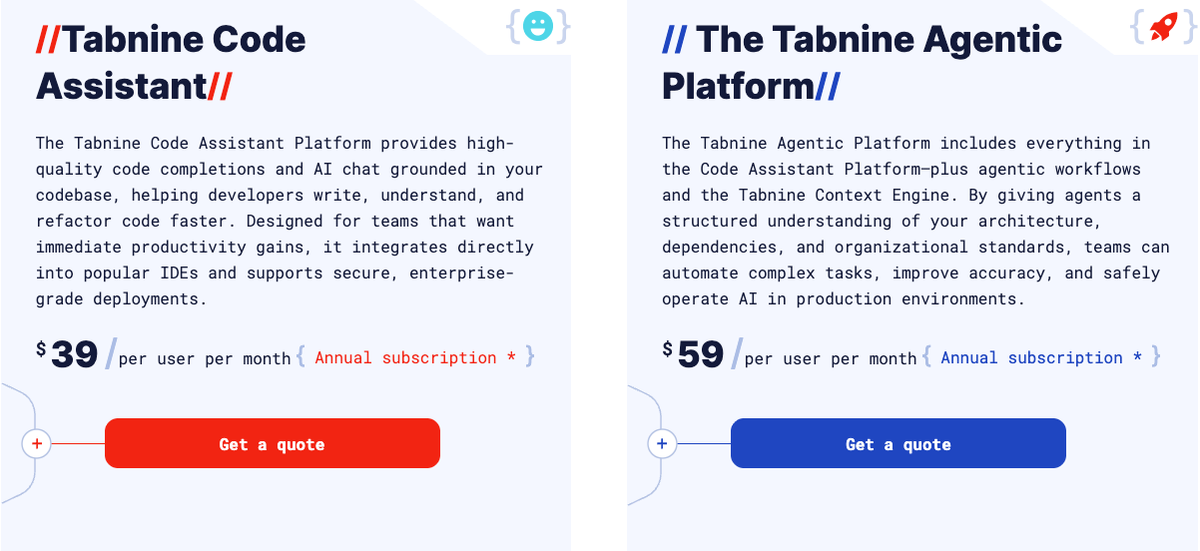
Tabnine's current main pricing page lists two paid plans: the Code Assistant Platform and the Agentic Platform, priced at $39 and $59 per user per month on annual subscriptions. The page does not publish a free or individual plan in that main lineup, so any comparison table still quoting a Basic tier or a $9 Dev seat needs a same-day source check before procurement uses it.
One more item belongs on the diligence list before features: Tabnine now states across its site that it has been acquired by Tricentis. Acquisitions do not automatically change a product. They can change the contracting entity, support path, roadmap ownership, subprocessors, and renewal conversation. Ask about those in the same call where you ask about deployment.
How This Tabnine Review Was Evaluated
Evidence from Official Product and Policy Documentation
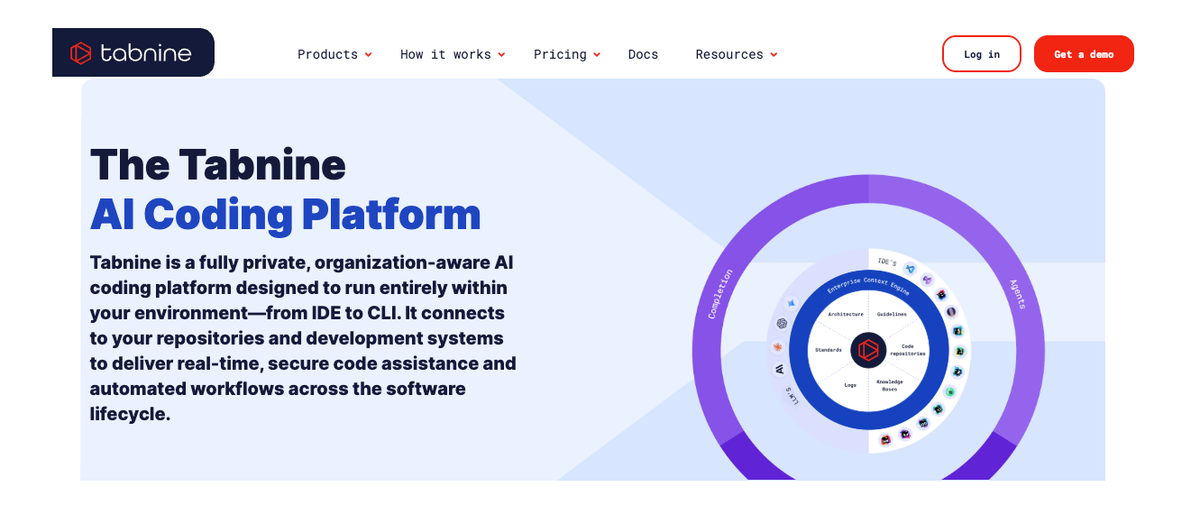
This is a documentation desk review, completed on August 17, 2026. The sources are Tabnine's own pricing page, public acquisition notice, headless-agent pricing page, Context Engine pricing page, and public documentation or search-indexed documentation snippets for IDE and CLI boundaries. Where a capability appears only as marketing language, I treat it as a claim to verify in contract, not as established behavior.
What This Desk Review Can and Cannot Establish
It can establish what Tabnine currently presents for sale, how the tiers divide, which deployment and governance controls are published, and which questions a buyer should push into a paid pilot.
It cannot establish acceptance rates, agent task success on your repositories, latency under load, or whether completions feel better than the assistant your team already uses. No first-party testing was performed here. Any number describing real-world performance would be borrowed, not verified, so vendor-reported results stay labeled as vendor-reported.
Criteria for Context, Reviewability, and Recovery
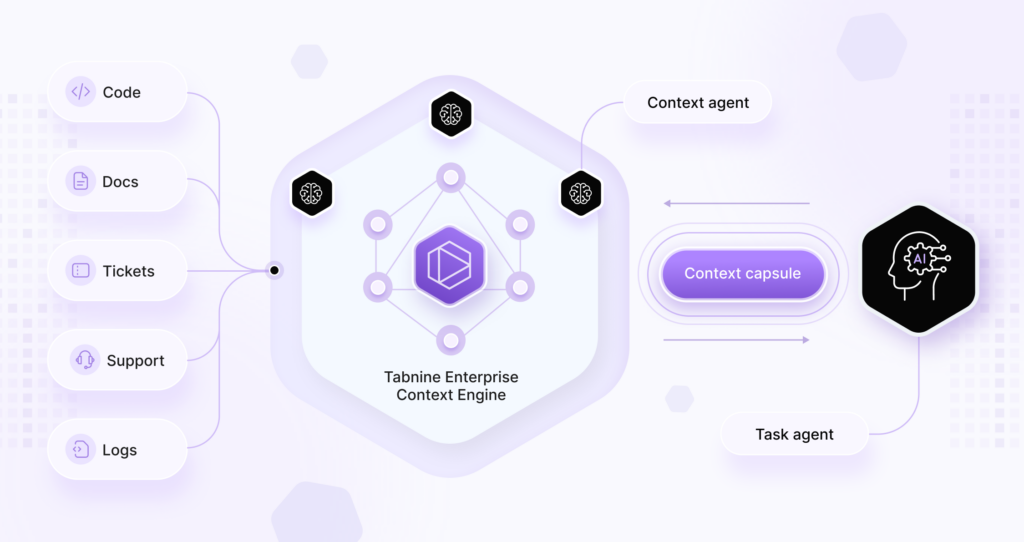
Three criteria carry the assessment, plus deployment and governance evidence:
- Context quality: what the assistant can see, which systems ground its answers, and who authorizes each connection.
- Reviewability: whether a reviewer can reconstruct what the tool did, per user and per team, after the fact.
- Recovery: what stops an agent mid-task, and what the rollback path looks like when it has already touched a branch or a pipeline.
Anything that cannot be checked against documentation or contract stays in the pilot column.
Code Assistant and Agentic Platform Differences
Completions, Chat, and Codebase Context
The lower tier is the familiar shape of an AI-powered coding assistant: single-line and multi-line completions, in-IDE chat across SDLC steps, and model choice spanning Anthropic, OpenAI, Google, Meta, Mistral, and other providers. Jira Cloud and Data Center integration can feed responses.
What matters more for an enterprise buyer is what ships alongside completions: usage metrics per user and team, LLM access control by user and team, code generation provenance, and auditability of usage. That is the reviewability criterion, and it is present at the entry tier rather than gated behind the agentic one.
Terminal and Agentic Workflows
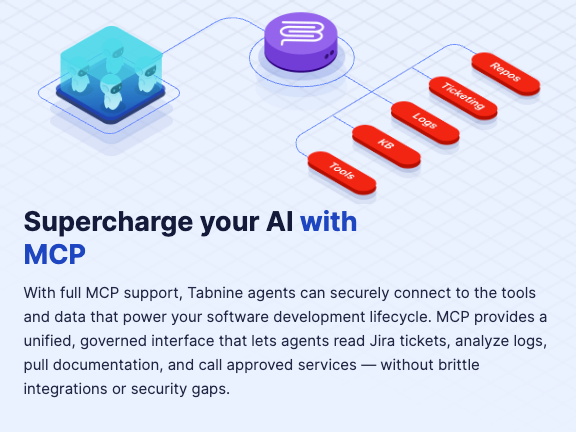
The Agentic Platform adds autonomous agents with optional user-in-the-loop oversight, organizational Coaching Guidelines, and tool access through the Model Context Protocol. Tabnine's published MCP categories include code tools such as Git operations, testing frameworks, and linters; external services such as Jira, Confluence, databases, and APIs; and development tools such as Docker, package managers, and CI/CD systems.
It also adds the Tabnine CLI for terminal, remote session, and pipeline execution, plus the Context Engine with unlimited codebase connections for Bitbucket, GitHub, GitLab, and Perforce P4.
Read that list as scope of action, not as a simple feature upgrade. The $20 delta buys an execution surface that reaches your pipelines, plus MCP governance controls and per-team spending thresholds that make the surface supervisable. Teams that are not ready to own that supervision are buying capability they will have to disable.
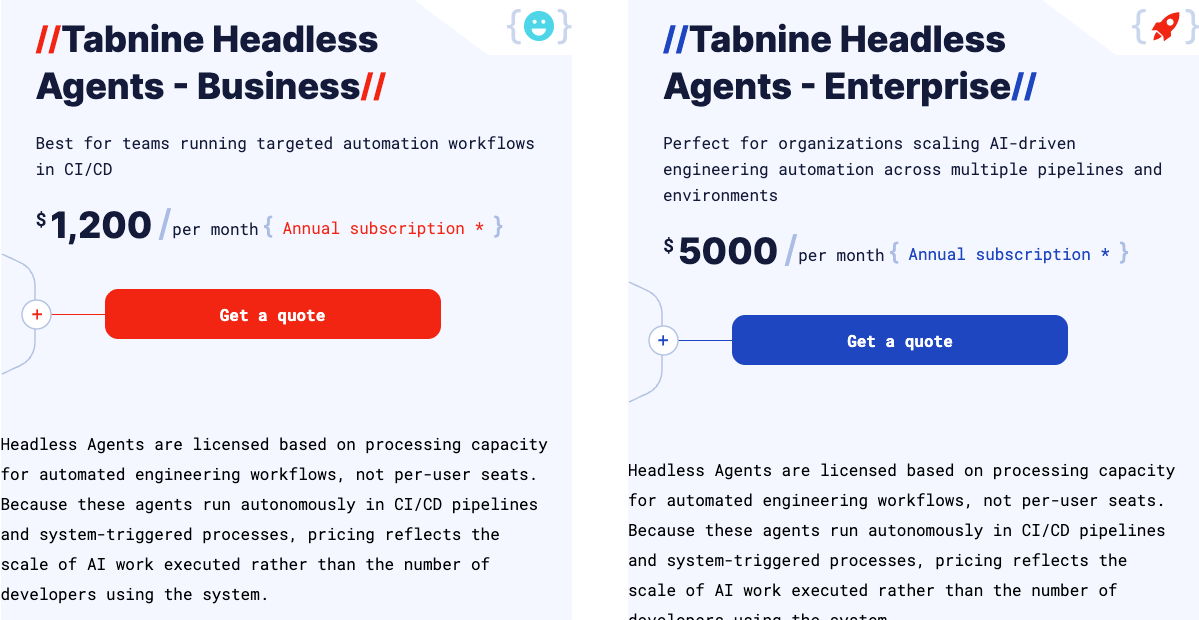
Headless agents for CI/CD run as a separately priced add-on, which is a useful signal. Tabnine's headless-agent pricing is based on processing-capacity tiers for automated engineering workflows, not per-user seats. The vendor treats unattended execution as a distinct commercial and operational decision. So should you.
Deployment, Privacy, and Governance Options
Both plans list the same deployment matrix: SaaS, VPC, on-premises, or fully air-gapped. The pricing page also states zero code retention, no training on customer code, end-to-end encryption and TLS, SSO for private deployments, and compliance coverage stated as GDPR, SOC 2, and ISO 27001.
Two cautions before that paragraph enters a security memo. First, IP indemnification is published as subject to terms and conditions, so the scope your legal team gets is whatever the contract says, not what the page implies. Second, self-hosted and especially air-gapped deployments can add model, infrastructure, and update-management costs. Confirm GPU, model-hosting, provider-routing, and upgrade responsibilities for the proposed deployment rather than assuming the seat price contains them.
The governance controls worth naming in an RFP are the ones tied to blast radius: permission and scope management, MCP governance controls on the agentic tier, per-user and per-team LLM access control, spending thresholds, and provenance on generated code. Those map cleanly onto reviewability and recovery. What documentation cannot tell you is how noisy the analytics are at your headcount. That is a pilot question.
Developer Workflow and IDE Fit
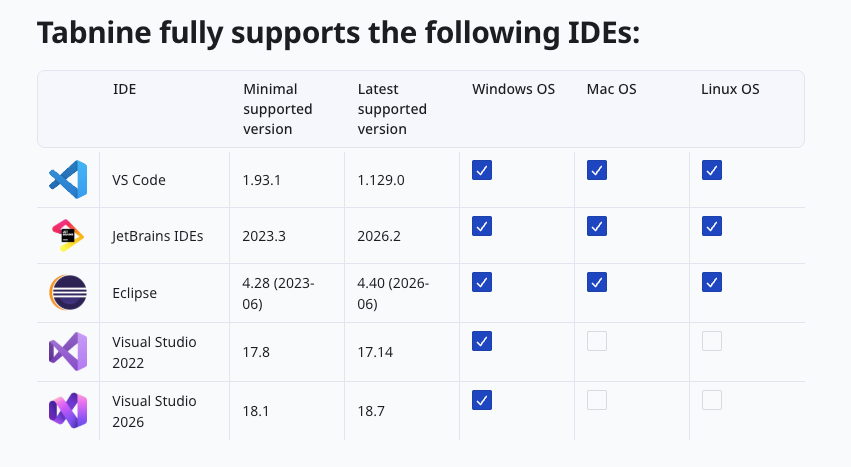
Tabnine's supported-IDE documentation is the page to check before a pilot if your organization pins editor versions. The current matrix names VS Code, JetBrains IDEs, Eclipse, Visual Studio 2022, and Visual Studio 2026, each with minimum and latest supported versions. Instead of copying those numbers into a static scorecard, treat the matrix as a release-gate artifact and recheck it on the day you size seats.
The main risk is not whether Tabnine supports one popular editor. It is uneven experience across a real engineering organization. A JetBrains-heavy team, a Visual Studio Windows group, a VS Code platform team, and developers working in community or legacy editors may not get the same surface area.
CLI support changes that question again. The pricing page says the Tabnine CLI runs in local environments, remote sessions, and CI pipelines, while the CLI documentation describes non-interactive and pipeline use cases. That is useful for automation, but it also moves the review conversation from "Can developers use this in their editor?" to "Which identity is allowed to run this against our repositories, diffs, and pipelines?"
Frozen IDE baselines deserve one more check. Regulated environments that pin editor versions for months should confirm the pinned version sits inside the supported range in both directions: not too old for the plugin and not too new for a private deployment that updates slowly.
Pricing Structure and Cost Variables
Seat price is the smallest part of this model. The pricing page footnote is the line to bring to finance: usage is unlimited when you run your own LLM on-premises or point at your own cloud endpoint, while Tabnine-provided model access is billed as a reserved token consumption quota at actual provider prices plus a 5% handling fee.
That produces three different cost shapes from the same seat count:
| Cost shape | What finance should model |
|---|---|
| Bring your own model | Seats plus your existing provider contract, without a Tabnine resale margin, but with your own routing and capacity decisions |
| Tabnine-provided model access | Seats plus token quota plus 5%, simpler to start, with variable cost growing as agent adoption grows |
| Self-hosted or air-gapped | Seats plus whatever infrastructure, model-hosting, and update-management responsibilities the final deployment assigns to your team |
Headless agents are the clean add-on to model separately. The Context Engine needs more careful wording: it is included with Agentic subscriptions on the main pricing page, while Tabnine also offers the Enterprise Context Engine separately on a custom-quote basis for agent-agnostic organizational intelligence.
Build the model per team rather than per organization. Agentic seats concentrated in a platform team behave nothing like agentic seats spread across product squads.
Who Tabnine Fits and Who It Does Not
Tabnine fits organizations whose constraint is where code is allowed to run: regulated industries needing VPC, on-premises, or air-gapped deployment; mixed enterprise IDE estates that want one governed assistant across several major editors; and teams with existing model contracts who want to avoid paying a second margin on inference.
It is weaker for buyers who need a published individual or small-team plan from the current main pricing page. Tabnine may still have legacy, sign-up, or segment-specific paths elsewhere in its ecosystem, but the public page used for enterprise pricing does not present that as the main buying motion. Confirm current availability directly before writing "no individual option" into a procurement memo.
It also does not fit editor stacks outside the supported matrix, or teams that want the agentic tier without the operating capacity to govern MCP tools, CI execution, headless agents, and rollback. That capability becomes risk the moment nobody owns it.
If your actual need is parallel multi-agent project delivery rather than a governed enterprise assistant platform, that is a different product category. Verdent sits in that category: it is designed around goal breakdown, parallel work, testing, and returning for key decisions rather than selling a single governed enterprise assistant layer. Naming the category difference early keeps the shortlist honest; comparing across it produces a scorecard nobody can act on.
FAQ
Who should approve access for contractors?
The manager who owns the repository scope, jointly with whoever owns the vendor contract. Contractors should be provisioned as identifiable named users under your SSO, never through shared credentials, and with an end date that matches the statement of work rather than the subscription term.
How should teams offboard users from shared AI workflows?
Treat offboarding as three revocations, not one: the seat, the identity's repository and tool connections, and any agent or automation running under that person's authorization. Run a check afterward for scheduled or pipeline-triggered runs that still reference the departed user, since those fail quietly rather than loudly.
What rollback plan belongs in an IDE migration?
Pin the previous plugin version and keep it installable, document the settings you changed centrally, and keep the prior assistant licensed through at least one full sprint after cutover. Define the trigger in advance: a specific failure rate, a broken debugger, a compliance objection, or a measurable drop in accepted review flow. Rolling back should be a decision, not an argument.
Which records should procurement keep after a pilot?
Keep the evaluation criteria as written before the pilot, the raw results including failures, the deployment mode tested, the model configuration used, the exact quote with effective dates, and the security review findings with their resolutions. The negotiating value at renewal comes from the failures you documented, not the summary slide.
When should a team rerun its privacy assessment?
At renewal, and whenever four things change: deployment mode, model provider or routing, the set of connected systems, or the vendor's corporate structure and subprocessors. Any one of those can move data across a boundary your last assessment assumed was fixed.
Related Reading
- If the harder problem is organizational rather than technical, start with who owns an agentic workflow once it is running across teams.
- Before agents touch your pull requests, decide how automated review stays queue triage instead of an approval bot.
- When a vendor cites benchmark results, it helps to know what a benchmark like SWE-bench Pro can and cannot tell you about your repository.
- For pilots that need a repeatable scoring method, use a harness evaluation checklist that records scope, inputs, failures, and acceptance criteria.
- If the IDE question is the blocker, compare how agent-first editor surfaces differ in day-to-day control.