What is Muse Code?
Muse Code is Meta's terminal coding agent, released in beta on August 5, 2026 by Meta Superintelligence Labs. Powered by the Muse Spark 1.2 model, it plans changes, writes code, and validates results across large repositories, coordinating persistent background sub-agents throughout a session.
It is Meta Superintelligence Labs' first coding-specific product — the unit Alexandr Wang leads as Meta's chief AI officer — and lands directly opposite Claude Code and Codex. One distinction worth holding onto: Muse Code is the agent and runtime; Muse Spark 1.2 is the model that powers it. Two days in, the claims outnumber the evidence. If you want to see which is which, a third-party site has assembled the launch claims and sources side by side; it states that it is not affiliated with Meta.
Core features
Terminal agent & one-command install
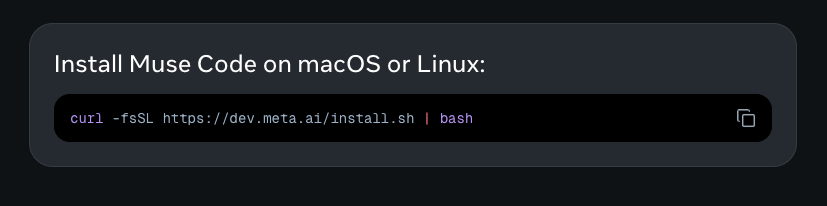
Muse Code runs in the terminal, installed via a single shell command on macOS or Linux. The framing is deliberate: it takes on complete engineering tasks — planning, implementing, validating — rather than generating snippets, and leans on async background agents to do it. It ships with bundled skills: /plan produces an approval-gated plan, /grill stress-tests that plan until it holds, and /goal drives toward a stated objective.
Parallel sub-agents & isolated git worktrees
Muse Code coordinates multiple sub-agents per task, and the interesting part is where the writes land: a fan-out mode puts write-capable child agents in isolated git worktrees, git's native mechanism for separate per-branch directories. That's what keeps parallel agents off each other's files.

Async background agents (session-level, always-on)
The runtime pairs a main agent loop with async background agents that stay active for the whole session rather than spawning per subtask. Meta says this avoids redundant context-gathering: the agents take next steps and decide when to report back, cutting latency and steering on multi-step work.
Pricing & the Contributor Tier
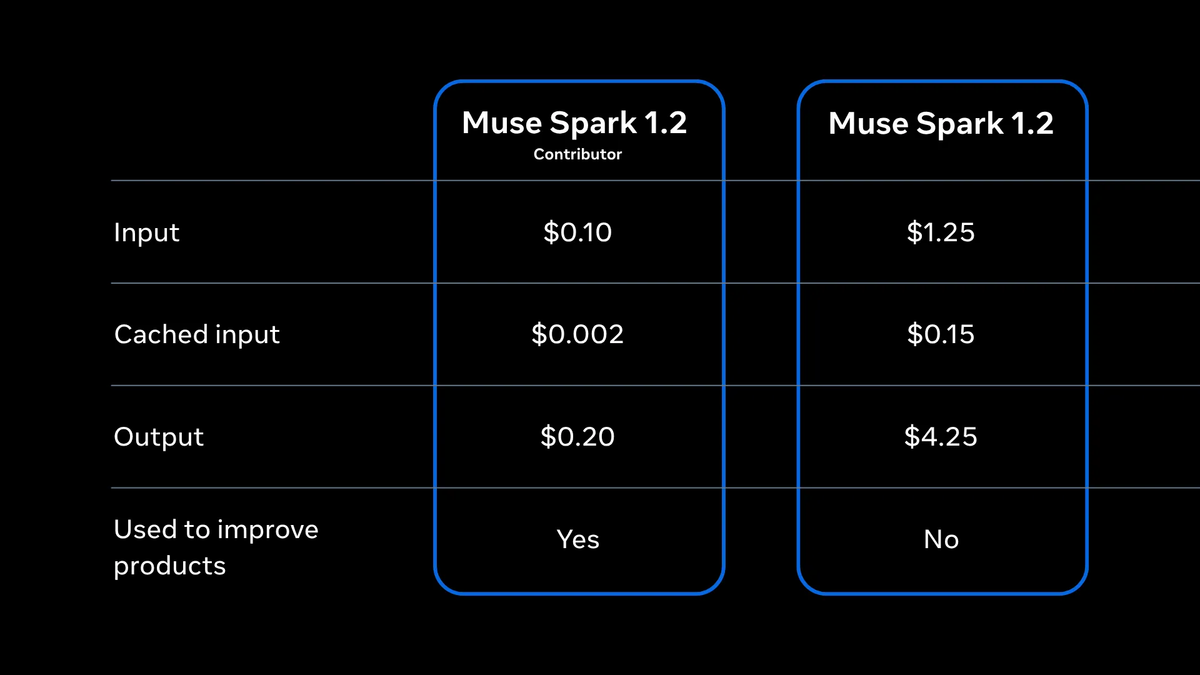
There are two paths to the model, and they differ on more than price. The figures below were checked on August 6, 2026; Muse Spark 1.2 rates move, so re-check before you budget against them.
| Standard (pay-as-you-go) | Contributor Tier | |
|---|---|---|
| Model ID | muse-spark-1.2 | muse-spark-1.2-contributor |
| Input | $1.25 / M tokens | Discounted |
| Output | $4.25 / M tokens | Discounted |
| Cached input | $0.15 / M tokens | — |
| Limits | Pay-as-you-go | Token rate limit, rolling 5-hour window |
| Availability | Broad | Select countries only |
| Your data | Not used for product improvement | May be used to improve Meta products |
Reasoning tokens are billed as output. The tradeoff is explicit: the Contributor Tier trades data for cost. Early user reports indicate Muse Code defaults to the Contributor Tier after install, meaning you must actively switch to Standard to opt out of data-for-training — confirm your tier setting before pointing it at proprietary code.
Runtime design: event log & crash recovery
Muse Code appends every model call, tool run, approval, and edit to a local event log. Meta describes this as making the runtime replay-exact and restart-safe: after a crash, a session resumes precisely where it stopped. For long-horizon work — Meta's case study ran 1,000+ tool calls across up to 24 hours — that recovery path keeps a failure from discarding a day of progress. No independent stress-test has been published.
The Muse Spark 1.2 model
Muse Spark 1.2 is a coding-focused update to 1.1, with Meta reporting gains in code generation, debugging, codebase understanding, and end-to-end workflows. Three training choices stand out: co-training with Muse Code (harness trajectories, recipe optimization for goals, compaction, sub-agents), long-horizon training including whole-repository generation, and a self-improvement loop where Muse Spark 1.1 generated and graded training environments.
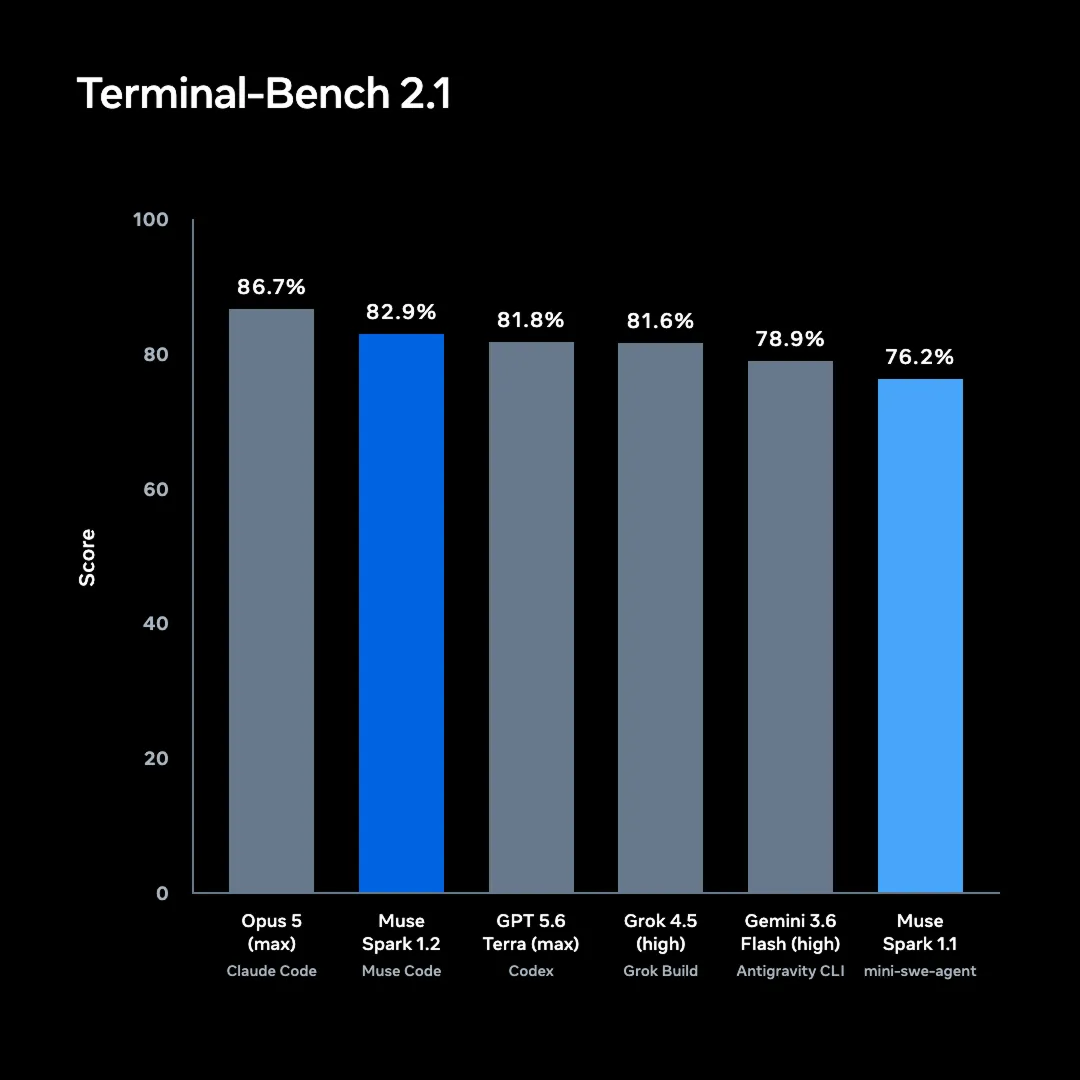
Meta's charts cover Terminal-Bench 2.1, DeepSWE 1.1, and an internal coding benchmark. Read them as vendor-reported — Meta's evaluation under Meta's harness, which Meta notes may not be tuned for third-party models. Notably, those charts show Claude Opus 5 leading all three coding benchmarks; Meta published that as-is.
Installation & system support
Installation is a one-line shell command on macOS and Linux. It pipes a remote script into your shell, so read the script and the current auth terms on the Muse Code beta page before running it, and start in a repository you don't mind breaking. Windows users report running it via WSL2 — not officially documented, so treat it as unsupported until Meta says otherwise. Meta has not published a context-window figure in its research announcement.
Muse Code vs Claude Code / Codex
All three are terminal agents targeting long-horizon repository work, so this is about approach, not a winner. Muse Code's distinguishing bets: always-on background agents, an append-only event log for exact crash recovery, and aggressive pricing with a data-sharing tier. Claude Code and Codex are more mature, with longer track records and larger ecosystems — and by Meta's own charts, Claude Opus 5 currently leads on coding. Muse Code is a beta from a first-time entrant — worth testing, not yet worth standardizing on. If you're weighing terminal agents, it's also worth knowing how third-party clients wrap Claude Code and Codex, since the harness around a model matters as much as the model.
FAQ
Is Muse Code free? How much does it cost?
Muse Code itself is a free download, but the model is metered. Standard pay-as-you-go pricing was listed at $1.25 per million input tokens and $4.25 per million output tokens as of August 6, 2026, with cached input at $0.15. Reasoning tokens bill as output.
What is the Contributor Tier? Will Meta train on my code?
The Contributor Tier (muse-spark-1.2-contributor) offers discounted access in exchange for data: Meta says the data may be used to improve Meta products. It's rate-limited on a rolling five-hour window and available in select countries only. Check your tier before using proprietary code.
Is it available now? Which systems are supported?
Yes — Meta released the early beta on August 5, 2026, with expanded global access. Officially supported platforms are macOS and Linux via a one-line installer. Native Windows support is not documented; WSL2 reports from users are unofficial.
What model does it use? What's special about Muse Spark 1.2?
Muse Spark 1.2, a coding-focused update to 1.1. Meta co-trained it directly with the Muse Code harness and trained it on long-horizon tasks like whole-repository generation, so model and agent were tuned together rather than paired after the fact.
How is it different from Claude Code / Codex?
Its distinctive design choices are session-persistent background agents, an append-only event log enabling exact crash recovery, and a discounted data-sharing tier. Claude Code and Codex are more established. Meta's own charts show Claude Opus 5 ahead on all three coding benchmarks it published.
Can it run multiple agents in parallel? Will they conflict?
Yes. Meta documents a fan-out mode where write-capable sub-agents run in isolated git worktrees, which is the standard git mechanism for keeping parallel branches in separate directories. That isolation is what prevents mid-run file collisions between agents.
Can it recover after a crash?
Meta says yes: the local append-only event log records every call, tool run, approval, and edit, making sessions replay-exact and restart-safe so a run resumes at its last recorded step. This has not been independently stress-tested — verify it on a low-stakes task first.
Conclusion
Muse Code is a credible first entry from Meta Superintelligence Labs: co-trained model and harness, persistent sub-agents in isolated worktrees, and a crash-safe event log built for long-horizon repository work. It's also a beta, its benchmark evidence is vendor-reported, and its cheapest tier costs you data. Test it on a non-critical repository, confirm your tier before it touches proprietary code, and re-check pricing and availability — this is a two-day-old product.
Related Reading