Every few weeks another frontier model lands, and the same question comes back to my desk: do I re-point the agent pipeline at it, or leave it alone? I put this Qwen3.8 review together to answer that before committing a team to anything — and to be clear up front, it is documentation work, not a benchmark run. For anyone running parallel agents across isolated worktrees, a model swap is never just a model swap. It touches your context budget, your cache strategy, and every client that speaks to the endpoint.
Alibaba previewed Qwen3.8-Max on July 19, 2026 at the World AI Conference in Shanghai with a headline parameter count and no benchmark table, shipped general availability on August 3, and released open weights in two pieces over the following fortnight. Below is what the documentation actually commits to, what is still a vendor claim, and the two places where Alibaba's own pages contradict each other.
Qwen3.8 Max Preview at a Glance
If you evaluated the July preview, you are no longer calling what you tested. qwen3.8-max-preview shipped through the Token Plan subscription; QwenCloud now states the preview period has ended, and the old ID routes to the production model while recommending migration. Worth checking your config files before you trust an old benchmark note.
The current release:
- Architecture: sparse Mixture-of-Experts, 2.4 trillion total parameters, roughly 95 billion active per token — the active count was withheld at preview and published at GA.
- Context: a 1,000,000-token window — 991,808 maximum input tokens without thinking, 983,616 with it, 131,072 maximum output.
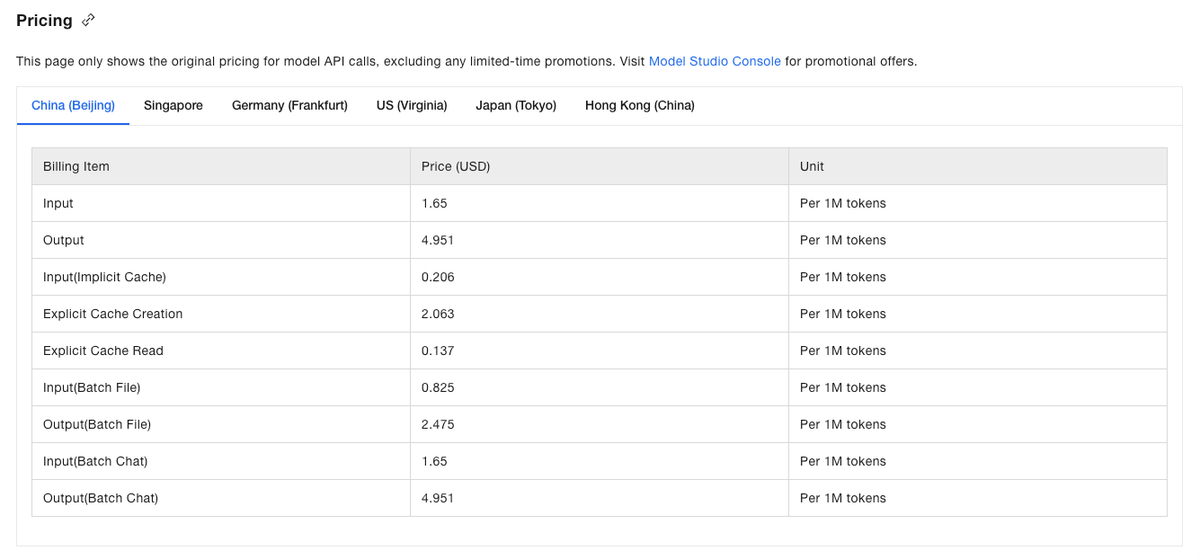
- Pricing (Singapore / QwenCloud): $2.00 per million input tokens, $6.00 output. Other regions differ, and the gap is not trivial — Beijing, Tokyo, Frankfurt, Virginia, and Hong Kong currently sit at $1.65 and $4.951 on the Model Studio model-info page. Within any one region the rate holds flat as the prompt grows.
- Inputs: text, image, and video, returning text.
- Interfaces: OpenAI-compatible Chat Completions and Responses, an Anthropic-compatible Messages surface, and DashScope.
- Open weights:
Qwen3.8-2.4T-A95Bunder a custom Qwen3.8-Max license,Qwen3.8-27Bunder Apache 2.0 as of August 14.
The vendor pages and model cards I read on August 24 do state top-level modality support, but give no model-specific knowledge cutoff and no detailed training-data description. Plan around that gap rather than waiting for it to close.
What Changes for Coding Agents
Tool Use and Long-Horizon Tasks
The documented agent surface covers function calling, structured output, prefix completion, context caching, and built-in tools. Two items need interface-level precision rather than a flat capability list, and both will bite you in code review if you skip them.
Reasoning effort is not portable between endpoints. On the OpenAI Chat interface, Qwen3.8-Max exposes low, medium, and xhigh, defaults to xhigh, and folds OpenAI's standard values onto that scale — high and max collapse to xhigh, minimal to low, none disables thinking. The Responses API exposes seven tiers: none, minimal, low, medium, high, xhigh, max. If you have agents on both surfaces, your effort configuration does not carry across, and the failure is silent.
Batch inference is documented inconsistently. The model-info page marks Batch Inference unsupported in every listed region, while Alibaba's rate-limiting page references Batch API calls under the Beijing qwen3.8-max entry. Two first-party sources disagreeing is a reason to verify against your own account before you design a batch path, not a reason to pick the answer you prefer.
Down at the request level, the detail worth designing around is reasoning preservation — and it is also interface-dependent. Under Chat Completions with preserved thinking, the client returns the complete, unmodified reasoning_content history, and that replayed reasoning bills as input. The Responses API works the other way: responses can be stored server-side, and previous_response_id or a conversation object makes the server retrieve and reassemble prior turns for you. Where conversation state lives is a decision you make at the interface, not a property of the model. In a team setting I would pin that decision early and write it down, because migrating an agent from one interface to the other later requires client-integration changes rather than just swapping a model ID.
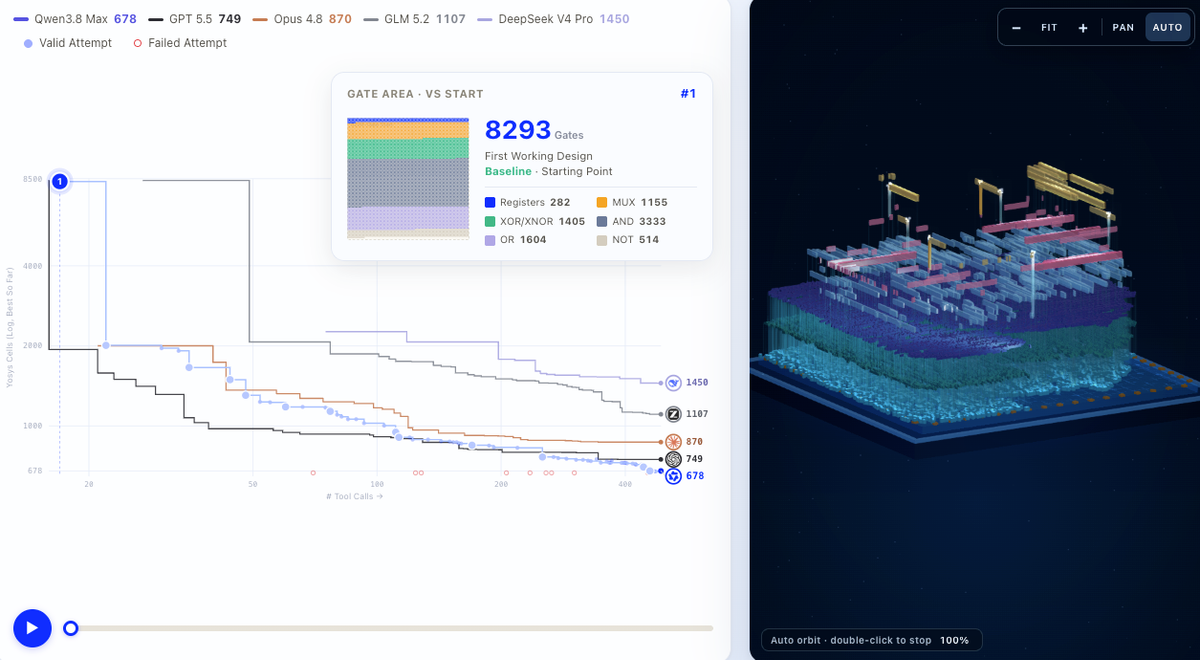
Alibaba's launch report describes an autonomous coding run of roughly 16 days producing 265 commits, 127 pull requests, and 151 issues without human intervention. One vendor-reported case, no published methodology, no acceptance criteria. Read it as a statement of intended operating envelope, not a number you can plan a sprint around.
Context Handling for Repository Work
The flat regional tier is the most concrete change to agent economics. Some competing frontier APIs apply long-context surcharges — Gemini's published pricing steps up above 200K tokens — so a rate that holds from 5K to 900K removes a planning variable from any workflow that pulls a whole repository into context.
Caching compounds that, but three modes are easy to conflate and the context cache documentation separates them clearly. Minimum cacheable content differs by mode: implicit caching starts at 256 tokens, explicit and session both need 1,024. So do the rates — in Singapore, implicit reads are $0.25 per million and explicit reads $0.17 against $2.00 uncached; other regions list $0.206 and $0.137. For an agent replaying a large system prompt and tool schemas across hundreds of turns, the warm-cache rate is what actually lands on the invoice, and an implicit-cacheable shared prefix shorter than 256 tokens will not be cached.
Budget the offsets. Thinking costs roughly 8K tokens of input headroom against the non-thinking ceiling, and under Chat Completions preserved reasoning accumulates as billable input across a long task. Neither is large on its own; together, across a multi-day agent run, they are not noise.
Where It Fits Real Engineering Work
Repository Analysis and Code Changes
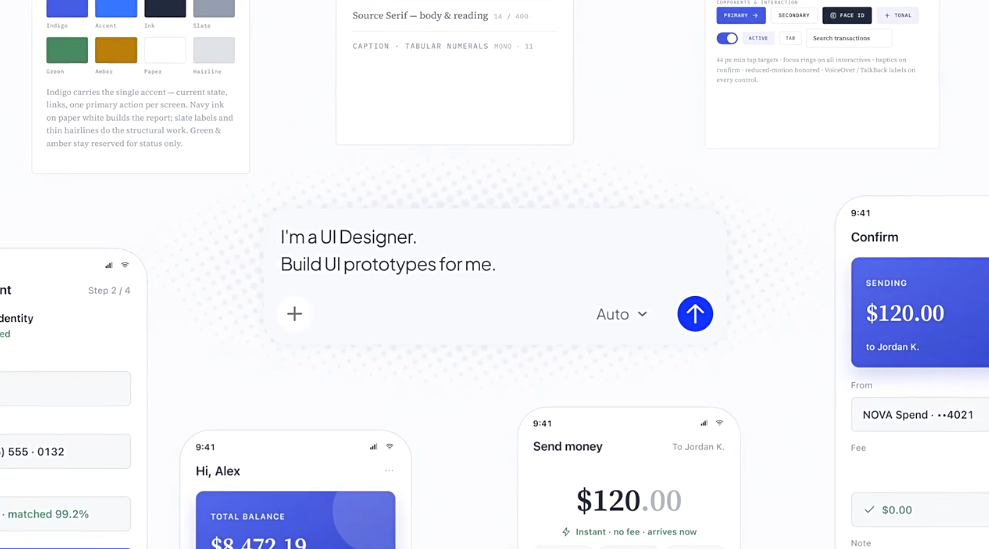
A window near a million tokens suits whole-repository reads, cross-file refactors, and migration passes that would otherwise need retrieval scaffolding. Native image input means design mocks, failing-test screenshots, and architecture diagrams enter the same request as source — useful if your agent loop currently drops visual context at the boundary.
Two constraints bound that. The 131,072-token output ceiling caps how much of a large refactor lands in one response, so chunking and patch orchestration stay your problem. And the 1M window and vision are properties of the hosted service, not the model family: the downloadable 2.4T checkpoint is text-generation only with 262,144 native context, and Qwen's own card notes the hosted version adds vision, default 1M context, and built-in tools on top. Self-hosting is not a like-for-like swap. If you need multimodal capability on infrastructure you control, the Apache 2.0 Qwen3.8-27B release is the one to look at — vision encoder included, same 262,144 native context, documented YaRN extension path.
Cloud Workflow Choices
Access splits across QwenCloud pay-as-you-go, Model Studio regional endpoints, the Token Plan subscription, and third-party gateways. Get the protocol right before you get the model right: the Anthropic-compatible Messages surface serves Anthropic-style clients, but current Codex builds need the OpenAI-compatible Responses interface with wire_api = "responses" — pointing Codex at the chat wire protocol is a documented failure mode, not a theoretical one. I have watched teams lose an afternoon to exactly this class of misconfiguration.
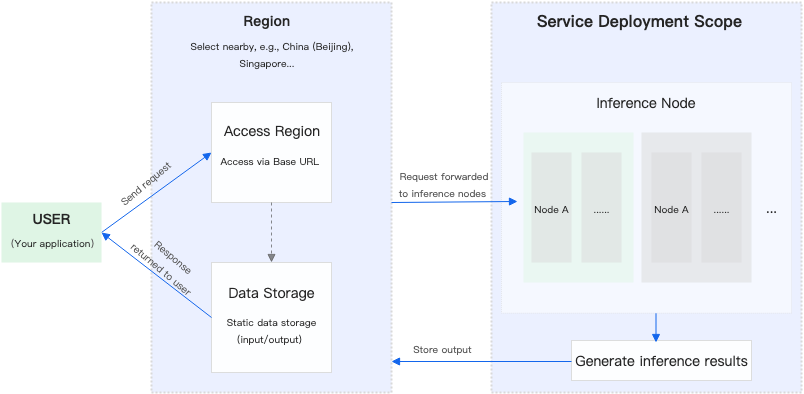
Region is both a compliance and a latency decision, and Alibaba is explicit about it — the region guide ties region to access point and data storage location, then recommends choosing a nearby one to reduce latency. Deployment scopes span Chinese mainland, international, US, EU, and Japan, each with different data-location and cross-border constraints. One boundary worth flagging to whoever handles your procurement: the contracting entity is determined by the applicable account terms, including residence and/or the billing address recorded at registration, rather than the endpoint you happen to call. Do not infer your legal posture from a base URL.
Risks Before Adoption
Preview Stability and Model Drift
The verifiable timeline is compressed: preview July 19, GA August 3 with weights promised the following week, the 2.4T open checkpoint documented around August 13, Qwen3.8-27B on August 14. Roughly four weeks from first public build to a settled lineup.
That pace has a practical consequence. Unless you pin to a dated snapshot alias where one exists, behaviour can shift beneath a stable model ID — and an agent that was passing your evals last Tuesday is not guaranteed to pass them today. Pin the alias, log request and response pairs, keep a regression suite you re-run before accepting any silent update. Preview-era promotional pricing has expired, so budget from your own region's current rate rather than the figure that circulated in July coverage.
Claims That Still Need Independent Testing
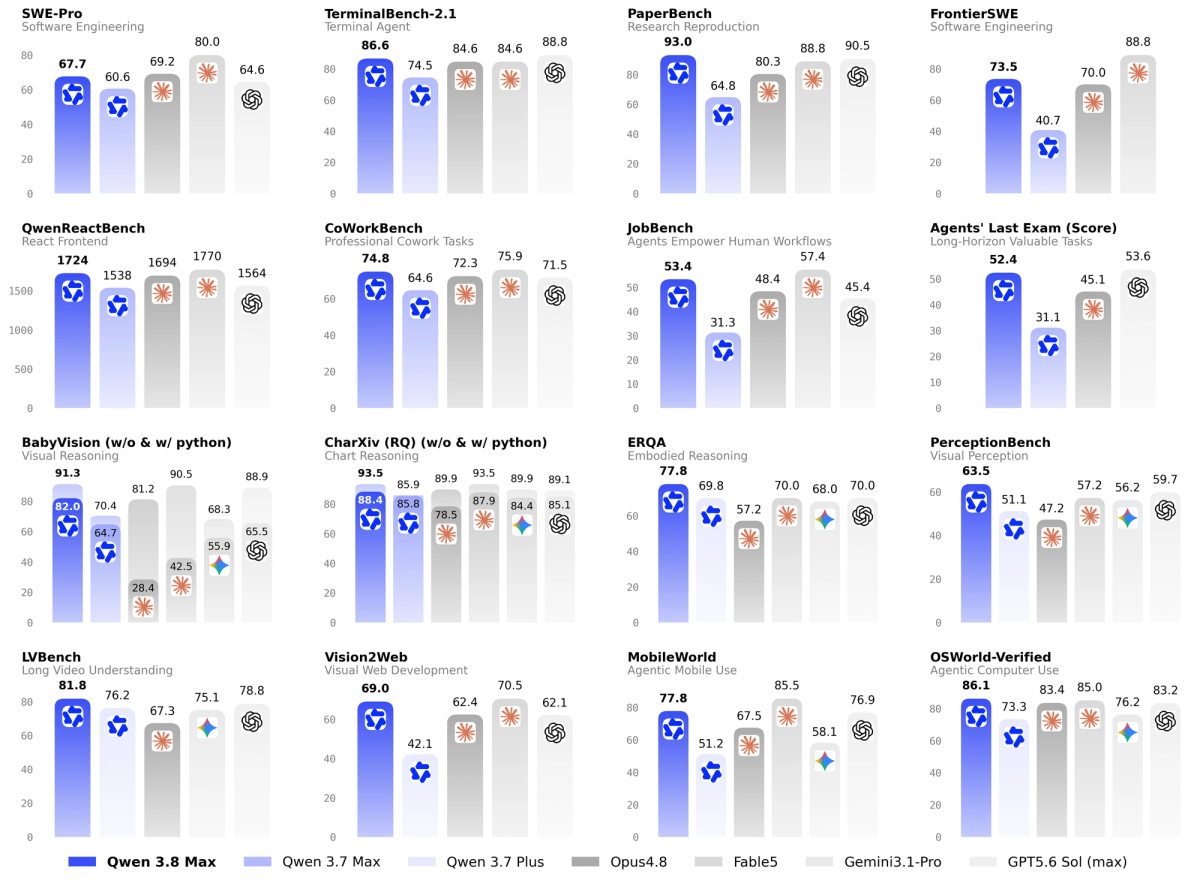
The launch benchmark figures below are Alibaba-reported. Qwen's model card shows large generational jumps: DeepSWE 1.1 from 21.6 to 56.6, FrontierSWE from 40.7 to 73.5, JobBench from 31.3 to 53.4.
Independent measurement does exist alongside those numbers — Artificial Analysis runs its own suite against Qwen3.8-Max and publishes separate intelligence, output-speed, and cost figures. That is a different thing from reproducing Alibaba's specific rows, and the distinction matters when you are deciding how much weight a launch table deserves.
One structural caveat to carry into your own reading: the multimodal comparison benchmarks against Qwen3.7-Plus rather than the mainline Qwen3.7-Max, so readers should note that the table uses a different predecessor baseline.
As of August 24 I did not find an independent reproduction of the DeepSWE, FrontierSWE, or JobBench figures specifically. Treat them as directional, weigh the independent evaluations separately, and run the model against your own repositories before an agent pipeline depends on it. If you only do one thing this week, point it at your three ugliest open pull requests and see what comes back.
Frequently Asked Questions
Can Qwen3.8 preserve reasoning across separate sessions?
It depends on the interface. Under Chat Completions, yes if your application persists and replays the full unmodified reasoning_content; the endpoint does not provide server-side persistence for you, and the replayed reasoning is billed as input.Under the Responses API, yes in a meaningful sense: responses can be stored server-side, and previous_response_id or a conversation object makes the server retrieve and reassemble prior turns. Choose the interface that matches how you want to hold state; switching later means rewriting the client.
Can Qwen3.8 Max Preview return token-usage metadata for each request?
The preview ID now routes to production, so this is really a question about qwen3.8-max. It is served through OpenAI- and Anthropic-compatible endpoints carrying standard per-request usage reporting, and cached versus uncached input is metered separately. Field naming for cache-hit counts differs by endpoint, cache mode, and gateway — confirm the exact shape against QwenCloud's reference for the interface you call rather than assuming parity with another vendor.
Can teams route fallback requests to Qwen3.7 Plus?
Yes. qwen3.7-plus remains a listed QwenCloud model with context-cache support, so it is a valid fallback target. It sits below Qwen3.7-Max in the previous generation, making this a capability step down rather than a lateral move — size your degraded-mode expectations accordingly. Worth noting that Alibaba's own multimodal comparison uses this same model as its baseline.
Can Qwen3.8 Max Preview process images alongside code?
The hosted model accepts text, image, and video in the same request as source code. The open-weight 2.4T checkpoint does not — it is text-generation only, with vision available on the hosted service. Qwen3.8-27B keeps a vision encoder if you need multimodal input on your own infrastructure.
Can Qwen3.8 return structured patch outputs?
There is no dedicated patch format, but response_format with a JSON schema is documented for qwen3.8-max alongside function and tool calling. You define the patch envelope — file path, hunk, rationale — as a schema and validate against it. Schema conformance is not a substitute for applying the patch and running your tests; a well-formed diff that breaks the build is still a broken build.
Related Reading
- GLM-5.2 for coding agents — the closest peer release to weigh Qwen3.8 against before committing to one flagship.
- What SWE-bench Pro actually measures — context for reading the coding benchmark numbers above critically.
- A harness evaluation checklist — a repeatable way to run the on-your-own-repositories test this review recommends.
- Choosing a coding harness for a frontier model — how harness choice interacts with context limits and caching behaviour.
- Rolling out agentic workflows across a software team — what changes after the model decision is made.
Specifications, pricing, and regional rates verified against Alibaba Cloud Model Studio and QwenCloud documentation on August 24, 2026. Launch benchmark figures are Alibaba-reported. Confirm current values for your own region and account before committing to a production workflow.