Qodo AI code review is a pull request review and governance layer that uses repository context, review history, and team rules to prioritize findings inside Git workflows. The adoption question is whether those findings improve a team's decisions without adding another noisy queue or unowned policy system.
For Tech Leads, Engineering Managers, and senior developers with Qodo on a shortlist, this page turns the product surface into a pilot covering PRs, signal quality, rule ownership, access, data handling, cost, and the human merge boundary.
What Qodo AI Code Review Does
Qodo's current documentation calls the product Qodo Review (v2). Qodo Merge is the legacy v1 name, and existing installations may need an upgrade before they expose the v2 Review Standards and findings experience.
At the pull request layer, the Qodo review agent analyzes bugs, rule violations, requirement gaps, UX deviations, and cross-repository conflicts. Specialized agents draw on the codebase, PR history, linked requirements, and organizational standards. Findings explain what needs attention, why it matters, and how a developer can proceed.
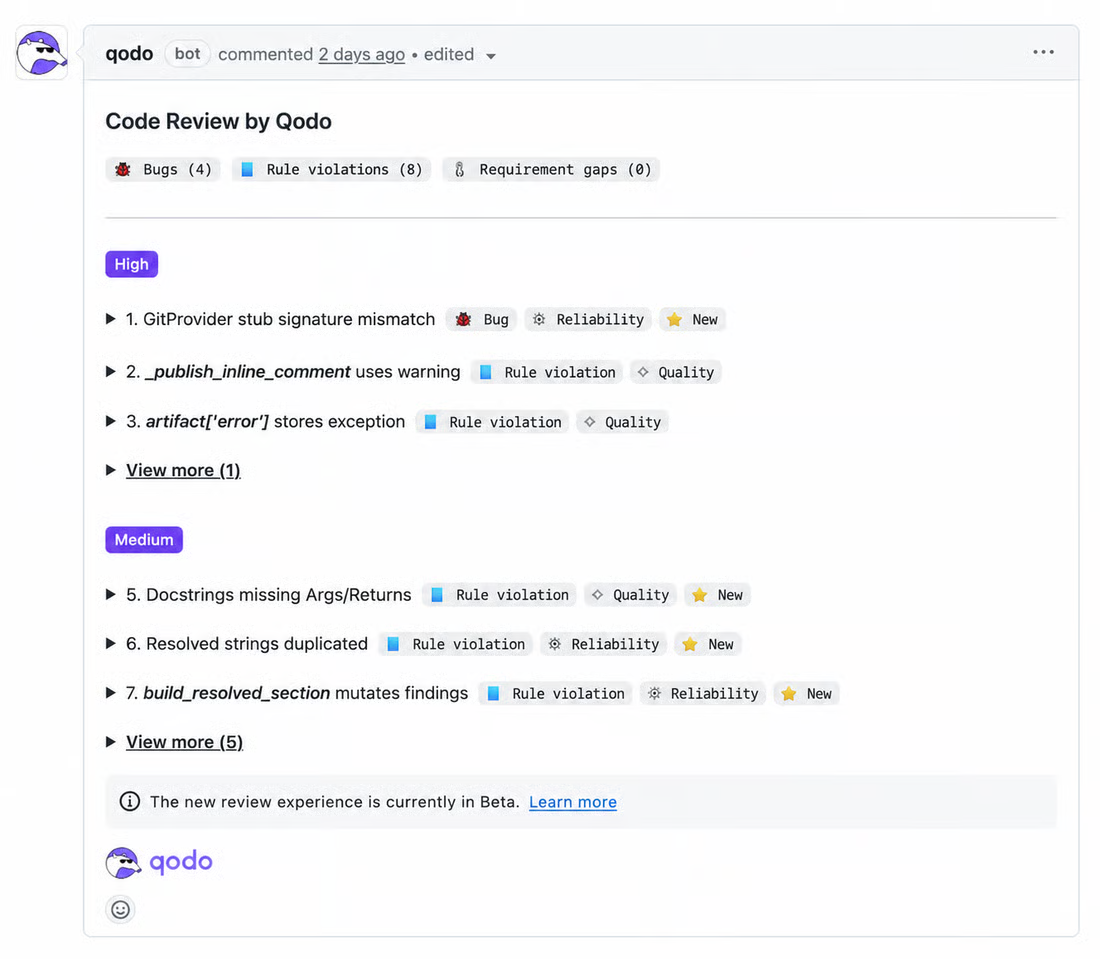
That places Qodo code review between deterministic checks and final review. A linter can prove that a rule fired; a test can prove one expected behavior passed. Qodo can identify a plausible issue those checks do not encode. None of these outputs proves that the change is safe to merge.
How Qodo Reviews a Pull Request
Repository Context and Review Rules
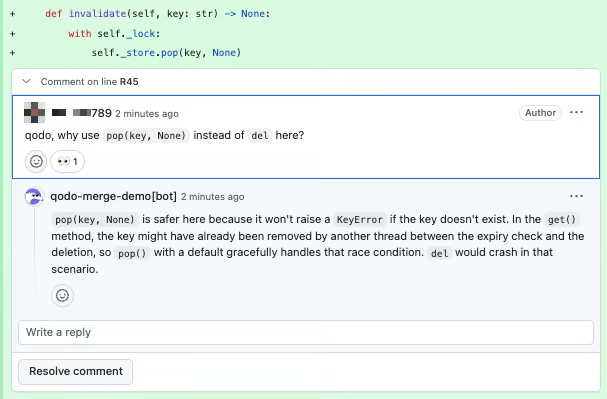
Qodo says its Context Engine reasons over repository structure, cross-file relationships, implementation patterns, dependencies, PR decisions, and organizational guidance. The pilot question is not whether context exists, but whether the right context was retrieved for the PR.
PR history has an important availability boundary. The current PR-history indexing feature is marked Beta for GitHub and GitLab. Initial indexing starts after the first PR opens on a connected repository, then updates as later PRs merge. Record indexing status before comparing early and later reviews.
Qodo can create rules manually, import supported instruction files, or derive suggestions through Rule Miner. The v2 rule-enforcement page lists GitHub, GitLab, Bitbucket Cloud, and Azure DevOps support, while individual features can still be Beta or provider-specific. Treat generated rules as proposed policy. Give each active rule an owner, scope, severity, review date, and rollback path.
Findings, Explanations, and Developer Actions
In a Qodo pull request review, each useful finding should stand on its evidence. A developer should be able to identify the affected code, understand the risk, reproduce it where practical, and decide whether to fix, dismiss, or escalate it. Severity is a routing aid, not proof.
Qodo's PR chat is Beta and supports discussion and dismissal. On GitHub and GitLab, eligible inline findings can receive committable suggestions; finding remediation is a Research Preview that Qodo advises against using in production or business-critical workflows. A correct finding can still lead to an over-broad patch or weaker test. Sample the finding and patch; do not score only whether someone responded.
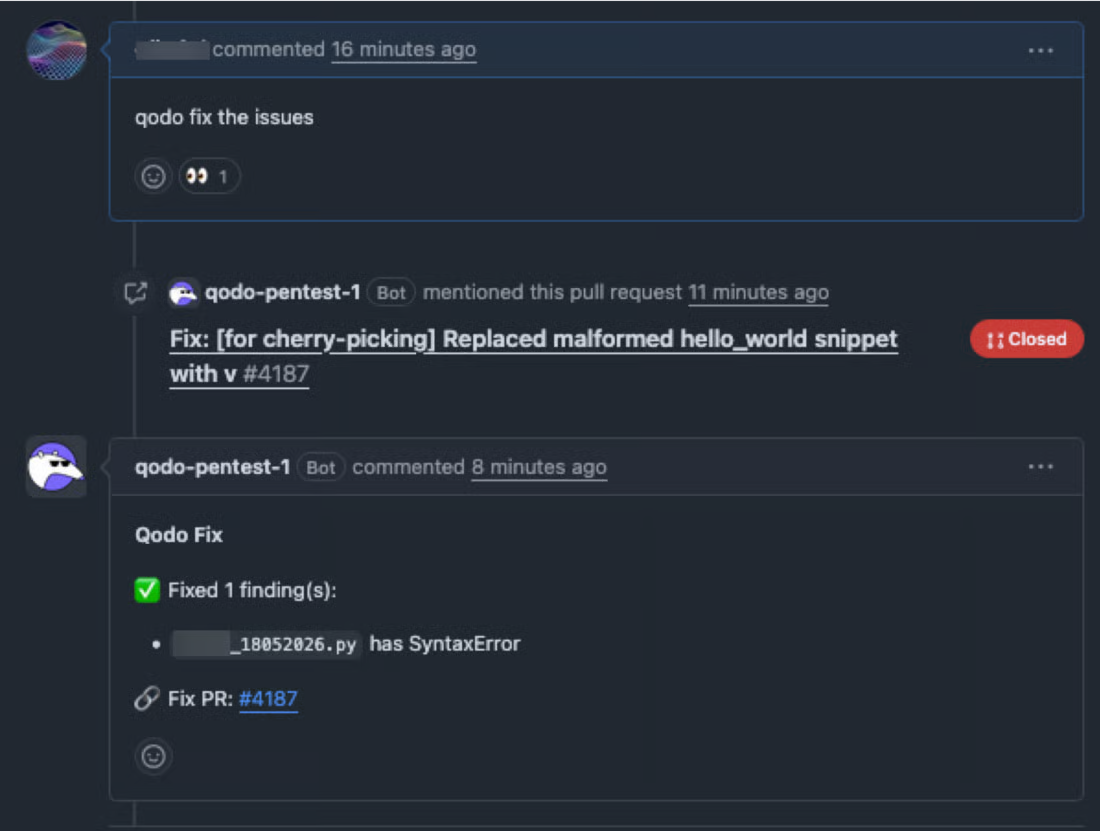
For each pilot finding, capture five fields:
| Field | Decision question |
|---|---|
| Classification | Was this a real defect, policy violation, useful question, duplicate, or false positive? |
| Evidence | Did the comment point to enough code or repository context to verify the claim? |
| Action | Did the developer fix, dismiss, discuss, or escalate it? |
| Review cost | How many active minutes did verification and remediation require? |
| Outcome | Did the final change reduce risk without creating a regression or unnecessary churn? |
Where Qodo Fits the Review Workflow
IDE Feedback Before a Pull Request
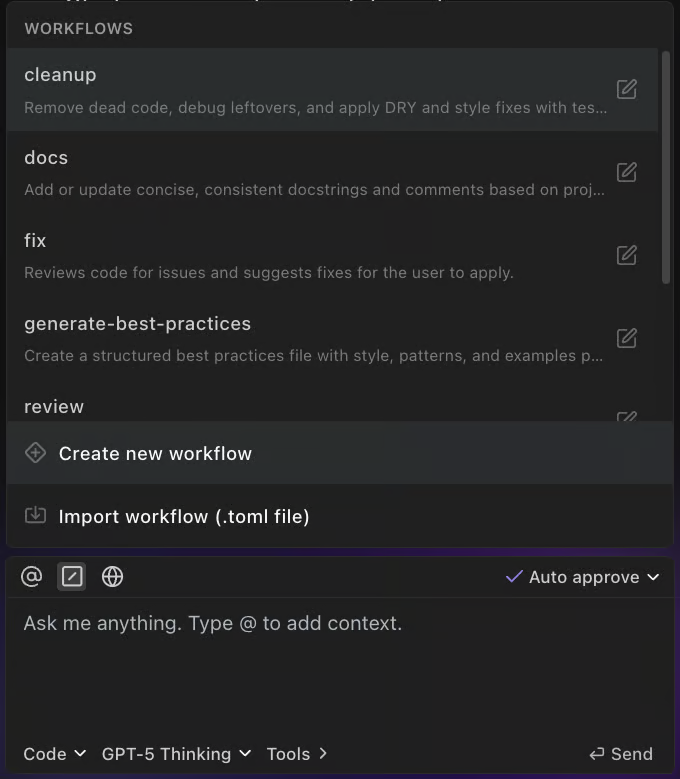
Qodo can move part of review earlier. The Qodo IDE plugin runs local review workflows in VS Code, JetBrains IDEs, and Visual Studio Professional. The same page says the plugin was formerly Qodo Gen and that code-generation features are being deprecated as the product shifts toward review and governance.
Use this as defect containment: inspect local changes, apply team rules, run missing checks, and resolve obvious findings before human review. Qodo Agent Skills can also bring rules and finding-resolution workflows into compatible coding agents. For CLI-oriented work, qodo-pr-resolver uses Git for local branch and commit operations and a Git provider CLI or API to locate the open PR and retrieve Qodo review comments. Audit both commit and push rights and the credentials used to post replies or summaries before enabling batch fixes. Local feedback prepares the change; it does not create independent approval.
Git Review Before Merge
The Qodo Git integration reads the PR and publishes summaries or findings back to the provider. Qodo's installation matrix covers GitHub Cloud and Enterprise Server, GitLab, Bitbucket, and Azure DevOps with different deployment combinations. The pricing page lists Gerrit for Enterprise; confirm exact feature coverage rather than infer parity.
Place Qodo after the author has produced a coherent PR and before final human approval. Run tests, type checks, security scanners, and policy checks beside it. The broader automated code review workflow still needs ownership routing, deterministic status checks, and escalation rules; this page evaluates how Qodo occupies that review slot.
What Engineering Teams Should Evaluate
Signal Quality and Review Noise
Qodo says multi-agent review and shared context improve recall and precision while filtering low-impact comments. Those remain vendor claims until reproduced on your repositories, PR mix, and rule set. Clean feature PRs alone cannot test architectural drift, requirement gaps, or noise.
Use a fixed set of PR scenarios instead:
| Pilot scenario | What to measure |
|---|---|
| Small, correct maintenance change | Unnecessary comments and verification time |
| Seeded cross-file logic defect | Detection, evidence quality, and severity |
| Intentional exception to a team convention | Whether repository context prevents a false positive |
| Missing requirement or test case | Whether the finding maps to the actual ticket or acceptance criterion |
| Sensitive auth, data, or migration change | Escalation quality and whether humans reject unsafe remediation |
Measure precision as confirmed actionable findings divided by all findings reviewed. Track duplicates, dismissal reasons, verification time, high-risk misses found by humans, and developer action rate. Record silent PRs separately; silence is not a pass result.
Use a current, source-checked category comparison to form the shortlist, then apply the same acceptance set and human rubric to every finalist. Comment count is not a useful comparison metric.
Governance, Deployment, and Permissions
Before installation, identify who can install the Git app, select repositories, manage teams, activate rules, alter triggers, inspect analytics, and authorize remediation. Grant access only to pilot repositories and verify the provider's actual permission screen.
Qodo documents multi-tenant, single-tenant, on-premises, and some air-gapped combinations, with availability varying by provider and plan. Ask where code, PR comments, embeddings, rules, telemetry, and audit logs are processed and retained. The pricing page states that customer code is not used to train models and prices Pro Team from $30 for 2,500 pooled credits, with a 14-day trial and usage-based overage. Enterprise is a custom plan and adds, SSO/SAML, audit logs, BYOK, single-tenant SaaS, and on-premises deployment.
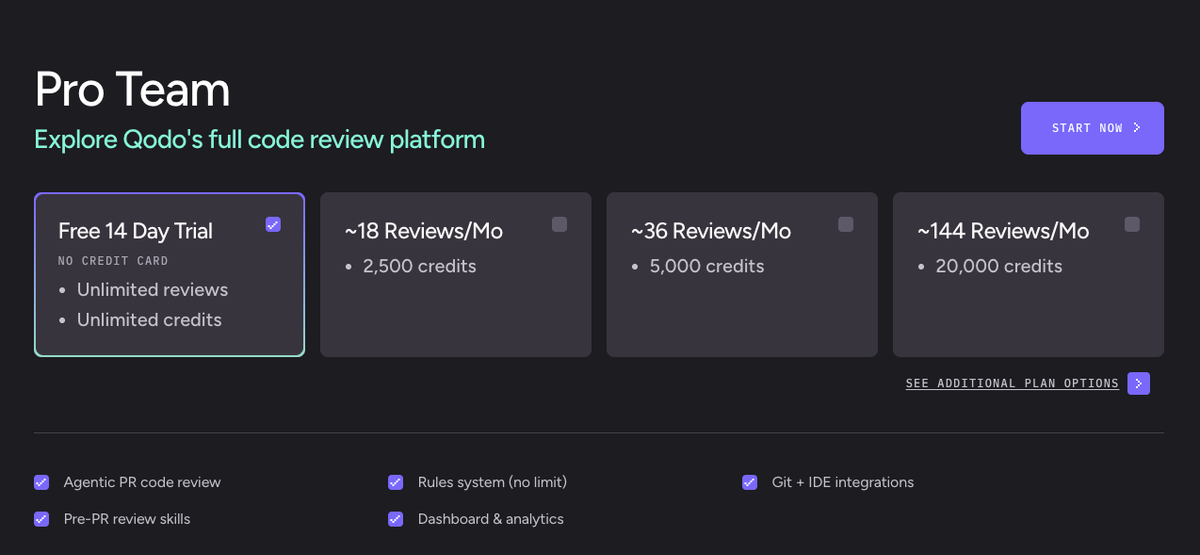
That is a starting point, not a security review. Because Qodo documents repository and PR-history indexing, obtain the current data-flow diagram, retention schedule by data type, subprocessor list, deletion process, region options, and contractual controls. Price the accepted review: credits, overage, setup, rule maintenance, noise handling, and human verification.
Limits and Human Review Boundaries
Context Gaps and False Confidence
Repository context is not business context. An agent may see code and PR history but miss a customer commitment, incident workaround, staged migration, threat model, or operational constraint outside connected systems. Historical learning can also preserve yesterday's compromise instead of today's intended standard.
False confidence appears when a contextual comment sounds more authoritative than its evidence. Require reviewers to trace high-severity findings to code, a rule, a requirement, or a reproducible behavior. When reviewing AI-generated code before merge, the implementation still needs an independent check of scope, behavior, dependencies, tests, security, and maintainability, regardless of whether another model wrote the review.
Final Approval and Accountability
Qodo should advise, prioritize, and help remediate. It should not inherit accountability from the code owner, security reviewer, release owner, or merge approver. Several probabilistic reviewers can share the same missing context.
Define the boundary in repository policy:
- Qodo findings do not satisfy required human approvals.
- Deterministic checks remain required even when Qodo reports no issue.
- High-risk changes keep named code-owner or specialist review.
- AI-generated fixes receive the same tests and diff review as the original change.
- The person approving the merge records any accepted exception and owns the decision.
The pilot succeeds only if Qodo changes where humans spend attention while leaving the final decision legible. Faster comments without clearer ownership are not a review improvement.
FAQ
Each answer below reflects the public Qodo v2 documentation I reviewed on August 26, 2026; it does not prove that no other document exists.
Can Qodo review pull requests from forked repositories?
I did not find a documented general fork policy. Support may depend on the provider and whether the app can read the source branch. Test internal and external-contributor forks separately, then confirm the supported permission model before making fork coverage a requirement.
How are review comments retained after uninstalling Qodo?
I did not find a retention policy covering Git-provider comments, portal findings, and context records after uninstall. Do not assume that uninstall deletes history or preserves every record. Ask for the deletion sequence, export options, retention period, and audit-log behavior.
What happens when a repository changes its default branch?
I did not find a complete account of how a default-branch change affects rules, configuration, indexing, or historical relevance. Because file-based configuration may live there, validate configuration discovery and PR-history status after the change. Confirm whether reindexing is required.
Does Qodo preserve review history when a repository moves to another organization?
I did not find a guarantee that PR-history indexes, rule scopes, analytics, and repository identity survive an organization transfer. Treat it as a migration: export available records, capture rule ownership, reconnect the repository, and obtain Qodo's transfer procedure before relying on continuity.
Can Qodo review a pull request after its source branch is deleted?
I did not find documented review behavior after a source branch is deleted. Existing comments do not prove Qodo can rerun analysis, retrieve the head, or remediate after the branch disappears. Preserve the commit SHA and required review evidence, then confirm provider-specific behavior.
A code-generation system and an independent review layer solve different problems. Verdent can organize planned implementation and reviewable code production, while a product such as Qodo can be evaluated as a separate PR review and governance layer. This is a category boundary, not a claim of an official Verdent–Qodo integration.
Related reading
- For the broader pattern this fits into, see why automated review works better as queue triage than as an approval bot.
- If the review gate is part of a spec-first process, spec driven development
covers where the checkpoints belong.
- Once more than one person depends on it, the harder question is who owns an agentic workflow across a team.
- For a governed team deployment with its own permission layers, see this
- And when a vendor cites benchmark numbers, what SWE-bench Pro can and cannottell you is the right lens.