The best no code app builder tests the riskiest product assumption without creating a migration problem larger than the evidence the first build produces.
For internal workflows, start with Retool or Softr. For a gated portal, start with Softr and compare Retool when deeper operational access matters. For mobile, compare Adalo with FlutterFlow. For a full web product, compare Bubble with an export-oriented stack such as FlutterFlow. The answer changes when code ownership, governance, or backend control becomes a requirement.
This is a documentation-based selection model, checked against current official pages on September 16, 2026. It is not a matched hands-on benchmark, and plan limits, pricing, and policies should be rechecked before purchase.
Quick Verdict for Founder-Led Product Validation
Choose the smallest control surface that can test your main business risk. If the open question is whether operators will use a new approval screen, an internal tool builder is enough. If the question is whether customers will pay for a multi-role SaaS workflow, you need stronger data, permission, and billing control from the start.
| Product need | Shortlist | Why it fits the first build | Handoff risk to examine now |
|---|---|---|---|
| Internal operations tool | Retool, Softr | Fast UI over existing data and business systems | Role controls, external-user economics, environment separation |
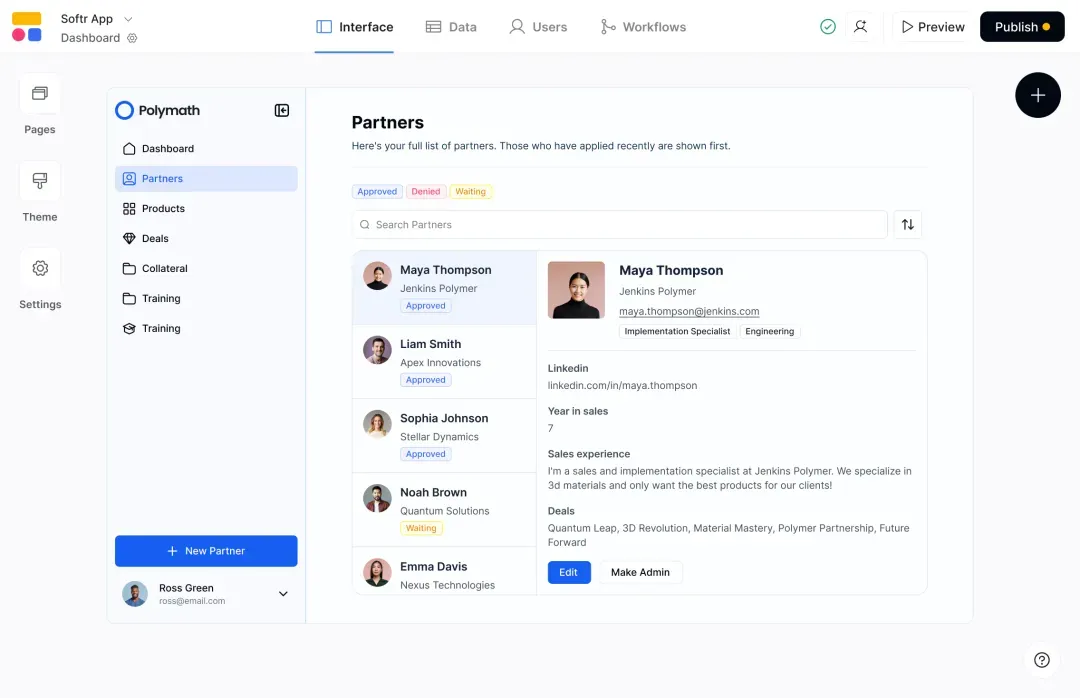
| Customer or partner portal | Softr, Retool | Authentication, gated records, forms, and operational views | Data-source limits, row-level rules, branding, account ownership |
| Native mobile validation | Adalo, FlutterFlow | Visual mobile UI and app-store deployment paths | Source export, backend ownership, signing keys, device-specific code |
| Full web or SaaS workflow | Bubble, FlutterFlow | Custom interfaces, state, integrations, and multi-step logic | Platform runtime lock-in versus exported code and separate backend work |
This is a shortlist, not a universal ranking. Do not pay the learning cost of an imagined enterprise future, but do not optimize for demo speed when the current product already requires regulated data, complex authorization, or an engineer-owned codebase.
What Makes a No-Code App Builder Fit the First Build
Among no-code app builders, the right app builder for founders answers whether a defined user completes a valuable job. Scope fit matters more than feature count.
Before opening a visual app builder, define these constraints:
- User and job: who must complete what?
- Data: where do records live, and which fields are sensitive?
- Permissions: who may view, create, edit, approve, or delete?
- Integrations: which APIs, payments, or identity providers are required?
- Release: browser, private link, domain, or app store?
- Exit: can engineers export code and data, or must they rebuild behavior?
Free tiers answer whether you can learn the builder, not whether you can operate the product. Retool limits Free to five users and reserves external apps and richer permissions for higher tiers. Adalo permits free building and testing but charges for publishing. FlutterFlow separates free web prototypes, Basic code download, and Growth GitHub integration. Bubble requires a paid plan for a live app and meters runtime through workload units. Treat these as pilot boundaries, not permanent prices.
Best-Fit Categories by Product Need
Internal Tool Builders
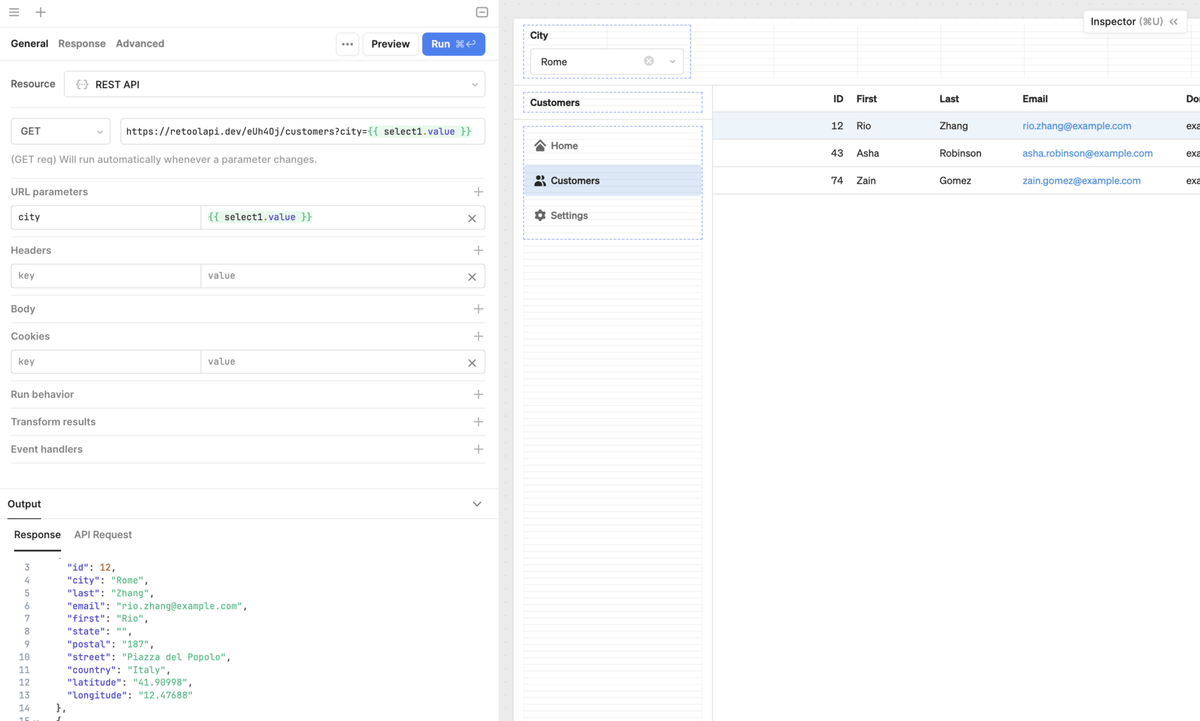
Retool is the stronger start when an operations app must sit directly on existing databases and APIs. Its plan matrix separates builders, internal and external users, workflows, environments, and permissions, exposing governance cost. Softr is lighter when tables, forms, lists, and standard actions can express the workflow. Choose by testing the hardest permission and write action, not template counts.
Customer Portal Builders
Softr is practical when customers need authenticated access to their own records. Its global restrictions distinguish view, create, edit, and delete, but current documentation places the last three on Business and above. Retool supports external apps, but places portals, embedded apps, rich permissions, and external-user pricing on Business or Enterprise. Model user type and volume before choosing either.
Mobile App Builders
Adalo is simpler when the experiment requires iOS or Android and no exported codebase. Its plans separate free test apps from paid web and app-store publishing. Record who owns developer accounts, signing credentials, domain, and backend before submission.
FlutterFlow accepts more setup in exchange for a clearer path into Flutter development. Its plan comparison separates code download, GitHub integration, branches, environments, and collaboration. If handoff is likely, pay for the artifacts engineers need, not merely a rendered prototype.
Full-Stack Visual Builders
Bubble is a broad no-code SaaS builder combining database, workflows, frontend, and hosting. Its structural tradeoff is that data can be exported, but application logic cannot be exported as code. Moving runtimes therefore means rebuilding behavior, not cleaning generated files.
FlutterFlow exports Flutter code but does not remove backend decisions. Firebase, Supabase, APIs, authentication, cloud functions, and deployment still need owners. Prefer it when portability justifies governing those layers earlier.
Compare No-Code Builders by Control Layer
Data Modeling
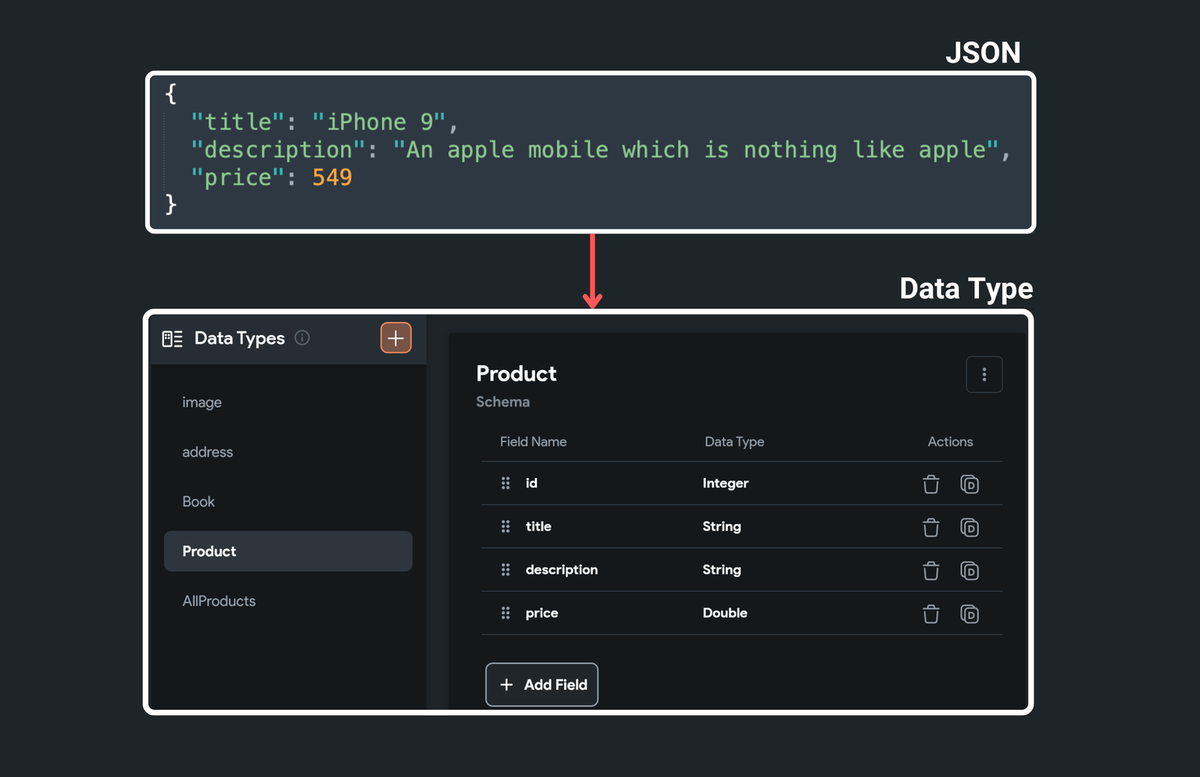
List entities, identifiers, relationships, retention, and export formats before screens. A spreadsheet may validate a directory, but multi-tenant products need tenant keys, constraints, and migration ownership. Ask whether the schema is inspectable, bulk export is complete, and engineers can reproduce it. Include upstream request and concurrency limits for connected sources.
Workflow Logic
Visual workflows become hard to govern when retries, background jobs, payments, and errors spread across canvases. Record each workflow’s trigger, preconditions, side effects, failure state, retry rule, and visible result.
Bubble meters hosted execution through workload units, and its pricing page allows overages to be disabled. FlutterFlow’s free plan currently limits API endpoints while paid plans raise that limit. The economic and technical limit is therefore part of the workflow design, not a detail to discover after launch.
User Roles and Permissions
Visibility is not always security. A hidden button may leave a record accessible elsewhere. Test one unauthenticated, ordinary, cross-tenant, and administrator account.
Bubble’s privacy rules can restrict fields, searches, files, and auto-binding, but the data model must support the rule: its documentation notes that search access cannot be granted through multi-level chained references. Every platform has equivalent implementation details. Make the hardest authorization case a pilot acceptance test.
Deployment and Maintenance
Record what the vendor hosts, what the founder owns, and what must be renewed: domains, store accounts, certificates, secrets, subscriptions, backups, logs, and rollback.
Commercial use is not one checkbox. Bubble permits customer apps but retains its runtime and assigns users responsibility for third-party services. FlutterFlow says creators own exported work but package licenses can vary. Review plan, terms, dependencies, and marketplace items together before selling access.
When a No-Code Build Needs Engineering Handoff
Handoff is due when the next product risk cannot be tested safely inside the builder’s control model:
- A required authorization rule cannot be expressed or tested.
- Usage cost is less predictable than the validated value.
- A critical API, job, or payment needs stronger retry and observability.
- Native behavior, performance, or accessibility work exceeds the builder.
- Security, residency, audit, or procurement exceeds the plan.
- Engineers need source, tests, reviewable changes, and repeatable environments.
- Migration inconvenience is postponing necessary architecture work.
The cheapest handoff is often after validation but before customer data, permissions, integrations, and workarounds multiply.
How to Prepare the Project for Agentic Coding Work
Preserve product evidence even when the implementation cannot be preserved. Build a handoff packet with:
- the validated user journey and acceptance criteria;
- screen inventory, states, responsive behavior, and accessibility;
- data dictionary, sample data, ownership, retention, and export files;
- role-permission matrix with negative tests;
- workflow map with triggers, side effects, retries, and failure messages;
- API contracts, rate limits, webhooks, and secret owners;
- analytics events, support findings, known defects, and discarded assumptions;
- domains, deployment accounts, licenses, dependencies, and migration constraints.
If the builder exports source, commit a snapshot, pin dependencies, run it locally, and add tests before extending it. If it does not export logic, use the visual project as a behavioral specification and rebuild in bounded slices.
Agentic coding can divide that work into schema, frontend, integration, test, and migration tasks. Verdent can be evaluated then as a project-level coding workflow, but it is not a no-code builder and cannot turn an unexportable project into source. Attach each task to a repository revision, checks, and a human merge decision.
FAQ
Do no-code builders publish incident history?
Some do. Retool, Bubble, and FlutterFlow publish status pages with different components and history. Check retention and whether self-hosted, dedicated, mobile, or third-party services are excluded. Green status is not an SLA or complete incident record.
Which builders document data residency options?
Retool documents cloud and Enterprise self-hosting. Bubble offers an Enterprise dedicated AWS instance with a selectable region. Softr states that hosted user data is stored in Germany, while connected sources keep their own policies. Confirm separately where account data, app data, logs, backups, AI inputs, and external databases are processed.
Are marketplace plugins reviewed before listing?
Some marketplaces impose submission requirements, but listing is not a security warranty. Bubble’s policies require a functional demo and tracking-tool disclosures, while its terms say Bubble does not warrant marketplace items. FlutterFlow warns that third-party package licenses and dependencies can change. Review the publisher, permissions, network calls, maintenance, license, and exit plan.
Do external API limits vary by plan?
Yes, at both layers. FlutterFlow allows two API endpoints on Free; Basic, Growth, and Business list unlimited endpoints, while Enterprise is custom. Softr says source rate limits vary and high concurrency may require a different source. Upstream providers add quotas, bursts, and commercial terms. Test the combined path, retries, and overages.
Which builders disclose AI feature data policies?
Disclosure varies by feature. Bubble says AI inputs may reach third-party services and input and output may improve or train Bubble AI. FlutterFlow says its desktop AI Agent uses a local provider CLI and FlutterFlow does not store those conversations. Retool says only configured queries, fields, and resources reach models. Read the policy for the exact feature, provider, and account.
Conclusion
The best no code app builder is the one that proves the next product decision while keeping its control boundaries visible. Use Retool or Softr for bounded operational and portal workflows, Adalo or FlutterFlow when mobile distribution defines the experiment, and Bubble or FlutterFlow when the first build needs deeper product logic.
Test the hardest data rule, permission case, integration failure, and deployment path. Then decide whether the product can remain on-platform or needs an engineer-owned codebase. A planned handoff means the first build answered its question; it does not mean no-code failed.