
A $25 plan can still produce a much larger invoice. Cost changes with project count, compute, MAU, disk, storage, egress, Edge Functions, and Realtime traffic.
This is a documentation-based analysis, not a personal-invoice review or production benchmark. Supabase is the source of record for rates and invoices; Verdent turns them into a reproducible planning model.
For a first production SaaS app, use this estimate:
Monthly Supabase cost = plan fee + net compute + usage overages + add-ons + tax
Supabase Pricing at a Glance
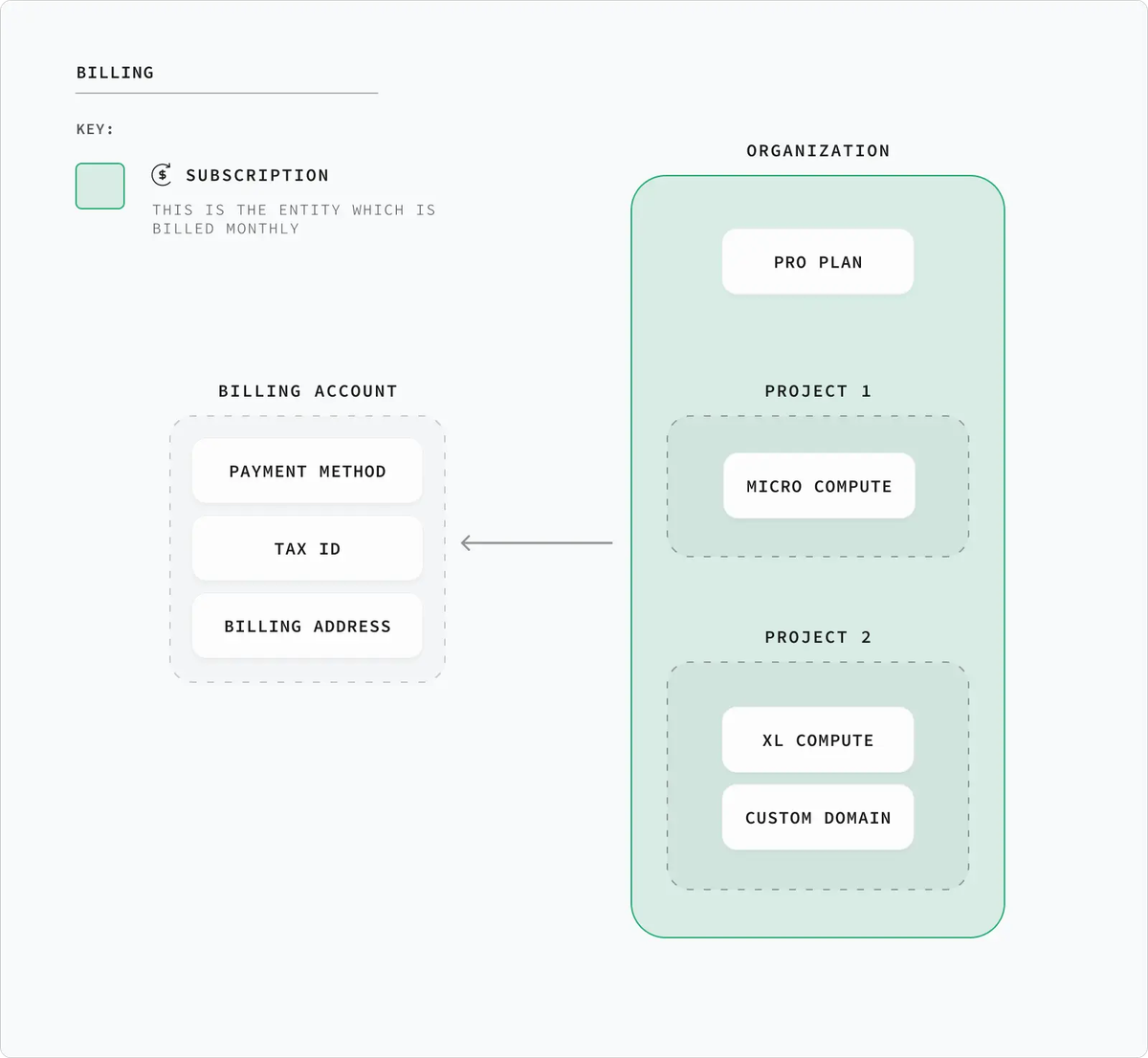
Supabase billing is organization-based. A paid organization has one plan, while every project has its own Postgres instance and compute charge. Most included usage is pooled across the organization; database disk allowances apply per project.
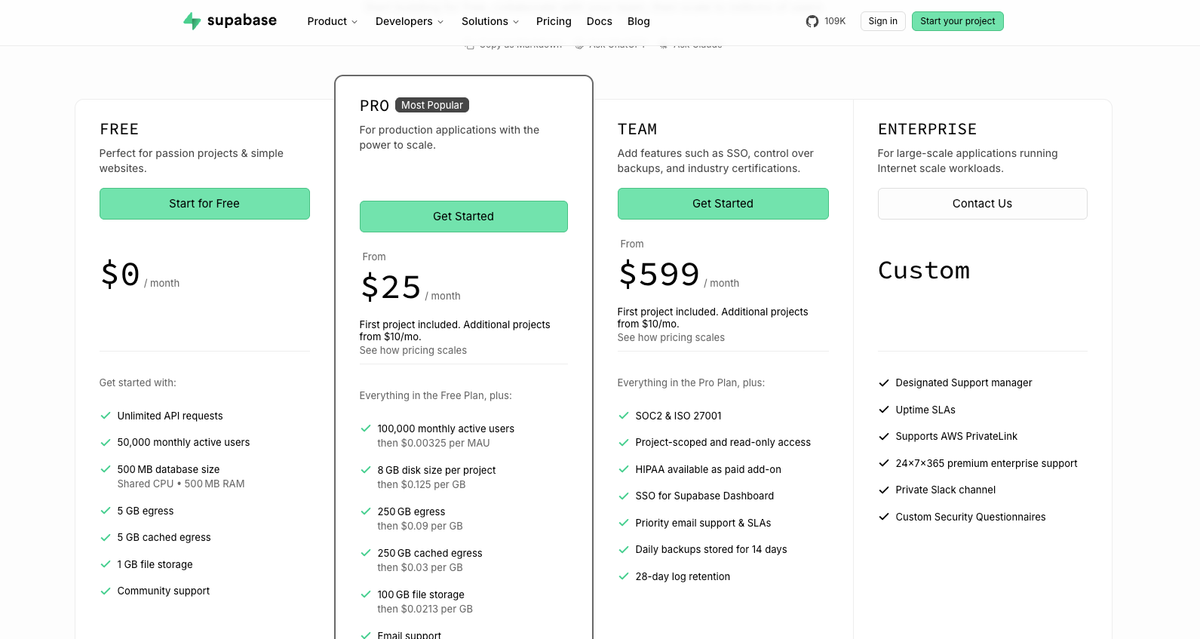
The Supabase free tier currently allows two active projects, 50,000 MAU, 500 MB of database size per project, 1 GB of storage, and 5 GB each of uncached and cached egress. Low-activity projects may pause after seven days, so Free is a weak production budget assumption.
Supabase Pro starts at $25 per organization per month and includes $10 in compute credits—enough to offset one Micro instance. One Pro organization with one Micro project can remain at $25 when metered services stay within allowance. Recheck the current Supabase pricing table before approval.
Fixed Project Costs and Included Usage
A paid bill has two fixed-looking layers: subscription and compute. The credit offsets one Micro; a second adds about $10/month, while Small leaves $5 after credit. Production, staging, and demo projects share organization-level quotas, but each incurs compute. Count environments first under the organization and project billing model.
Usage-Based Services That Change the Bill
One Pro organization currently includes 100,000 standard MAUs, 8 GB of disk per project, 100 GB of storage, 250 GB each of uncached and cached egress, 2M Edge Function invocations, and 5M Realtime messages.
Above those allowances, current rates include $0.00325 per standard MAU, $0.125/GB disk, $0.0213/GB storage, $0.09/GB uncached egress, $2/M Edge Functions, and $2.50/M Realtime messages. Third-party MAUs, SSO, custom domains, and PITR need separate estimates.
Estimate the Cost of a First SaaS App
Start with one production project and billing cycle. Use allocated disk, separate stored files from transferred data, and calculate only usage above allowance:
**Billable units = max(0, forecast usage − included usage)**Line cost = billable units × current overage rate
Authentication, Database, Storage, and Egress
Authentication counts distinct users who sign in or refresh a token, not login requests. Provisioned disk includes indexes, WAL, and system use. File downloads consume storage and egress.
Egress spans database responses, Auth, Storage, Functions, Realtime, and pooler traffic. A 2 MB report downloaded 20,000 times is roughly 40 GB before other traffic.
For an AI-built app, keep Supabase CLI migrations in source control and publishable keys in client configuration; keep privileged server credentials out of it. An agent working with Supabase still needs explicit schema, RLS, migration, and credential rules.
Low-, Medium-, and High-Usage Scenarios
Assumptions: one Pro organization, one production project, no add-ons, standard Auth users, uncached egress, and a full compute month. Taxes, currency conversion, email, payments, frontend hosting, external observability, and labor are excluded.
| Scenario | Monthly assumptions | Estimated Supabase cost |
|---|---|---|
| Low | Micro compute; 5,000 MAU; 2 GB database disk; 10 GB files; 30 GB egress; 0.5M function invocations; 1M Realtime messages | $25.00 |
| Medium | Micro; 60,000 MAU; 20 GB disk; 120 GB files; 300 GB egress; 3M function invocations; 8M Realtime messages | $40.93 |
| High-auth | Small; 160,000 MAU; 50 GB disk; 300 GB files; 800 GB egress; 10M function invocations; 20M Realtime messages | $337.51 |
Here is the medium scenario as a checkable worksheet:
| Line item | Forecast | Included | Billable calculation | Subtotal |
|---|---|---|---|---|
| Pro plan | — | — | Fixed | $25.00 |
| Micro compute | $10 | $10 credit | $10 − $10 | $0.00 |
| Standard MAU | 60,000 | 100,000 | 0 × $0.00325 | $0.00 |
| Database disk | 20 GB | 8 GB | 12 × $0.125 | $1.50 |
| File storage | 120 GB | 100 GB | 20 × $0.0213 | $0.43 |
| Uncached egress | 300 GB | 250 GB | 50 × $0.09 | $4.50 |
| Edge Functions | 3M | 2M | 1 × $2/M | $2.00 |
| Realtime messages | 8M | 5M | 3 × $2.50/M | $7.50 |
| Estimated total | $40.93 |
High-auth adds $5 net compute, $195 MAU overage, $5.25 disk, $4.26 storage, $49.50 egress, $16 functions, and $37.50 Realtime. Auth MAU drives most of that bill.
Where Backend Costs Usually Surprise Teams
Every active project adds compute, and preview branches create metered environments. A forgotten staging project is invisible to a model that counts only customers.
Realtime messages are counted per listener; downloads and large API responses increase egress. Database disks can auto-scale and do not automatically shrink after deletion.
A Spend Cap is not a custom monthly budget: compute, branching compute, read replicas, custom domains, PITR, and other provisioned items can sit outside it. The current cost-control boundary makes this an outage-versus-overage decision: cap on can restrict service; cap off permits covered overages.
When Supabase Is Cost-Effective
Supabase is easiest to justify when a small team wants managed Postgres, Auth, Storage, Realtime, APIs, and backups without operating each component. Pro allowances keep an early platform bill simple while the team observes usage.
The case weakens with heavy egress, high Auth MAU, many always-on environments, or a different topology. Compare the managed invoice with full self-hosted cost, not one VM. In a self-hosted Supabase deployment, your team owns provisioning, hardening, Postgres maintenance, scaling, backups, recovery, monitoring, and uptime.
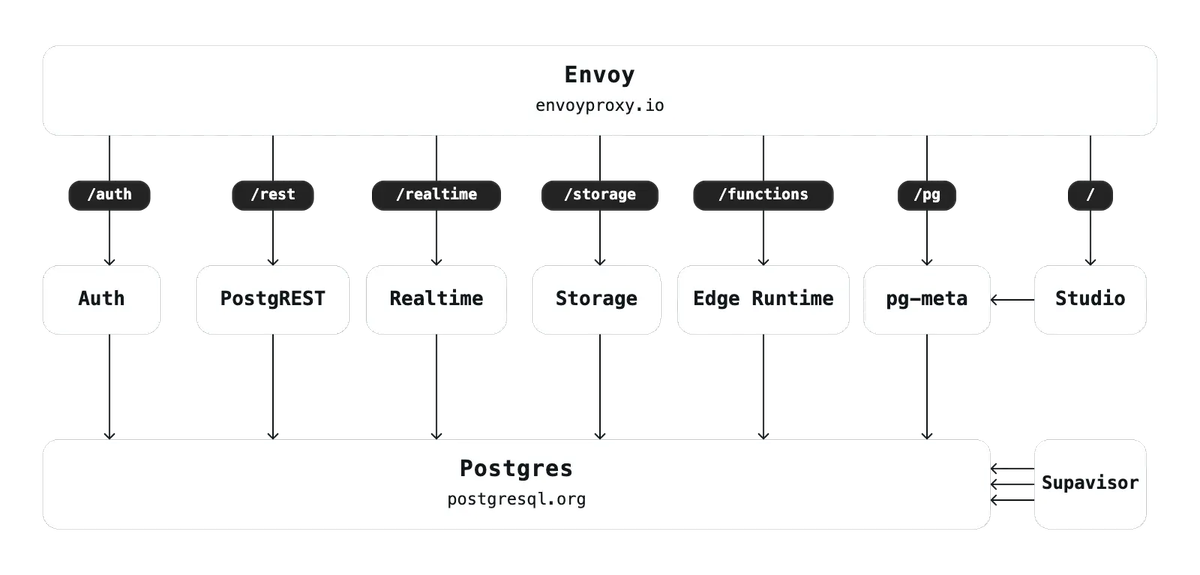
Managed Supabase still does not own your schema, indexes, RLS policies, secrets, query efficiency, or compute choice. It removes infrastructure work, not backend engineering responsibility.
FAQ
Can Supabase Usage Data Be Exported for Internal Cost Allocation?
Public billing materials describe usage pages, per-project filters, and invoices, but not one export for complete project chargeback. Preserve invoices and cycle-end snapshots, then document how pooled quotas are allocated. Use separate organizations when billing separation matters more than shared allowances.
How Does Billing Work When a Supabase Project Is Paused or Restored?
Paused projects do not incur compute charges. Free projects can currently be restored for up to one year; paid projects are not paused for inactivity. The billing FAQ separates upfront plan fees from usage charged in arrears.
Are Taxes and Currency Conversion Included in Supabase Prices?
No. Prices and invoices are in USD, while a card provider may add conversion costs. Applicable sales tax, VAT, GST, or other indirect tax is calculated from the billing address and appears separately.
Do Supabase Preview Branches Create Additional Charges?
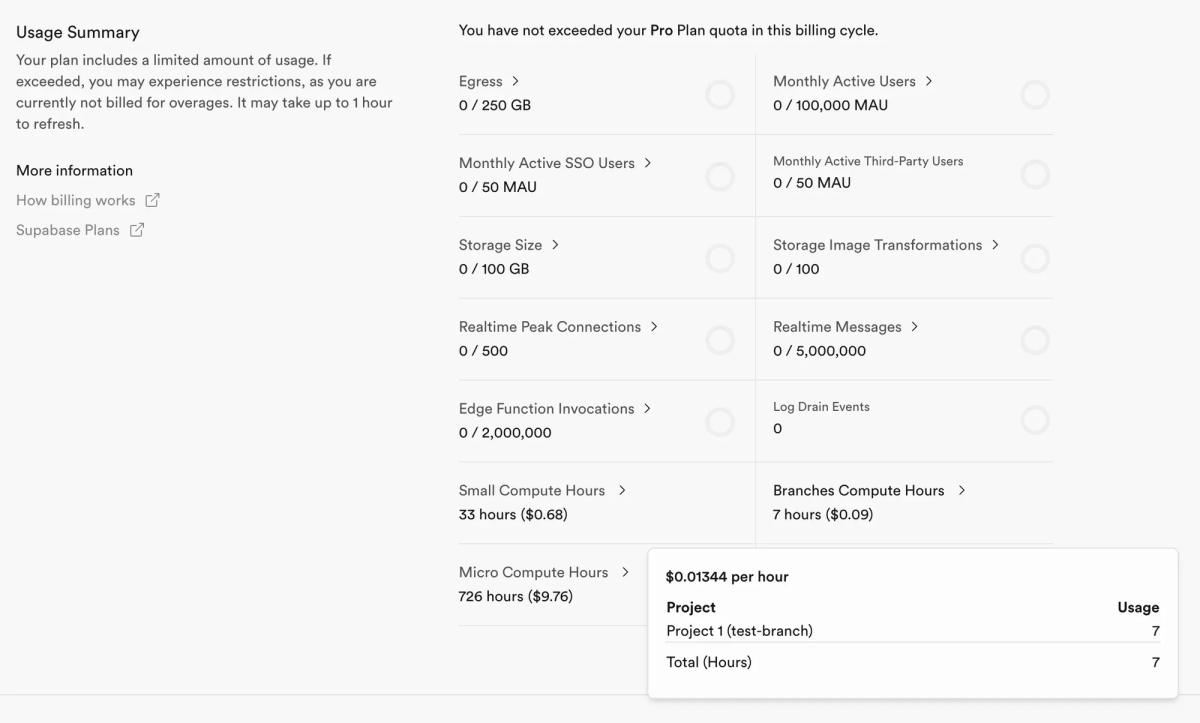
Yes. A default Micro preview branch currently starts at $0.01344 per hour, receives no compute credit, and sits outside the Spend Cap. Delete abandoned branches promptly; the branching usage page explains the invoice line.
Does Supabase Offer Education, Nonprofit, or Startup Discounts?
Current public pages do not list a universal student, nonprofit, or startup discount. Budget at public rates until Supabase confirms eligibility for a specific partner or credit program.
Conclusion
The useful Supabase cost estimate is not “Free or $25.” Count projects, choose compute, forecast metered services, subtract allowances, and add taxes and external services. Replace assumptions with usage-page data after launch.
Review it before adding an environment, disabling the Spend Cap, or reaching 70–80% of quota. That leaves time to optimize, cache, close a branch, or approve budget.