Agnes 2.0 Flash arrives positioned as a fast, tool-calling model for coding and agent workflows — and the right first question isn't "is it good?" but "how would I find out for my repository?" A model's documentation tells you what it's designed to do; it can't tell you how it behaves in your harness, on your codebase, under your failure conditions. This guide separates what Agnes's official documentation actually confirms from what you'd need to test yourself, then lays out how to evaluate it in a real repository workflow before granting it any access that matters.
Capabilities below reflect Agnes's official documentation as of June 2026. API behavior, limits, and policies change — confirm current details at the official Agnes documentation before relying on any specific. Pricing, limits, and data-handling terms should always be checked against the latest official docs before production use.
What Official Agnes Documentation Confirms
Which coding and tool-use scenarios the documentation identifies
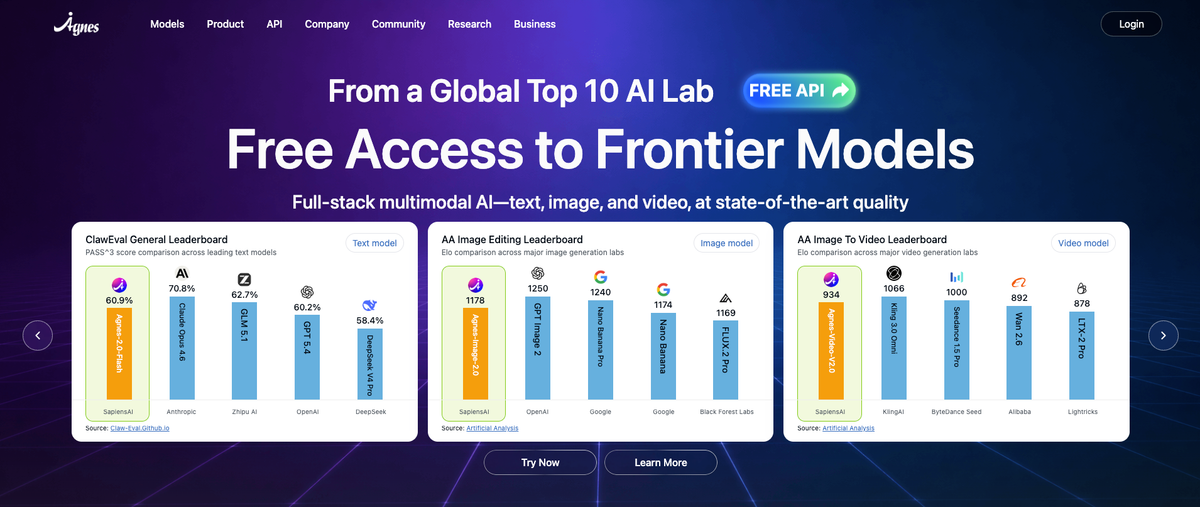
Agnes 2.0 Flash is a language model from Sapiens AI, and its documentation identifies a clear set of intended scenarios: agent workflows, tool calling, coding tasks, reasoning, multi-turn conversations, and image understanding, aimed at high-frequency production use. Concretely for a builder, the documented capabilities that matter are tool calling (the API accepts a tools definition and optional tool_choice, the mechanism an agent needs to invoke functions), streaming output, image input via URL, and an optional thinking mode for coding tasks. It's served through an OpenAI-compatible API (with an Anthropic-compatible option), using the model name agnes-2.0-flash — which means it generally drops into agent frameworks that accept a custom OpenAI-style endpoint as a configuration change. The documentation also lists compatibility with coding-agent tools like Codex and Claude Code.
Which access and capability claims still need verification
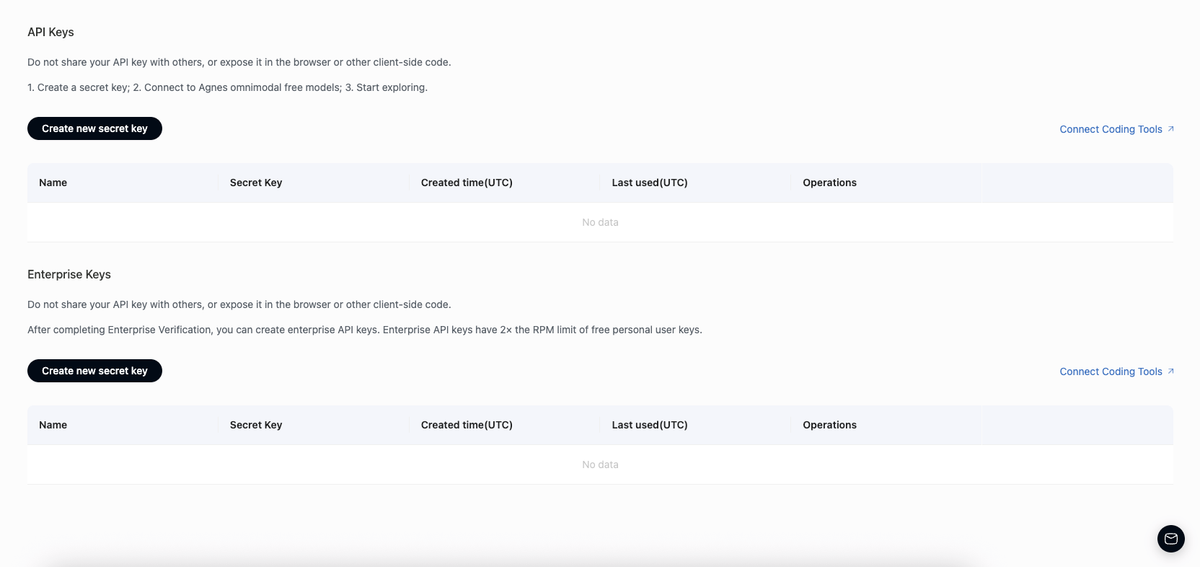
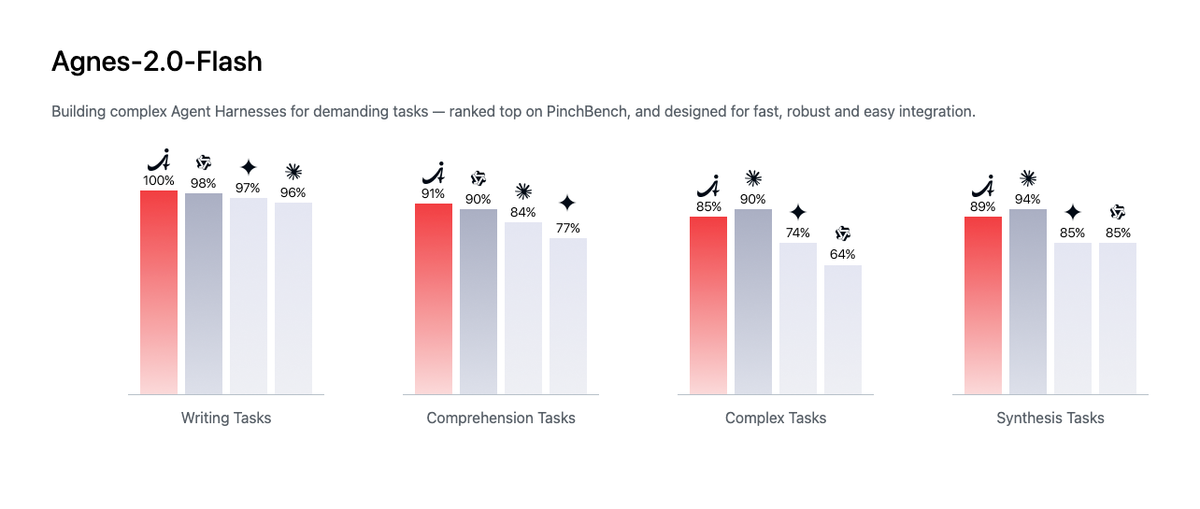
What the documentation establishes is the interface and intended use — not how the model performs on your work. The capability descriptions ("strong autonomous agent capabilities," suitability for coding) are the vendor's framing, and any leaderboard placement cited in the docs is a vendor-referenced result, not an independent measurement of your tasks. Equally, access terms (limits, pricing, data handling) are stated in the documentation but are exactly the kind of detail that changes, so they need checking against the current official docs rather than a secondhand summary. The honest split: the API shape and documented features are confirmable facts you can build against; the performance and access claims are starting points to verify, not conclusions to adopt.
A Coding Model Is Not a Complete Coding Agent
What the harness must provide around the model
A model that emits tool calls is a component, not a coding agent. Around Agnes 2.0 Flash (or any model), your harness still has to supply everything that makes an agent work: constructing the prompts and tool definitions, parsing the model's tool-call output, actually executing the file edits and shell commands, capturing results and feeding them back, managing context across turns, and handling failures. The model proposes; the harness disposes. When you evaluate Agnes, you're really evaluating the model-plus-harness system, and a capable model in a weak harness underperforms — so don't attribute harness problems to the model, or assume a good model compensates for missing harness logic.
Why successful tool calls do not verify the resulting code
A correctly formatted tool call is not correct code. The model emitting a well-formed <tool_use>-style block that edits a file means the call parsed and executed — it says nothing about whether the edit is right. Verification of the actual result (does the patch compile, do tests pass, does it solve the problem without breaking something else) is a separate step the model's tool-calling success doesn't provide. This is the gap that bites teams who treat "the agent ran without errors" as "the agent did the work correctly." The tool call is plumbing; the correctness of what flowed through it has to be checked independently, every time, regardless of how reliably the model formats its calls.
Limits Developers Should Test
Whether tool schemas remain stable across multi-step tasks
The first thing to probe: does the model hold its tool-calling format consistently across a long, multi-step task? A model can emit clean tool calls early in a session and drift later — malformed arguments, wrong tool selection, or format changes that break your parser as context grows. Run a multi-step task that exercises the same tools repeatedly and watch whether the schema stays stable from the first call to the fiftieth. Schema drift mid-task is a common, hard-to-spot failure, and it's something only repeated runs on realistic task lengths will reveal.
Whether edits stay consistent across multiple files
The second probe: when a task spans several files, do the edits stay coherent with each other? A change in one file often assumes something about another, and a model can make a locally-correct edit that contradicts an edit it made elsewhere. Give it a task that genuinely requires coordinated multi-file changes and inspect whether the resulting set of edits is internally consistent — not just whether each individual edit looks fine in isolation. Cross-file consistency is where multi-file coding tends to break, and it won't show up in single-file tests.
How the workflow recovers after a failed tool call
The third probe: what happens when a tool call fails? Feed back an error result (a failed command, a test that didn't pass, a rejected edit) and observe whether the model recovers sensibly — diagnoses the failure and adjusts — or loops, repeats the failing action, or gives up. Recovery behavior under failure is where an agent's real robustness lives, and it's invisible in happy-path testing. Deliberately inject failures and watch the recovery, because production tasks will hit failures whether you tested for them or not.
Evaluate Agnes in a Repository Workflow
Begin with read-only repository tasks
Start where the blast radius is zero. Point Agnes at a repository in a read-only capacity — ask it to explain code, locate where something is implemented, or summarize how a module works — before it can change anything. Read-only tasks let you assess whether it understands your codebase and uses tools sensibly without any risk to your code, and they surface comprehension problems early, when they cost nothing. Only move past read-only once the model demonstrates it actually understands the repository it's working in.
Run bounded edits and inspect the resulting patches
Next, allow narrowly-scoped edits and read every resulting patch. Give it a small, well-defined change in an isolated copy of the repository, let it produce the edit, and inspect the diff closely — does it do what was asked, only what was asked, and nothing that breaks an assumption elsewhere? Bounded edits with full patch review are how you build evidence about edit quality without betting your real codebase on it. Keep the scope small enough that each patch is genuinely reviewable; a patch too large to read carefully is a patch you're approving on faith.
Confirm tests and rollback before expanding permissions
Before widening access, confirm two safety properties: that the project's tests pass on the model's changes, and that you can cleanly roll back what it did. Run your test suite against its patches and verify a failed change can be reverted without residue. Only after read-only comprehension, reviewed bounded edits, passing tests, and working rollback have all held up should you consider giving Agnes broader repository or shell permissions. Each stage earns the next; skipping ahead is how an unevaluated model ends up with access it hasn't proven it deserves.
Adoption Checklist for Builders and Teams
Define tool and repository permissions explicitly
Decide, in advance and in writing, exactly which tools the agent may call and which parts of the repository and system it may touch. Default to the narrowest permissions that let the task succeed, and expand only with evidence. An agent's access should be a deliberate decision, not whatever the harness happens to allow — explicit, scoped permissions are the difference between a contained evaluation and an open-ended risk.
Record failures instead of relying only on vendor claims
Keep your own record of how Agnes performs on your tasks — what it got right, where it failed, which failure modes recurred. This log is worth more than any vendor capability claim or leaderboard position, because it measures the one thing that matters: behavior on your work, in your harness. Vendor framing tells you what a model is designed to do; your failure log tells you what it actually does for you, which is the evidence an adoption decision should rest on.
Review private-code and API policies before adoption
Before sending any real code through Agnes, review the data-handling and API policies — what happens to the code and prompts you send, retention, and any terms relevant to proprietary code. Because Agnes is an API service, your code transits its infrastructure, so the policy terms determine whether it's appropriate for your private or sensitive code at all. Confirm the current official policy terms for your specific situation before adoption, since this is a compliance question that a model's coding ability can't override.
FAQ

What repository data may leave your environment during testing?
When you use Agnes through its API, the content you send — prompts, code snippets, file contents, error messages, and any context your harness includes — transits the API provider's infrastructure, since it's a hosted service rather than a local model. During testing, that means whatever your harness puts into the request leaves your environment, so be deliberate about what you include: test with non-sensitive or synthetic code first, and avoid sending proprietary or secret-bearing files until you've reviewed the provider's data-handling policy. The exact retention and usage terms are stated in the official documentation and should be confirmed there for your specific use case, as these terms can change.
How can repeated runs expose unstable tool-call behavior?
A single successful run can hide instability that only appears across many runs or longer sessions. Running the same task repeatedly — and running longer multi-step tasks — surfaces variance that one happy-path test misses: tool-call format that drifts as context grows, occasional malformed arguments, inconsistent tool selection on equivalent inputs, or recovery that works once but not reliably. Because agent reliability is about consistency under real conditions, not a single good result, repeated and extended runs are how you measure whether the tool-call behavior holds up. Treat a model as reliable for your workflow only after it stays stable across repetition, not after one clean pass.
When should builders evaluate a local model instead?
Consider evaluating a locally-hosted model when your constraints make a hosted API unsuitable: when code can't leave your infrastructure for data-residency or confidentiality reasons, when you need to avoid dependence on an external service's availability, or when sustained high volume makes self-hosting economically preferable to per-call API usage. A hosted model like Agnes is convenient and removes infrastructure work, but a local model keeps code on your own machines and removes the external dependency — at the cost of the hardware and operational effort to run it. The decision rests on your specific constraints around data, dependency, and volume, which only you can weigh for your situation.
Conclusion
Agnes 2.0 Flash presents a documented, OpenAI-compatible interface for tool-calling, coding, and agent workflows — and that documentation tells you what it's built for, not how it behaves on your code. The useful work is evaluation: confirm what the official docs actually establish (the API shape and features) versus what you must verify yourself (performance, stability, access terms), remember that a tool-calling model is only one part of a working coding agent, and test the things that matter — schema stability across multi-step tasks, cross-file edit consistency, and recovery after failures. Then evaluate it in a repository the safe way: read-only first, bounded reviewed edits next, tests and rollback confirmed before any expansion of permissions. Let your own evaluation and policy review decide whether Agnes earns a place in your workflow — and check its current limits, pricing, and data policies against the official documentation before you commit.
Related Reading