Imagine you're a Tech Lead evaluating coding agent infrastructure in April 2026. The landscape looks settled: Claude Code and Codex CLI for the Anthropic and OpenAI camps, Cursor for IDE-native work, and a new category of community tools using DeepSeek V4's API at a fraction of the cost. Then in May, three things happen in rapid succession: DeepSeek's senior researcher posts a public recruiting call for a "Code Harness from zero" team, job postings name Claude Code, Cursor, and Codex as the explicit benchmark tools, and a Rust terminal agent for DeepSeek V4 adds 21,000 GitHub stars in one week.
That's the moment when DeepSeek's coding strategy becomes worth mapping as a system, not just as a collection of announcements.
Signals are current as of May 22, 2026. Pre-launch information is marked accordingly. Verify all data at source before making tool decisions.
Why "DeepSeek's Coding Plan" Is Suddenly a Question Worth Asking
From "ship a stronger model" to "ship an agent"
For most of 2024 and early 2025, DeepSeek's coding relevance was model-level. DeepSeek V3, then R1, then V4 — progressively stronger, progressively cheaper, progressively more widely integrated into third-party tools. The question was "which model do you use?" not "which DeepSeek coding product do you use?"
That framing changed in May 2026. DeepSeek's own job posting stated the internal thesis directly: "Model + Harness = Agent. What DeepSeek needs to fill this time is the most critical layer between the model and action." This is not a model-capability claim. It's a product-layer claim. DeepSeek is saying explicitly that having a frontier model is insufficient — that the harness (context management, tool invocation, verification, workflow) is the remaining gap between a model and a usable agent.
The May 2026 signals that changed the conversation
Three events in May 2026 moved DeepSeek from "model provider" to "coding platform in formation":
- Hiring posts for Harness Product Manager and Harness R&D Engineer appeared, both Beijing Haidian, citing Claude Code, Cursor, Codex, Manus, Hermes, and OpenClaw as familiarity requirements
- Deli Chen's public X post (May 20) confirmed the internal project name "Code Harness" and the working label "DeepSeek Code"
- Community response was immediate: DeepSeek-TUI added 21,000+ stars in one week as developers drew connections between the official hiring and the existing community tools
None of these events announced a product. Together, they revealed a strategic direction.
Who this article is for
Tech Leads and tool selection decision-makers evaluating which AI coding ecosystems to invest in — whether to build workflows on DeepSeek V4 now, wait for the official product, or avoid pre-launch ecosystem risk entirely. This article doesn't tell you which choice is right. It maps the three layers of DeepSeek's coding strategy so you can evaluate them separately.
Layer 1 — The Model: DeepSeek V4 Pro and Flash
What V4 added for agentic coding
DeepSeek V4, released April 2026, introduced a dual-tier architecture specifically designed for agent workflows:
- V4-Pro: 1.6T total parameters, 49B active, 1M context window. Designed for complex multi-turn coding sessions and deep reasoning tasks.
- V4-Flash: 284B total parameters, 13B active, 1M context window. Designed for fast, cost-efficient subagent calls in parallel agent architectures.
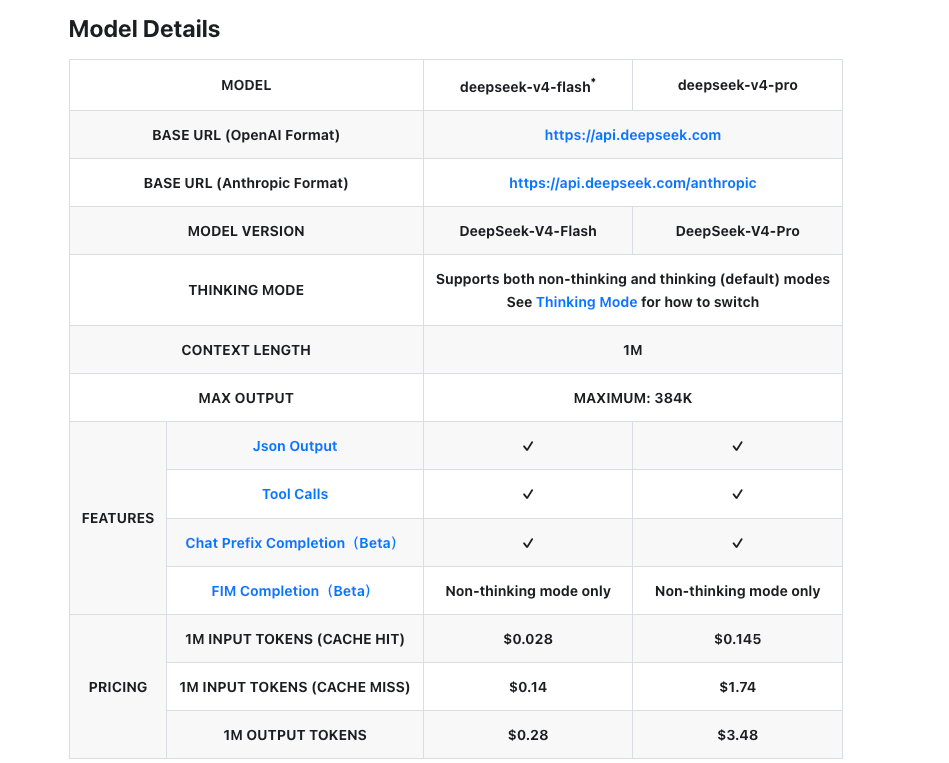
The two-model design maps directly to the pattern DeepSeek-TUI implemented with RLM: a stronger orchestrator model handling planning and complex decisions, a lightweight flash model handling parallel subagent calls. V4 was built with this split in mind.
Thinking mode and reasoning effort controls (max/high/off) are also available through the V4 API — the same controls that Deep Code CLI surfaces through its settings file, and that Claude Code users find analogous to the effort level system on Anthropic's side.
API positioning vs Claude Sonnet and GPT-5.5
At standard rates (the promotional pricing window closed May 31, 2026), V4-Pro's per-token cost is approximately 10–15× lower than Claude Opus 4.7 for input tokens. Compared to Claude Sonnet 4.6 at $3/$15 per million input/output tokens, V4-Pro's standard rates are substantially lower. For high-volume agentic workflows where model cost is a meaningful operational line item, this gap matters.
The capability comparison is more nuanced. DeepSeek V4-Pro performs competitively on coding benchmarks, but Claude Opus 4.7 leads on complex reasoning and instruction following at frontier difficulty. For most production coding tasks — implementation, refactoring, bug investigation — V4-Pro is a viable alternative. For tasks requiring extreme instruction fidelity, complex architectural reasoning, or the Anthropic-specific features Claude Code exposes, the gap is real.
Open-weight stance
DeepSeek V4's model weights are available under MIT license. This open-weight approach is strategically distinct from Anthropic and OpenAI: teams can self-host V4 on their own infrastructure, run it behind their own security perimeter, and modify it for specialized tasks. The open-weight option is a significant decision variable for enterprise teams with data residency requirements or compliance constraints that prohibit sending code to third-party API endpoints.
This also means the community can build on V4 without depending on DeepSeek's API — which is exactly what the ecosystem layer (Layer 3) has done.
Layer 2 — The Harness Team: A Product Line, Not Just Research
Hiring evidence: PM and engineer roles, May 2026
DeepSeek's official hiring platform listed two positions in May 2026, both tied to the Harness initiative:
Agent Harness Product Manager — responsible for the full development lifecycle of the DeepSeek Desktop Agent product. Requires hands-on experience with Claude Code, Cursor, OpenAI Codex, Manus, Hermes, and OpenClaw.
Agent Harness R&D Engineer — responsible for building the harness layer: context management, tool invocation, file I/O, terminal execution, and test feedback integration. Requires depth in how current coding agents handle multi-step task orchestration.
The product being built is described internally as a "Desktop Agent" — consistent with the Claude Code / Cursor product category rather than a cloud-only or API-only product.
Deli Chen's public recruiting post for "Code Harness from zero"
DeepSeek senior researcher Deli Chen, affiliated with Peking University's Language Computing and Machine Learning Group, posted on X (May 20, 2026):
"We're hiring! DeepSeek is forming a new Harness team to build Code Harness from the ground up — may be you can call it DeepSeek Code or something like this"
The same post linked to the LinkedIn profile of the project's reported technical principal, described by Chen as "one of our most gifted workmates."
Reported team lead Tianyi Cui
Tianyi Cui joined DeepSeek in March 2026, according to his LinkedIn profile. His background: approximately nine years at Jane Street in Hong Kong (equities and fixed income), followed by co-founding TSY Capital, a quantitative trading firm, in 2022. Multiple sources, including the South China Morning Post, have connected Cui to the Harness team based on Deli Chen's post.
DeepSeek has not published a formal organizational announcement. "Reported team lead" is the accurate characterization — not confirmed appointment.
The competitor list named in job requirements — what it signals
The Harness PM job post explicitly names Claude Code, Cursor, OpenAI Codex, Manus, Hermes, and OpenClaw as tools candidates should have hands-on experience with. This is an evaluation benchmark list, not a marketing target list — but the signal is clear: DeepSeek is positioning the Harness product to compete in the same category as these tools, not to complement them.
What's notable about the list: it includes Claude Code (Anthropic), Codex (OpenAI), and Cursor (independent), as well as Manus (ByteDance ecosystem) and OpenClaw (community). The breadth suggests DeepSeek is watching the full category rather than targeting any single incumbent.
Layer 3 — The Ecosystem: Integration and Community Harness Tools
DeepSeek-TUI (Rust, 25,000+ stars)
Before DeepSeek announced its Harness team, the developer community had already built what DeepSeek is now hiring for. DeepSeek-TUI, created by independent developer Hunter Bown, is a Rust-based terminal coding agent for DeepSeek V4. It implements skills (via .claude/skills/), MCP server support, RLM parallel sub-agents (1–16 V4-Flash children), sandbox isolation, and YOLO mode.
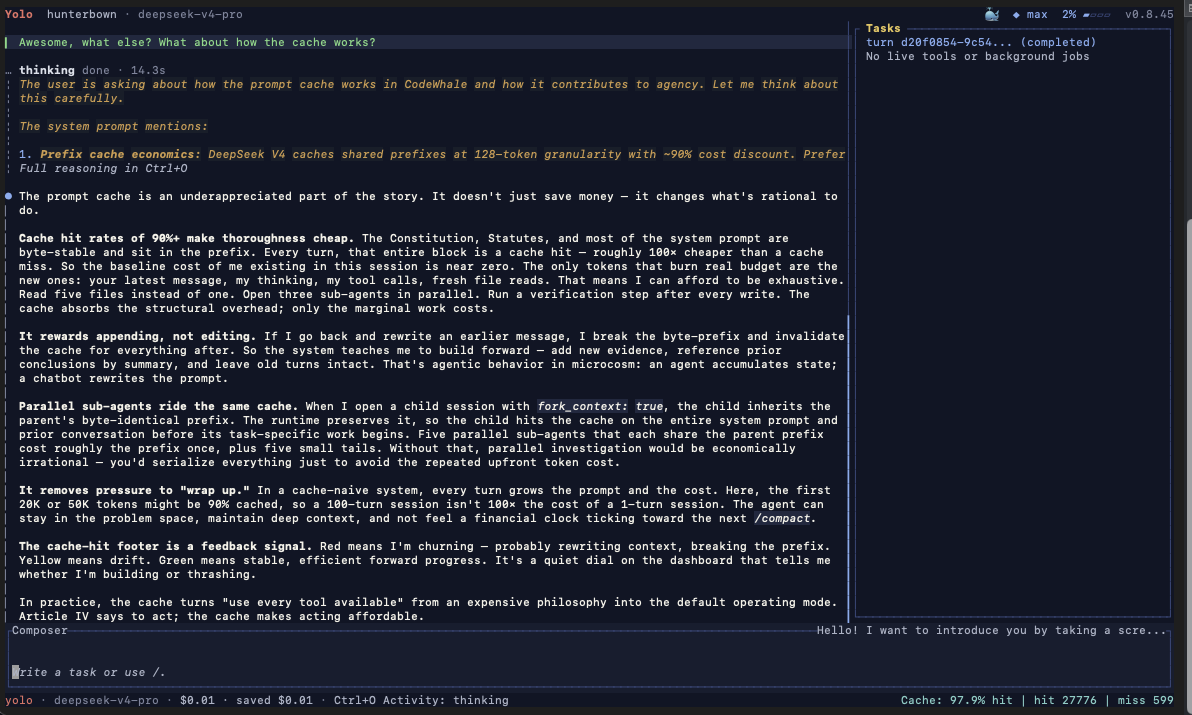
After the Harness team announcement in mid-May, DeepSeek-TUI's star count increased by 21,000+ in one week, reaching past 25,000 stars as of late May 2026. The number is moving — verify at github.com/Hmbown/DeepSeek-TUI.
DeepSeek-TUI is not affiliated with DeepSeek. It's a community project that predates the official Harness team by several months.
Deep Code CLI (Node.js, Skills/MCP)
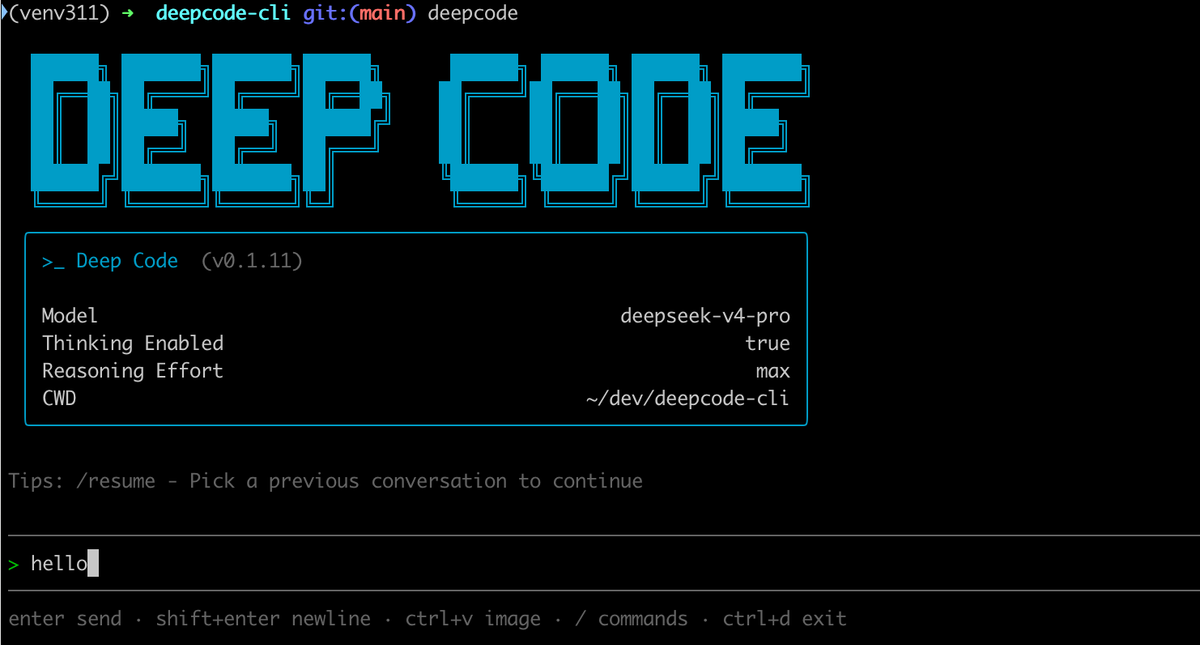
Deep Code CLI (@vegamo/deepcode-cli) is a Node.js terminal coding agent for DeepSeek V4, listed in DeepSeek's own integration documentation. It implements thinking mode, reasoning effort levels, Agent Skills via .agents/skills/, MCP support, and a companion VSCode extension sharing the same configuration file.
Smaller community than DeepSeek-TUI, simpler feature surface, but broader model compatibility: any OpenAI-compatible endpoint works by changing the BASE_URL in settings. Relevant for teams that want a lighter Node.js install without Rust binaries, or that need model flexibility beyond DeepSeek's family.
awesome-deepseek-integration and the integration ecosystem
DeepSeek maintains awesome-deepseek-integration — a curated list of third-party integrations, with 37,500+ stars and last updated February 23, 2026. It covers AI clients, coding tools, IDE integrations, mobile assistants, and API wrappers across dozens of tools that have added DeepSeek V4 support.
For teams evaluating the ecosystem breadth, this repository is the most complete directory of what's currently available. Cursor, Windsurf, Cline, and most major AI coding tools are represented, along with mobile assistants and standalone applications.
The newer awesome-deepseek-agent (2,530 stars, last updated May 23, 2026) focuses specifically on coding agent integrations with V4 — installation guides for Claude Code, DeepSeek-TUI, Deep Code CLI, OpenCode, Codex, and others.
What the Plan Implies for AI Coding Tool Buyers
If you're on Claude Code or Cursor today
Nothing in DeepSeek's current situation changes that. The Harness team hasn't shipped a product. DeepSeek V4 is available as a backend alternative inside Claude Code via env var substitution, but that's a workaround that loses Claude-native features. Cursor's native model support includes DeepSeek V4 — you can use the model within your existing IDE.
The decision to switch ecosystems should be made on what's available now, not on pre-launch signals. DeepSeek's roadmap is evidence that something is coming; it's not a shipped product.
If you're evaluating self-hosted agent stacks
The open-weight V4 model is available today under MIT license. DeepSeek-TUI and Deep Code CLI are functional tools that teams can run against self-hosted V4 or the DeepSeek API. For teams with data residency requirements that preclude Anthropic or OpenAI endpoints, the self-hosted V4 path is a real option.
The caveat: self-hosting V4-Pro (1.6T total parameters, 49B active) at production quality requires infrastructure investments commensurate with the model size. The API is lower operational cost for most teams.
If you're a Tech Lead deciding what to pilot now
The realistic options in May 2026:
- DeepSeek V4 via DeepSeek API + Claude Code — documented integration, lower token costs than Anthropic native, loses Claude-specific features
- DeepSeek V4 via API + DeepSeek-TUI — functional community tool, active development, not officially supported
- DeepSeek V4 via API + Deep Code CLI — simpler Node.js tool, VSCode extension, also community-maintained
- Wait for official DeepSeek Code — no timeline, appropriate if you're not under cost pressure on current tools
None of these require abandoning existing investments entirely. Most are additive experiments rather than migrations.
What's Still Genuinely Unknown
Release timing for the official product
DeepSeek has not announced a release date, a preview program, or a regional rollout plan for the Code Harness product. Hiring began in May 2026; typical product development cycles for a "from zero" team suggest months, not weeks, before anything ships publicly.
Whether DeepSeek Code will ship open-source
DeepSeek's model releases have been open-weight. Their product layer doesn't have a consistent open-source pattern. The Code Harness product could ship as open-source (consistent with the model licensing), as closed-source with an API, or as a hybrid. The job descriptions don't disambiguate this.
Pricing model and regional availability
No pricing information has been published. DeepSeek's API pricing has been aggressive and promotional — whether the Code Harness product follows that pattern is unknown. Regional availability (specifically whether EU and US users have full access, or whether China-based regulatory context creates limitations analogous to those facing Codex Chrome) has not been addressed.
FAQ
Has DeepSeek officially named the product?
The informal working name "DeepSeek Code" comes from Deli Chen's public X post: "may be you can call it DeepSeek Code or something." It's a researcher's informal description, not a formal product announcement or naming decision. Internally, the project appears to be called "Code Harness."
Is the Harness team only working on coding?
The current job postings are explicitly for coding agent work — the product is described as a "Desktop Agent" focused on software development. Whether the Harness team scope extends to other domains over time is not addressed in any public materials.
Can I get on a waitlist?
No waitlist or early access program has been announced. Following Deli Chen's X account and monitoring DeepSeek's official job postings at their hiring platform are the closest things to an early access signal path.
Will V4 weights stay open?
DeepSeek has not announced plans to close the V4 weights. MIT license is the current state. Whether future model releases continue the open-weight policy is not stated. DeepSeek's pattern through V3, R1, and V4 has been open weights, but past behavior is not a guarantee.
How does DeepSeek's plan compare to Anthropic's Claude Code or OpenAI's Codex strategy?
All three are pursuing the same product-layer thesis: "model + harness = agent." Anthropic shipped Claude Code as a GA product with enterprise support, managed authentication, and Anthropic-native features. OpenAI shipped Codex CLI as open-source with a cloud agent backend. DeepSeek is in the hiring stage with no shipped product.
The differentiators to watch: whether DeepSeek ships open-source (which neither Anthropic nor OpenAI has done for their coding agents), and whether the aggressive API pricing that distinguishes DeepSeek V4 extends to the harness product layer.
What to Watch Next
Concrete trackable signals for the DeepSeek coding strategy:
DeepSeek's hiring platform — new job postings in the Harness category indicate team expansion and development acceleration. Postings for roles beyond PM and R&D Engineer (QA, DevRel, design) would signal product readiness approaching.
Deli Chen's X account (@victor207755822 or equivalent — verify current handle) — Chen has posted public updates on the Harness team and recruiting. A launch announcement, beta access post, or GitHub repository publication would appear here first.
awesome-deepseek-integration and awesome-deepseek-agent commit activity — if a first-party DeepSeek coding tool ships, it will appear in the integration directory within days. The integration repository (currently last updated February 2026) resuming active commits would be a significant signal.
DeepSeek V4 API changelog — capability additions to the V4 API that are specifically relevant to coding agent use cases (tool call improvements, context management features, harness-relevant extensions) would indicate the product team's progress even before a public launch.
Related Reading