Muse Spark 1.1 matters less as a new name than as a release delta. It moved Meta's model closer to the operating patterns used by coding agents: explicit planning, bounded delegation, long-session context management, and tool-mediated validation. It also introduced an external route through the Meta Model API.
One naming trap is worth correcting once: “Muse Code” was sometimes used loosely for the model, but Meta later adopted that name for a separate terminal product. This article covers Muse Spark 1.1 only.
The architectural boundary is the key to reading the release correctly. Muse Spark 1.1 is a model, not an independent coding agent. It can reason about a task and produce tool calls, but a surrounding system still has to expose a repository, execute commands, manage permissions, preserve state, and decide whether a change is acceptable.
What Changed in Muse Spark 1.1
Agentic Planning and Parallel Delegation
The original release established the baseline; version 1.1 changed how the model was positioned for multi-step execution. According to Meta's Muse Spark 1.1 release, a main agent can gather context, form a plan, and delegate bounded work to parallel subagents. In the subordinate role, the model is intended to follow its assignment and return control when it needs escalation.
That is a model-level improvement, not an orchestration system. Parallel workers still require task boundaries, isolated state, conflict handling, and a parent process that can reconcile their results.
Meta also emphasized active context management: retrieving earlier actions and compacting an extended session while retaining steps needed later. Test that claim against plan revisions, failed commands, and constraints introduced mid-task. A successful long prompt does not prove that a long repository session remains coherent.
Coding and Multimodal Tool Use
Meta says 1.1 improved over the first release on large-codebase work. It also names planning mode, goal conditioning, delegation, and compaction as supported behaviors in coding harnesses.
The clearest example is Meta's OpenCode demonstration. The model builds a chat application, takes screenshots, identifies visible failures, traces them back to code, applies fixes, and validates the result. That sequence matters because it connects perception, reasoning, editing, and verification instead of treating code generation as the whole job.
It is still an official demonstration in a selected environment, not evidence of success across unfamiliar repositories, frameworks, test suites, or security policies. Treat it as a pilot hypothesis, not cross-team production validation.
The New Meta Model API Access Path
The other release delta was the Meta Model API public preview. It created a hosted route to Muse Spark 1.1 and made authentication, service behavior, model identifiers, and usage terms part of the integration decision.
Meta described structured output and tool-calling affordances. A familiar API shape can reduce adapter work, but it does not prove drop-in compatibility. Check request fields, streaming, tool serialization, errors, retries, model naming, and documented reasoning controls.
This article deliberately does not preserve launch-day prices, credits, location lists, quotas, or availability claims. Those values can change independently of the model release. As of the publication date, teams should verify the Meta Model API announcement against the current Meta AI developer surface, then confirm the account-specific documentation and terms shown during access. A historical release post explains what launched; it is not a permanent service contract.
How Muse Spark 1.1 Fits an AI Coding Stack
The Model Layer
Muse Spark 1.1 belongs at the model layer. It receives context, reasons over the task, generates code or explanations, and proposes tool calls. The Meta Model API is the delivery path for those capabilities; it does not add repository permissions, a terminal sandbox, branch isolation, or merge policy.
This distinction changes evaluation design. A weak result may come from the model, missing context, a tool adapter, or a validation loop that stops too early. Model comparisons are only interpretable when those conditions are recorded.
The hosted path also differs from downloadable weights. Teams must assess current data terms, operational commitments, version behavior, and proprietary-code policy. A self-hosting requirement may exclude the API before capability testing.
Coding Harnesses and Validation
The harness turns proposals into repository changes. It supplies tools and context, controls commands, records state, applies retries, and runs tests. Planning and tool calls do not move those responsibilities into the model.
A controlled pilot should therefore hold the harness conditions steady:
- Start each candidate from the same commit and task specification.
- Provide the same tools, permissions, time budget, and stopping rules.
- Define acceptance with tests, static checks, and human review before execution.
- Record repeated failures, unauthorized edits, review time, and accepted-task cost.
- Save the model identifier, harness version, prompts, and relevant configuration with the result.
The orchestration layer decides when work splits, where isolation and approval gates sit, and how failures recover. Verdent is one category example, not a claim of native Muse Spark support; compatibility requires separate verification.
The model determines reasoning quality, the harness determines what it can see and do, and orchestration governs multiple workstreams. Calling all three “the coding agent” obscures failures and comparisons.
What Meta's Evidence Does and Does Not Show
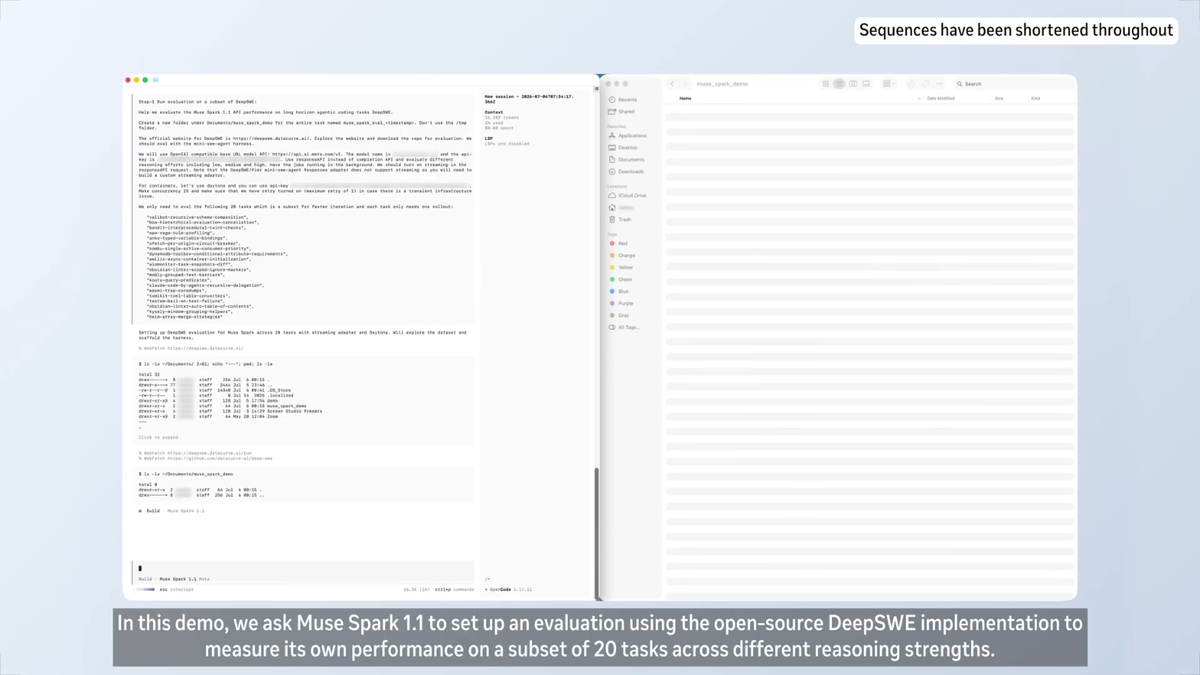
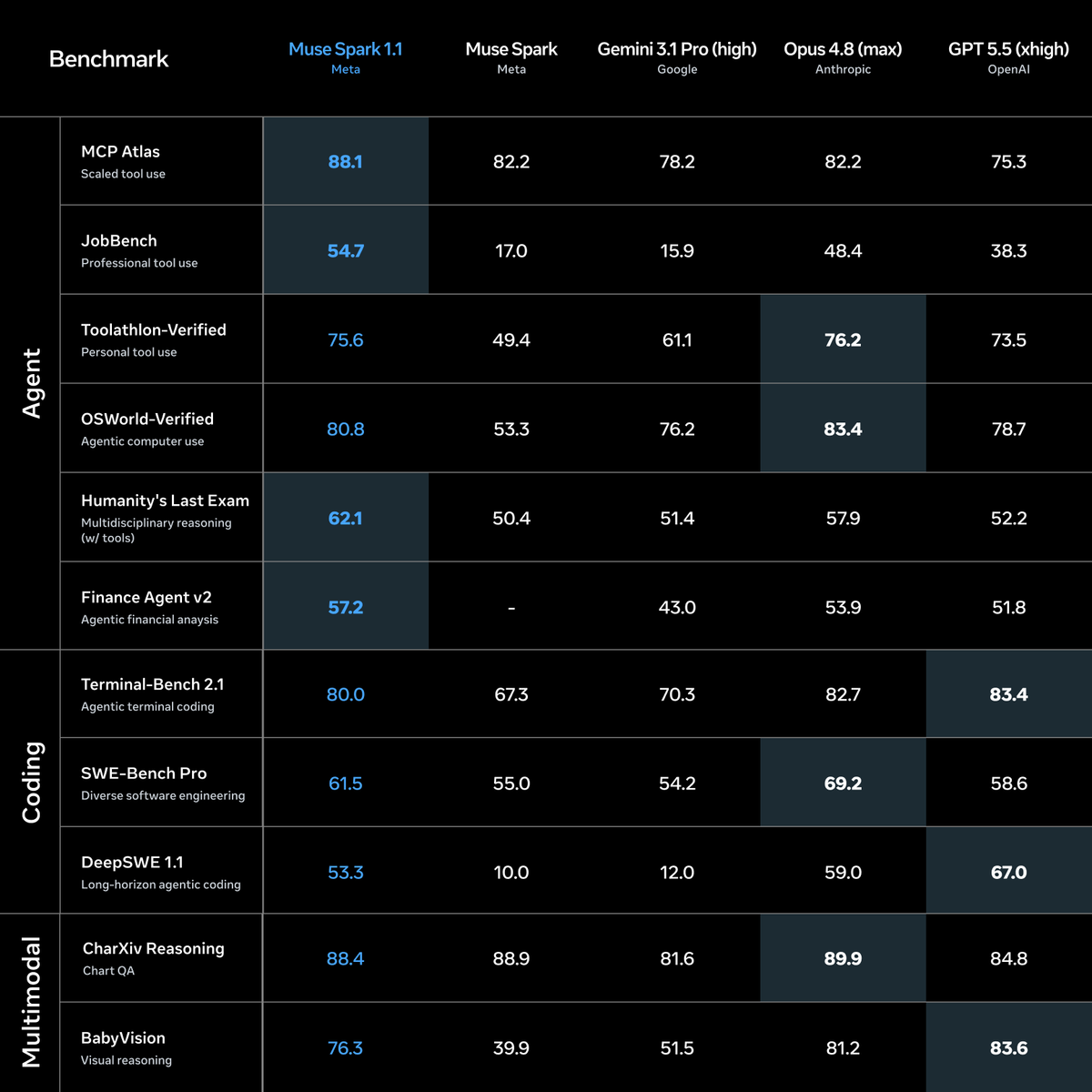
Meta's evidence supports a narrow conclusion: Muse Spark 1.1 was trained and evaluated for agentic behavior, including planning, subagent delegation, context compaction, tool use, and coding. The OpenCode demo shows those elements operating together in one workflow. The Muse Spark 1.1 evaluation report also documents Meta's capability, safety, and deployment-oriented evaluation setup.
It does not predict adherence to a repository's conventions or reveal failure rates across teams. Partner statements show interest, not independent reproduction under shared conditions.
Production evidence needs repeatable tasks across codebases, fixed permissions, declared acceptance criteria, and review-burden measurement. It must separate model errors from harness failures. The defensible claim is that 1.1 targets an agentic coding stack—not that it is broadly production-validated.
Who Should Evaluate the Upgrade
Advanced developers and Tech Leads should evaluate 1.1 to reproduce a version-bound result or test Meta's planning and context claims in a controlled repository workflow. Model-agnostic harness teams can also examine its tool calls and multi-turn state.
Without stable tasks, acceptance tests, or inspectable tool traces, a pilot mostly measures prompt luck and demo quality. Establish the harness and review criteria first.
Public-preview access may support compatibility testing, but production use needs current answers on data handling, support, version governance, and reliability. Use applicable documents and contracts, not inference from a launch post.
FAQ
Is Muse Spark 1.1 licensed separately from Llama models?
Treat them as separate legal and access paths. Review the current documents for the exact product, account, and intended use; do not assume permissions transfer between model families or delivery methods.
What data retention terms apply to Meta Model API?
Do not infer retention rules from the announcement. Before sending proprietary code, verify current terms and account documents for storage, retention, training use, subprocessors, and deletion. If answers are unclear, exclude private repositories.
Does Meta offer an enterprise SLA during public preview?
The release post establishes no universal support or uptime commitment. Confirm targets, escalation, remedies, and support boundaries in the current plan or contract. Retain a fallback until commitments are documented.
Can teams pin a specific Muse Spark model version?
A numbered release does not prove indefinite pinning. Check model identifiers, aliases, deprecation policy, and retirement notices. Store the resolved identifier with each evaluation and rerun regressions after provider changes.
Does Meta publish a model-change log for Muse Spark updates?
Dated posts cover major announcements, not necessarily every behavioral change, alias update, or deprecation. Maintain an internal registry with source URL, access date, model identifier, harness version, and regression result.
Conclusion
Muse Spark 1.1 changed two parts of Meta's AI coding proposition: the model was trained for planning, delegation, context compaction, and tool-mediated coding, and external developers gained a hosted API path. Neither change turned the model into a standalone coding agent.
The practical evaluation unit is the full stack. Test the model under a fixed harness, place orchestration and approval controls above it, and judge outcomes by accepted repository work rather than a demo or isolated score. Meta's evidence is sufficient to justify a pilot; production confidence still has to come from reproducible results, current service terms, and the latest developer documentation.
Related Reading
- Read what SWE-bench Pro can and cannot establish about repository engineering.
- Use Models.dev to check model capabilities, limits, providers, and pricing.
- Build pilots around a coding-agent loop with explicit checks and safe stopping rules.
- Clarify what a loop engineer still owns when agents execute the work.