Kimi K2.6 ships some of the most attention-grabbing agentic numbers of 2026 — 12-hour autonomous coding sessions, agent swarms coordinating up to 300 sub-agents across 4,000 steps. Those figures are real claims from Moonshot AI, and they're worth understanding. They're also vendor-published, measured under Moonshot's chosen conditions, and not a substitute for testing on your own repository. This is a developer's look at what K2.6 claims, how to read the benchmarks, and how to evaluate it through the API for real work.
Benchmark figures and model details are Moonshot AI-published, current as of June 2026. Models and benchmarks change — confirm current details at the official sources before production decisions.
Kimi K2.6 in One Paragraph
Coding model and agent workflow positioning
Kimi K2.6 is Moonshot AI's open-source (Modified MIT) Mixture-of-Experts model, released April 2026. Architecturally it's a one-trillion-parameter MoE with roughly 32B active per token across 384 experts, a 262K context window, and a production execution layer optimized for sustained autonomous operation. Moonshot positions it specifically as a coding and agentic model — built for long-horizon autonomous coding, coding-driven design (turning prompts into interfaces), and agent-swarm orchestration, rather than as a general-purpose chat model.
The positioning matters for how you evaluate it. K2.6 isn't competing primarily on single-turn benchmark cleverness; it's positioned on sustained agentic execution — the ability to run long, coordinated, multi-step coding sessions. That's a harder thing to benchmark and a harder thing to verify, which is exactly why repo-level evaluation matters more than headline numbers here.
What Kimi Claims for K2.6
The following are Moonshot AI's published claims. Treat them as the vendor's stated capabilities, not as independently verified results.
Coding and long-horizon execution
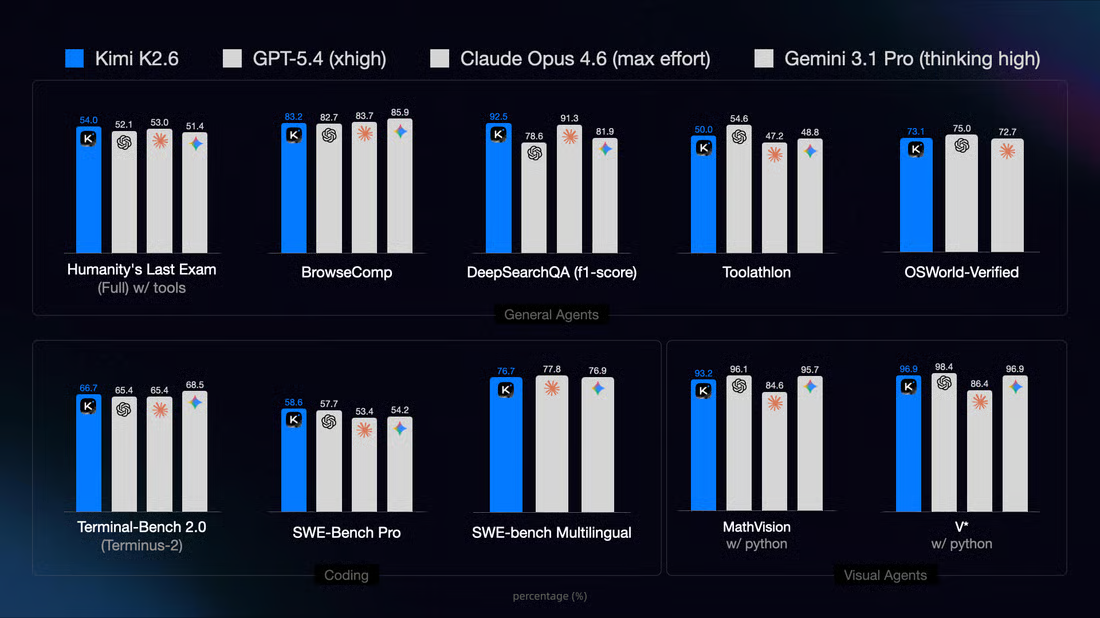
Moonshot reports K2.6 as built for long-horizon autonomous coding — sessions that run for extended periods (up to 12 hours of autonomous operation is the headline figure) while maintaining coherence. On coding benchmarks, Moonshot's published figures include SWE-Bench Pro around 58.6 and SWE-Bench Verified around 80.2 (the model card notes some scores were re-evaluated under K2.6's conditions). The model supports a preserve_thinking mode that retains reasoning across multi-turn interactions, relevant for agent scenarios where the model needs to remember earlier decisions.
The long-horizon angle is the differentiator Moonshot emphasizes. Where many models are benchmarked on single tasks, K2.6's pitch is endurance — staying on-task and coherent across a long agentic run. This is genuinely useful if it holds for your work, but "12-hour autonomous session" is a capability claim, not a guarantee that the output of such a session is correct.
Agent swarm claims
The most distinctive claim is the agent swarm: Moonshot states K2.6 can coordinate up to 300 sub-agents across as many as 4,000 coordinated steps in a single run. The idea is decomposing a large task into many parallel sub-tasks handled by specialized sub-agents, coordinated by a supervisor. For parallelizable work (large refactors, broad code generation), this is the capability Moonshot positions as a differentiator.
Read this claim precisely as stated: it's the model's capacity for swarm coordination under Moonshot's framework and conditions. It describes what the system can orchestrate, not a guarantee of output quality at that scale. More sub-agents and more steps mean more generated output to verify — the swarm claim is about throughput and coordination, not about correctness. Evaluate whether the coordinated output actually meets your requirements rather than assuming scale equals quality.
API and Kimi Code availability
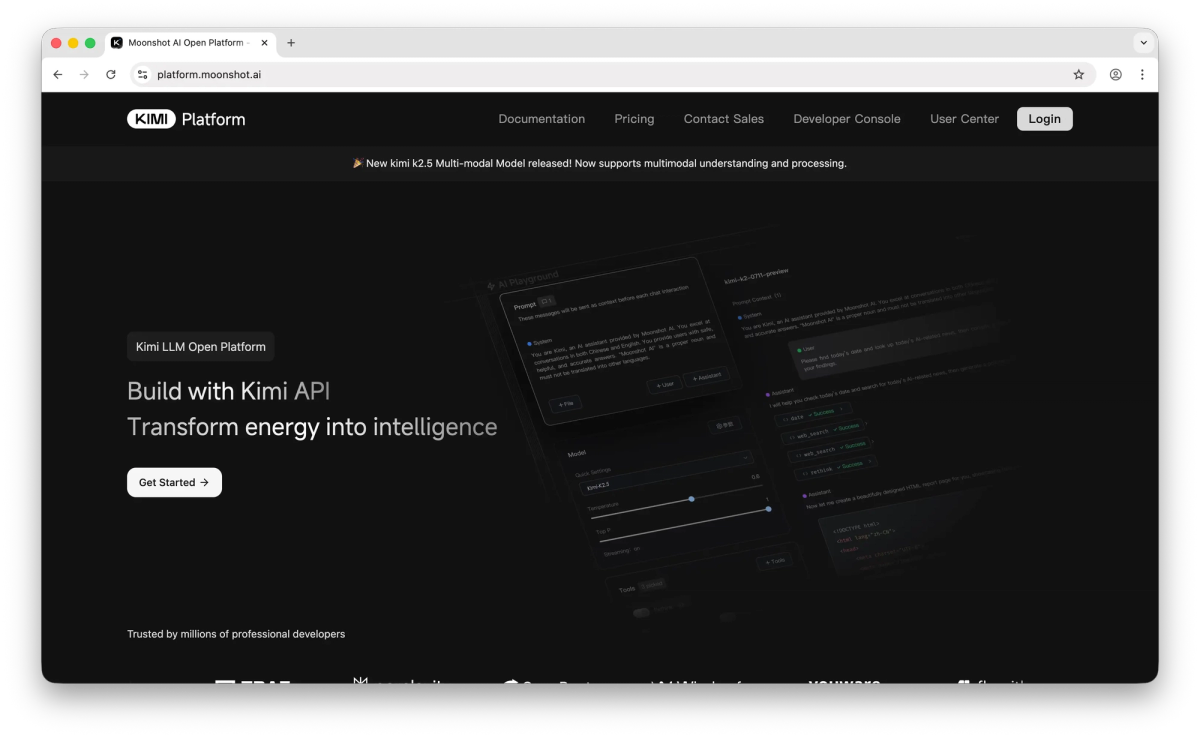
K2.6 is available through Moonshot's API (model ID kimi-k2.6), which is both OpenAI-compatible and Anthropic-compatible — meaning it works in tools expecting either format, including Claude Code via base-URL substitution. It's also the default backend for Kimi Code, Moonshot's first-party CLI coding agent. The model weights are open-source (Modified MIT), so self-hosting is possible for teams with the infrastructure. Availability spans Kimi.com, the Kimi app, the API, and Kimi Code CLI. Verify current API details, model IDs, and access at Moonshot's official documentation, as these evolve.
Benchmarks: What to Read Carefully
Official vs community benchmarks
Every benchmark figure in Moonshot's announcement is vendor-published — produced by the party with an interest in favorable results, under conditions they chose. That doesn't make the numbers false, but it means they're one input, not a verdict. The model card itself notes some scores were re-evaluated under K2.6's conditions, which is transparent but also a reminder that benchmark methodology shapes results.
Community benchmarks (independent evaluations from researchers and developers) provide a useful counterweight, but they come with their own caveats: smaller sample sizes, varying methodology, and sometimes specific use cases that don't generalize. The reliable picture comes from triangulating — vendor benchmarks for the official claim, community evaluations for independent signal, and your own testing for what matters to you. Don't treat any single source, vendor or community, as the final word.
Why repo-level eval matters
This is the central point for developers: aggregate benchmark scores don't predict performance on your codebase. SWE-Bench Pro and similar benchmarks test against curated problem sets that may not resemble your code, your conventions, or your problem distribution. A model scoring 58.6 on SWE-Bench Pro tells you it's capable in general; it tells you nothing specific about how it handles your repo.
The reliable evaluation is repo-level: run K2.6 on a representative sample of your actual tasks — a mix of bug fixes, feature implementations, refactors — and measure the outcomes you care about: completion rate, correctness, tokens per task, and how often it catches or introduces errors. For the agentic and swarm claims specifically, test them on your parallelizable work and verify the coordinated output, rather than trusting the headline numbers. The benchmark is orientation; your repo-level eval is the decision. And keep one distinction clear: a model capability improvement is not the same as workflow reliability. Even a strong agentic model produces output that needs structured planning, execution isolation, review, and verification before it lands in a real codebase — the concerns that workflow-layer tools like Verdent (Plan-First, parallel agents, worktree isolation, verification gates) address, separate from the model layer K2.6 represents.
API Workflow for Builders
Kimi API setup considerations
For builders integrating K2.6, the practical setup considerations: the API is OpenAI- and Anthropic-compatible, so you can point existing tooling at it by changing the base URL and key rather than rewriting your integration. The dual compatibility means K2.6 drops into OpenAI-format agent loops and Anthropic-format tools (like Claude Code) alike. Authentication, rate limits, and the exact endpoint paths are details to confirm against the current official documentation, since these change.
The preserve_thinking option is a setup consideration specific to agentic use — enabling it retains reasoning across turns (useful for long agent loops where context continuity matters), at the cost of additional tokens. Decide whether your workflow benefits from that continuity or whether the token cost outweighs it for your tasks.
Coding agent integration patterns
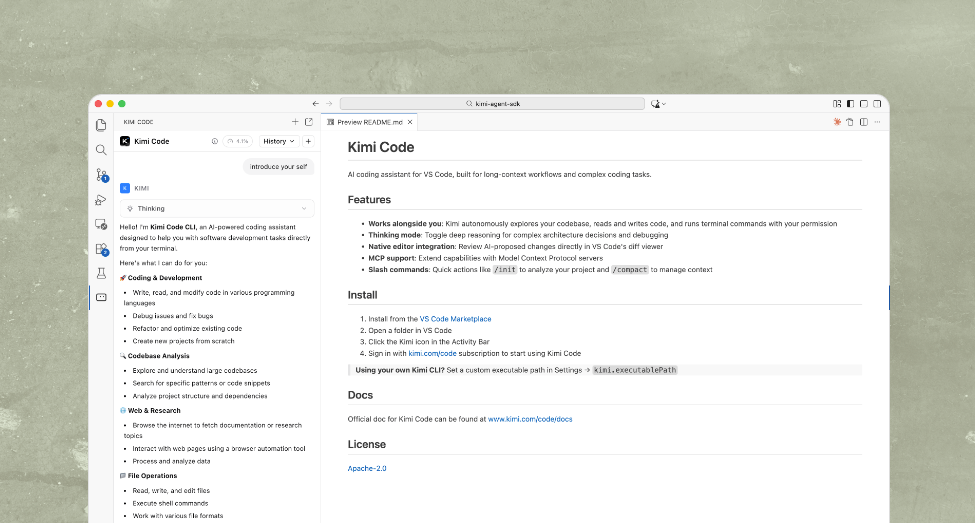
The common integration patterns for a model like K2.6 in a coding agent: as the primary model in a terminal agent (via Kimi Code or a custom harness), as a backend swapped into an existing tool (Claude Code via Anthropic-compatible endpoint), or as one model in a multi-model routing setup (K2.6 for agentic coding tasks, other models for other roles). The open-source weights add a fourth option — self-hosting for teams with data-residency requirements or high-volume cost concerns.
Whichever pattern you choose, the API is the model layer. The harness around it — context management, tool definitions, the swarm supervisor, error recovery, and verification — is what turns the model's capability into a working agent. The agent swarm capability, in particular, is realized through Kimi Code's (or your custom) coordination logic, not the raw API alone. Evaluate the full stack (model plus harness), not just the model's benchmark numbers.
Comparing Adjacent Models
Qwen and MiniMax as alternative model families
K2.6 isn't the only frontier agentic model from this wave. Two adjacent families worth knowing as comparison points (not a full head-to-head):
Qwen 3.7-Max (Alibaba, announced May 2026) is positioned as an "Agent Frontier" model for long-horizon autonomous execution — a similar agentic positioning to K2.6, with a 1M-token context window. Unlike K2.6, it's proprietary (not open-weight) and API-only, available through Alibaba Cloud Model Studio and aggregators. It's a text-focused reasoning model, strong on reasoning benchmarks. If your priority is reasoning depth and you don't need open weights, Qwen 3.7-Max is a relevant comparison.
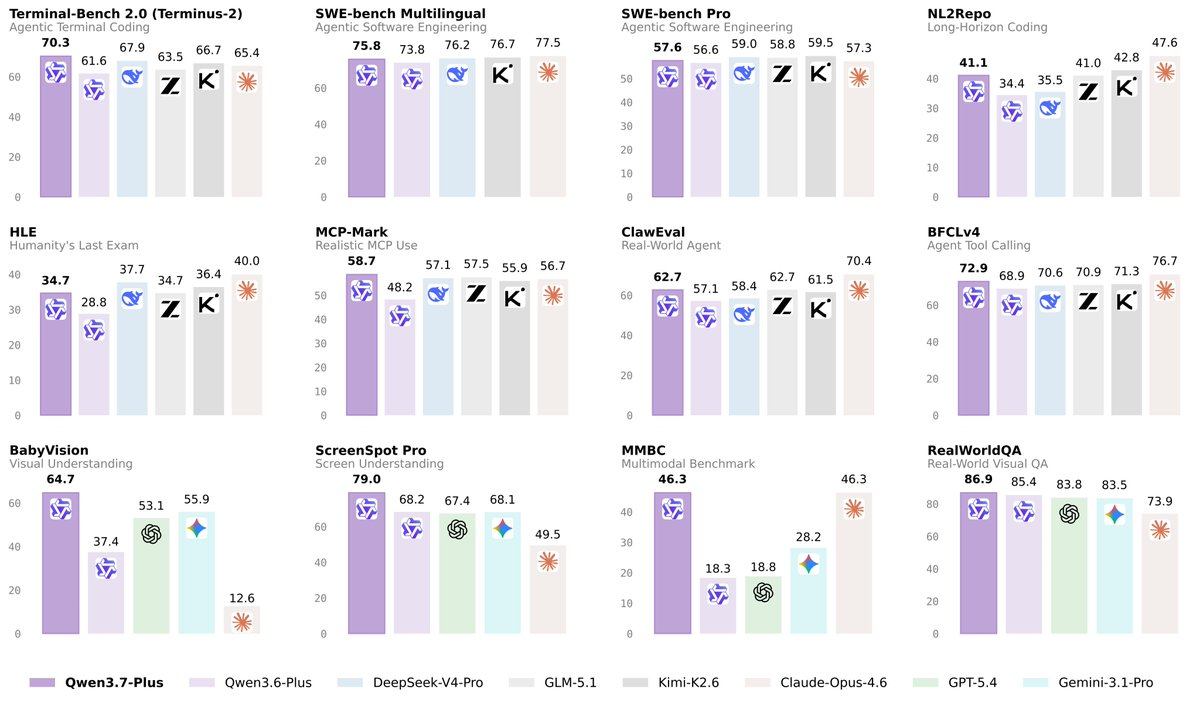
MiniMax M3 (launched June 2026) takes a different angle — a multimodal model with native vision, video, and computer-use capabilities via a sparse attention architecture, at aggressive pricing. Where K2.6 and Qwen 3.7-Max are text/code-focused, M3 adds multimodal breadth. If your work involves vision or computer-use alongside coding, M3 is the adjacent option to evaluate.
The point of mentioning these isn't to rank them — it's that the agentic-coding model space has multiple credible options, and the right choice depends on your specific requirements (open-weight vs proprietary, text vs multimodal, reasoning vs swarm orchestration). Evaluate the candidates that fit your constraints on your actual tasks. Model versions in this space move fast; verify the current version and capabilities of any comparison model before deciding.
FAQ
What is Kimi K2.6?
Kimi K2.6 is Moonshot AI's open-source (Modified MIT) Mixture-of-Experts model, released April 2026 — a one-trillion-parameter MoE with ~32B active per token, 262K context, positioned specifically for coding and agentic workflows. Moonshot emphasizes long-horizon autonomous coding (up to 12-hour sessions) and agent-swarm orchestration (up to 300 sub-agents). It's available via API (kimi-k2.6, OpenAI- and Anthropic-compatible), as the default backend for Kimi Code CLI, and as open weights for self-hosting. Verify current specs at the official model card.
How can developers use Kimi K2.6 through API?
The K2.6 API is OpenAI- and Anthropic-compatible, so you integrate it by setting the base URL to Moonshot's endpoint and your API key, then calling it like an OpenAI or Anthropic model (model ID kimi-k2.6). This means it drops into existing agent loops and tools expecting either format — including Claude Code via base-URL substitution. You can also use it through Kimi Code (the first-party CLI) or self-host the open weights. Consult Moonshot's official documentation for current authentication, rate limits, and endpoint details, as these change.
Are Kimi K2.6 benchmarks enough for production decisions?
No. K2.6's benchmarks are vendor-published, measured under Moonshot's conditions, and tested against curated datasets that may not resemble your codebase. The swarm and long-horizon claims describe coordination capacity, not guaranteed correctness at scale. For production decisions, run K2.6 on a representative sample of your actual tasks, measure completion/correctness/cost, and verify the output of agentic runs rather than trusting headline figures. Benchmarks are orientation; repo-level eval is the decision.
When should builders compare Kimi K2.6 with Qwen or MiniMax?
When selecting an agentic coding model and weighing alternatives. Compare with Qwen 3.7-Max if reasoning depth and large context matter and you don't need open weights (it's proprietary, API-only). Compare with MiniMax M3 if your work involves multimodal capabilities (vision, video, computer use). K2.6's distinguishing factors are open-weight availability and agent-swarm positioning. The right comparison is constraint-based and validated on your tasks — and since these versions update fast, verify each one's current version first.
Related Reading