Firebase pricing starts with two plans: Spark provides no-cost access within product limits; Blaze charges for eligible usage beyond included allowances. There is no single monthly price that covers every app architecture.
To estimate your Firebase cost, translate a user action into database operations, compute, file access, authentication, and transferred bytes. Then price normal usage and a busy-day case separately. The examples below use official information checked on September 21, 2026; they are reproducible estimates, not production bills.
Firebase Pricing at a Glance
Spark and Blaze Plans
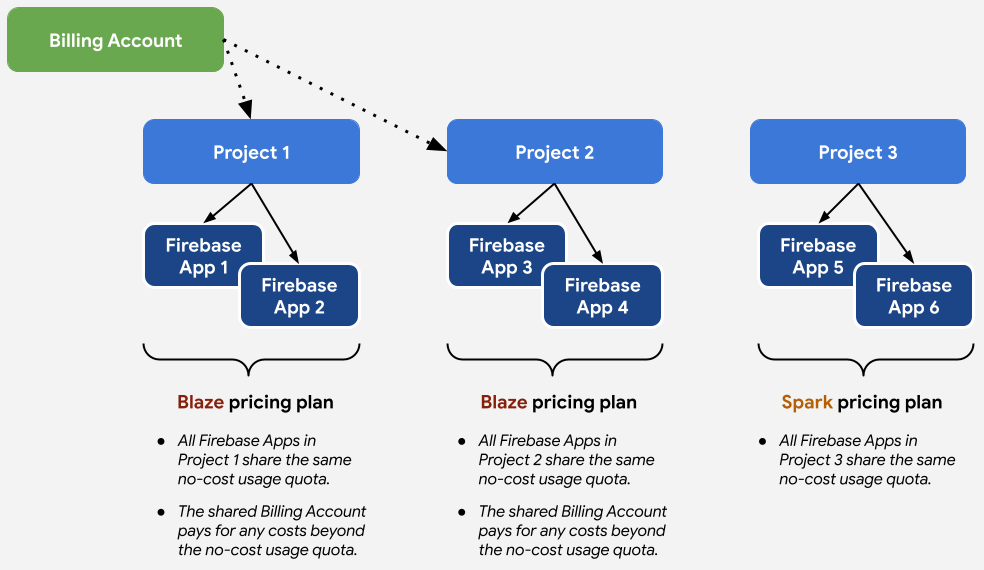
Spark needs no payment method. It suits prototypes whose required services and usage fit its limits. Exceeding a quota can restrict a product rather than automatically purchase more capacity.
The Firebase Blaze plan links a project to Cloud Billing and retains applicable no-cost allowances. Enabling billing does not make every request chargeable, but it enables charges from services your project uses.
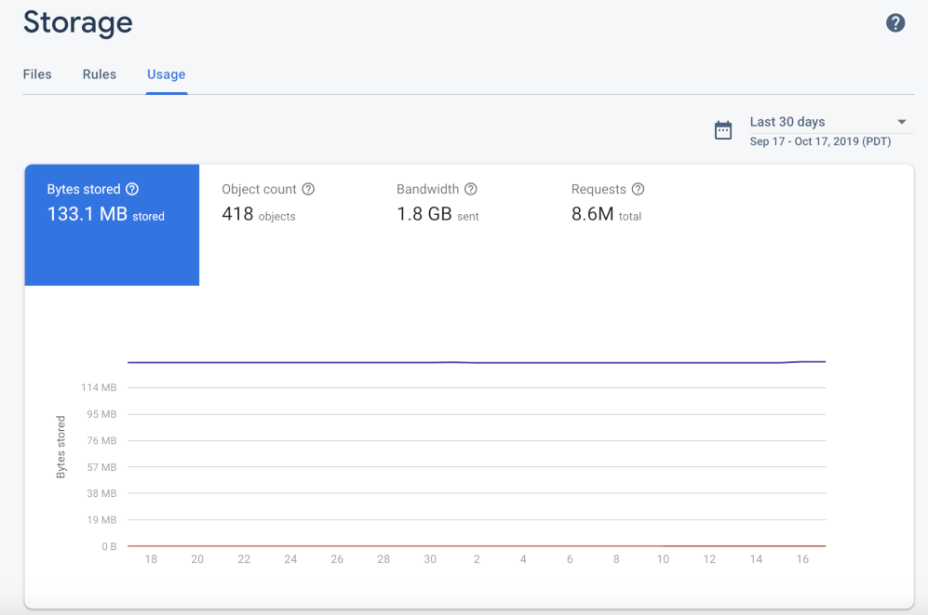
Service eligibility matters before traffic does. Cloud Storage for Firebase requires Blaze, with the existing-bucket requirement taking effect from February 3, 2026. A small upload feature can therefore require billing even when usage stays within an allowance.
No-Cost and Usage-Based Products
The Firebase free tier is a collection of product-specific allowances. Crashlytics and Cloud Messaging are listed as no-cost products. Firestore, Hosting, Functions, and Storage have distinct usage meters and eligibility rules.
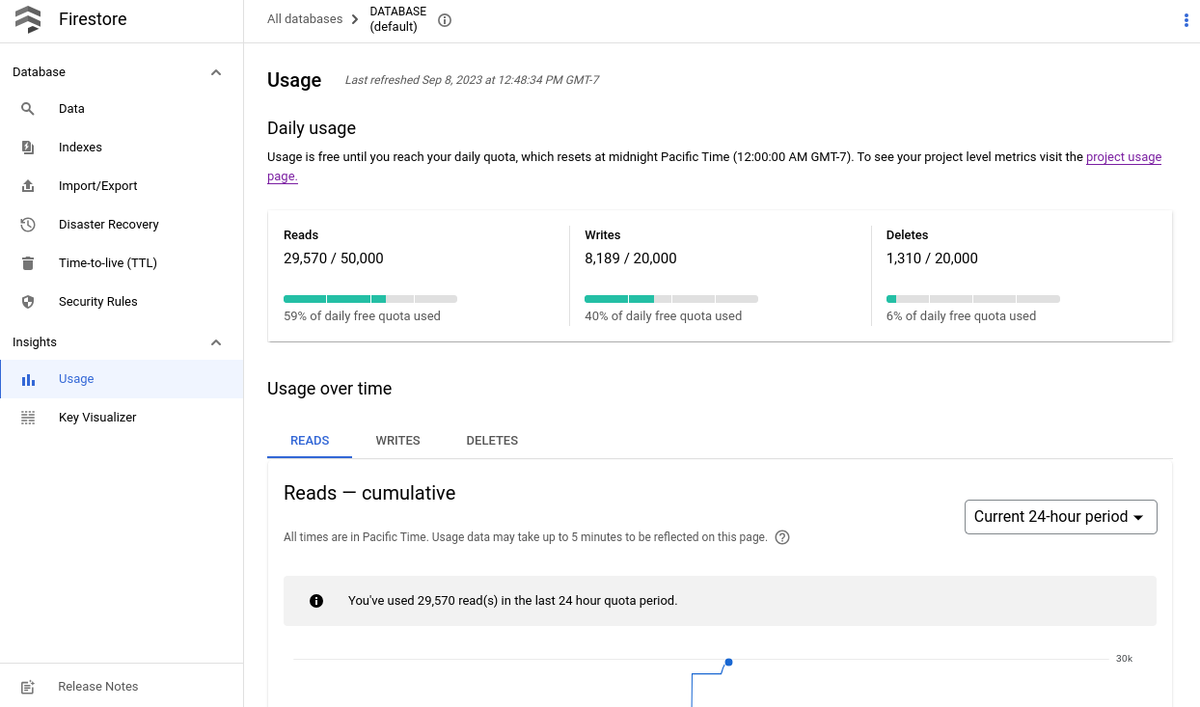
For Firestore Standard, included usage covers 50,000 document reads and 20,000 writes daily, plus 1 GiB stored. Unused daily operations do not become a pool you can spend during a launch spike.
Map an App Architecture to Billable Services
Database, Hosting, Functions, and Storage
Start with a request path: open dashboard → query records → download attachments → run backend work. Record the following inputs for each step.
| Service | Inputs your estimate needs |
|---|---|
| Firestore | Edition, region, document and index reads, writes/deletes, stored data, backups, outbound traffic |
| Realtime Database | Stored GB and downloaded GB; do not substitute Firestore’s operation model |
| Firebase Hosting | Retained deployment storage and delivered bytes |
| Cloud Functions | Generation, region, requests, execution time, memory/CPU, concurrency, idle instances, networking |
| Cloud Storage | Bucket location/type, storage class, stored volume, operations, retrieval and transfer |
Firestore pricing can include index-entry reads as well as document reads. Estimate listeners and repeated queries from their actual behaviour, rather than treating every screen opening as one database read.
Hosting storage includes retained releases, not just the latest deployment. App Hosting is a different product: its costs include underlying Google Cloud services, such as Cloud Run and build infrastructure.
For functions, request count alone is insufficient. Two endpoints with identical traffic can consume different compute resources. Include deployment artifacts and supporting services when moving from a runtime estimate to a project budget.
Authentication and Data Transfer
Record authentication methods explicitly. With Identity Platform pricing, tier-one providers have a 50,000-MAU no-cost tier; SAML/OIDC has a different allowance. Phone authentication adds destination-dependent SMS charges. Registered accounts and monthly active users are not interchangeable inputs.
Map transfer by source and destination: database to client, bucket to client, function to external API, or traffic between regions. Avoid one undifferentiated “bandwidth” allowance. Count each billable segment, without counting the same segment twice.
Estimate Costs with Three Usage Scenarios
Use the Firebase pricing calculator as a starting worksheet, then check regional SKU rates. The embedded calculator’s database-operation defaults differed from the Iowa rates below during this review; its output should not be copied as a region-specific quote.
These examples assume 30 identical days, one default Firestore Standard database in Iowa (us-central1****), USD list prices, and no commitments or credits. Regional reads cost $0.03 per 100,000 beyond the daily allowance; writes cost $0.09. Authentication uses Identity Platform tier-one providers, without SMS or SAML/OIDC.
| Monthly scenario | Reads/day | Writes/day | Auth MAUs | Database operations | Authentication | Selected-service subtotal |
|---|---|---|---|---|---|---|
| Prototype | 10,000 | 1,000 | 1,000 | $0.00 | $0.00 | $0.00 |
| Growing app | 100,000 | 10,000 | 10,000 | $0.45 | $0.00 | $0.45 |
| Higher activity | 1,000,000 | 100,000 | 100,000 | $10.71 | $275.00 | $285.71 |
The last row’s operation calculation is:
30 × [(1,000,000 − 50,000)/100,000 × $0.03
    + (100,000 − 20,000)/100,000 × $0.09]
= $10.71
Authentication adds 50,000 × $0.0055 = $275. These are deliberately subtotals, not promises that a 100,000-user application costs $285.71.
To complete each scenario, add measured or forecast database storage, index reads, backups and transfer; Hosting storage and delivery; Functions compute and supporting infrastructure; and Storage operations and downloads. Mark an unused service as zero, rather than silently omitting it. Use the Google Cloud calculator for those underlying services, preserving region, units and assumptions alongside the result.
Finally, rerun a burst case. The growing app’s three million monthly reads cost $0.45 when spread evenly; concentrated into one day, the read charge becomes about $0.89. The monthly total is unchanged, but daily allowances change the bill.
Set Budgets, Alerts, and Usage Controls
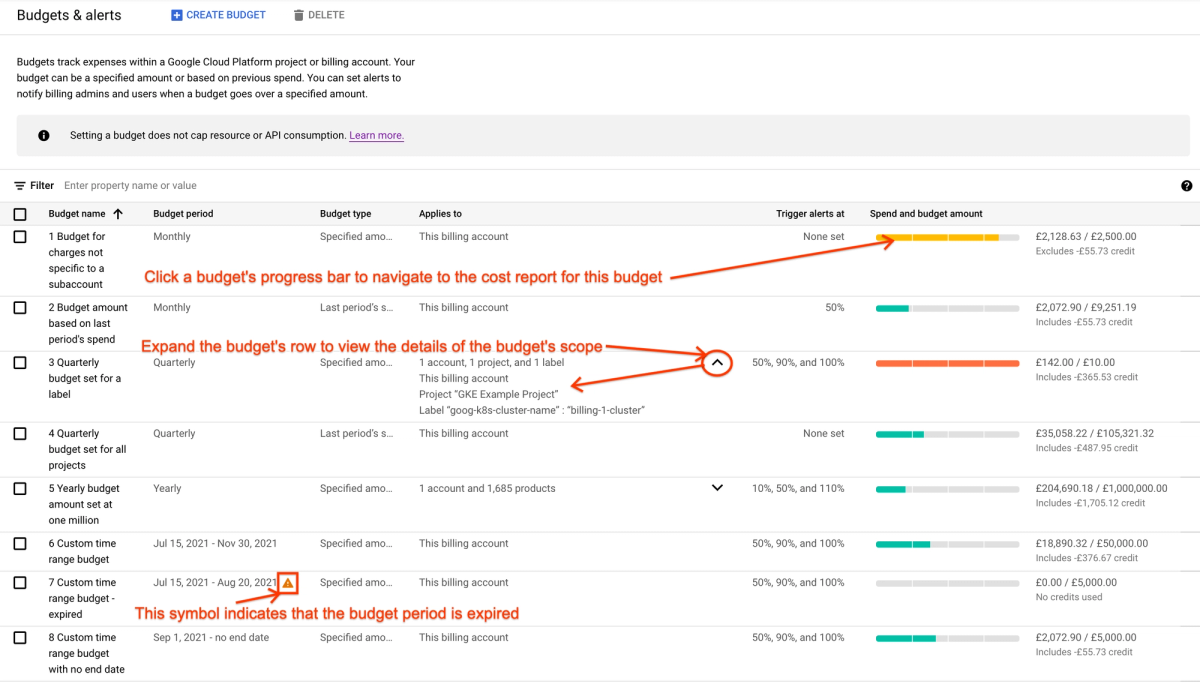
Create project-scoped billing alerts with an owner who will respond. Suggested review thresholds might be 50%, 80%, and 100% of your internal budget; alerts themselves do not stop usage.
Firebase now documents preview spend caps for selected services: AI Logic, App Hosting, Functions, and Extensions. They can pause the relevant underlying service, but are not hard caps: reporting delays can produce billable overages. They do not provide a universal Firestore or whole-project ceiling.
Control the workload too: bound queries, paginate results, prevent recursive triggers, limit upload sizes, and apply appropriate abuse controls. Function maximum-instance settings can constrain scaling, but introduce capacity tradeoffs. Decide which work can fail or wait before a traffic surge forces that decision.
When Firebase Pricing Fits a Project
Firebase is easier to budget when the team can relate product behaviour to billable operations and measure that relationship after deployment. It deserves closer scrutiny when large downloads, repeated listeners, SMS, or unpredictable backend work dominate the architecture.
Compare alternatives using the same workload and operational requirements. A low database-operation subtotal is not enough to choose a platform, and startup credits should not conceal the cost after they expire.
FAQ
Can a Firebase Project Move Back from Blaze to Spark?
Yes, through the Firebase console, but downgrading removes access to paid capabilities. New Functions deployments become unavailable, and Storage’s Blaze requirement also matters. Audit dependencies before changing plans; downgrading does not erase charges already incurred.
Are Google Cloud Charges Shown on the Same Firebase Bill?
Firebase projects are Google Cloud projects, so billing is shared. Review Cloud Billing by project, service, and SKU to understand supporting infrastructure charges rather than expecting a separate Firebase-only subscription invoice.
How Are Multiple Firebase Projects Billed Under One Account?
Multiple projects can share one Cloud Billing account; linked Firebase projects use Blaze. Keep project-level cost reporting and budgets so staging does not disappear inside production spending. Check each product’s quota scope: a shared billing account does not make every allowance a separate entitlement per app.
Do Emulator Suite Requests Count Toward Firebase Usage?
Requests handled locally by emulators do not consume hosted-service usage. However, emulated and live services can be mixed. Calls that still reach production resources or external APIs can generate charges. Check endpoint configuration before running automated tests.
Which Firebase Discounts or Credits Apply to Eligible Startups?
The Google for Startups Cloud Program advertises eligible Google Cloud and Firebase credits up to $200,000, or $350,000 for qualifying AI startups, over two years. Approval, coverage and expiry conditions apply. Estimate recurring costs before credits, then apply only the award attached to your billing account.
Conclusion
Build a Firebase budget that another engineer can reproduce: service inventory, regional rates, daily and monthly volumes, explicit exclusions, and a response plan. After launch, compare those assumptions with billed usage. The most useful estimate is the one that reveals which product decision changes your next bill.