"Kimi Agent" sounds like a chatbot with a fancier name. It isn't. The distinction matters more than the marketing suggests: a chat model answers a question and stops; an agent plans a multi-step task, calls tools, reads and writes files, runs commands, and keeps going until the work is done or it hits a limit. Kimi Agent — powered by Moonshot AI's K2.6 model and surfaced through Kimi Code — is built for the second mode. For builders, understanding that difference is the key to knowing when a Kimi AI agent fits a coding workflow and when it doesn't.
Verified against Moonshot AI's official documentation and Hugging Face model card as of June 2026. Model behavior and availability change — confirm current details at the official sources before relying on specifics.
Kimi Agent in One Paragraph
What Kimi Agent means for builders
Kimi Agent refers to Moonshot AI's agentic capability — the ability of its Kimi models to operate autonomously on multi-step tasks rather than just answer questions. In a coding context, this means the model can decompose a task, call tools (file operations, shell commands, search), execute steps, observe results, and iterate. The headline capability Moonshot emphasizes is duration and coordination: K2.6 is built for long-horizon autonomous coding sessions and agent swarms that coordinate many specialized sub-agents in a single run.
For builders, the practical meaning is that a Kimi AI agent isn't a code-completion tool or a chat assistant — it's an autonomous worker you delegate a task to. You describe what you want, and the agent works through it. That's a different interaction model than asking a chatbot for a code snippet, and it suits different work: tasks with multiple steps, tool use, and a defined completion state rather than single-turn questions.
How Kimi K2.6 powers the coding angle
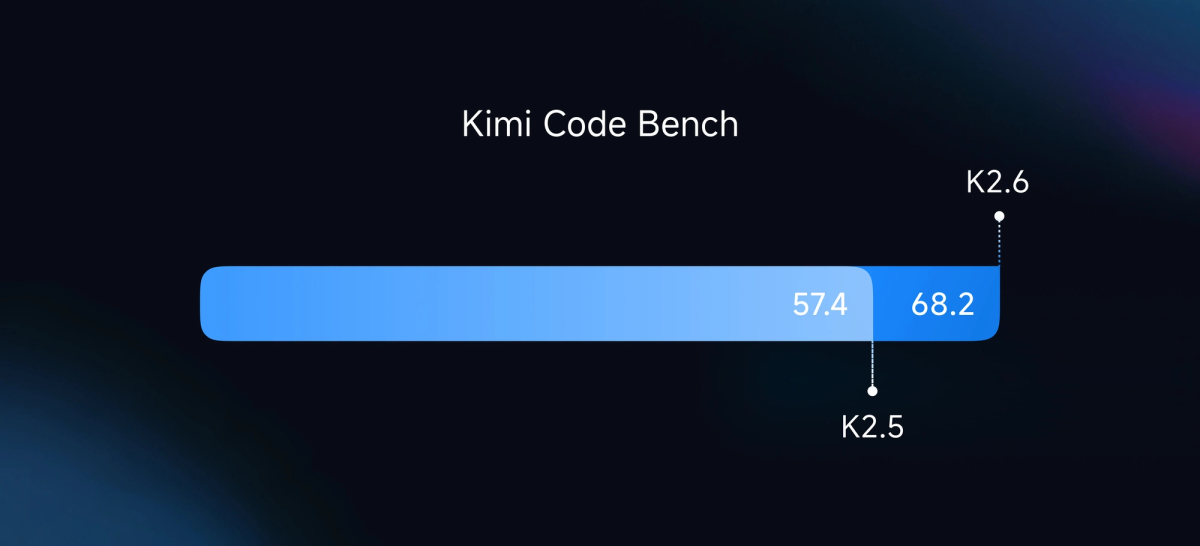
Kimi K2.6 is the model underneath. Released in April 2026 as an open-source (Modified MIT) Mixture-of-Experts model, it carries the K2 architecture — one trillion total parameters with a fraction active per token — and adds a production execution layer optimized for sustained autonomous operation. Moonshot positions it specifically for long-horizon coding, coding-driven design (turning prompts into interfaces), and swarm-based task orchestration.
The Kimi model's relevance to coding is that it was trained for the agentic loop, not just code generation. It generalizes across languages (Rust, Go, Python) and domains (front-end, DevOps, performance), and supports a preserve_thinking mode that retains reasoning across multi-turn interactions — useful in coding-agent scenarios where the agent needs to remember why it made earlier decisions. As always with vendor-reported capabilities, treat the model's published strengths as directional and validate against your own work.
Where Kimi Code Fits
CLI coding workflows
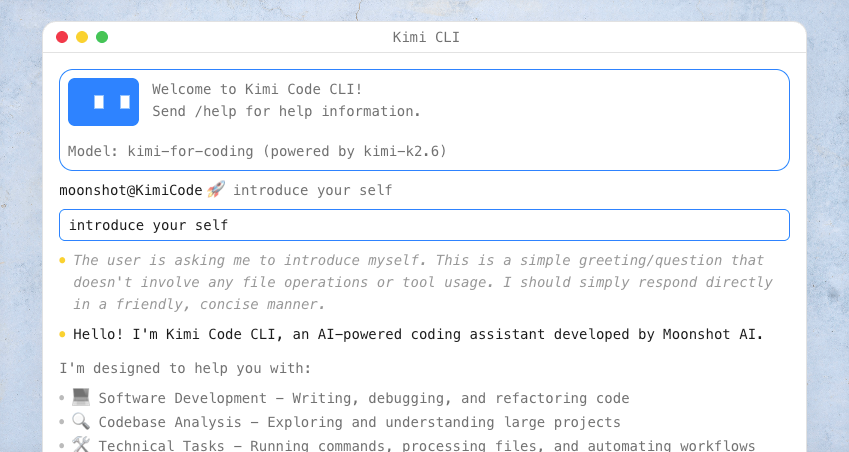
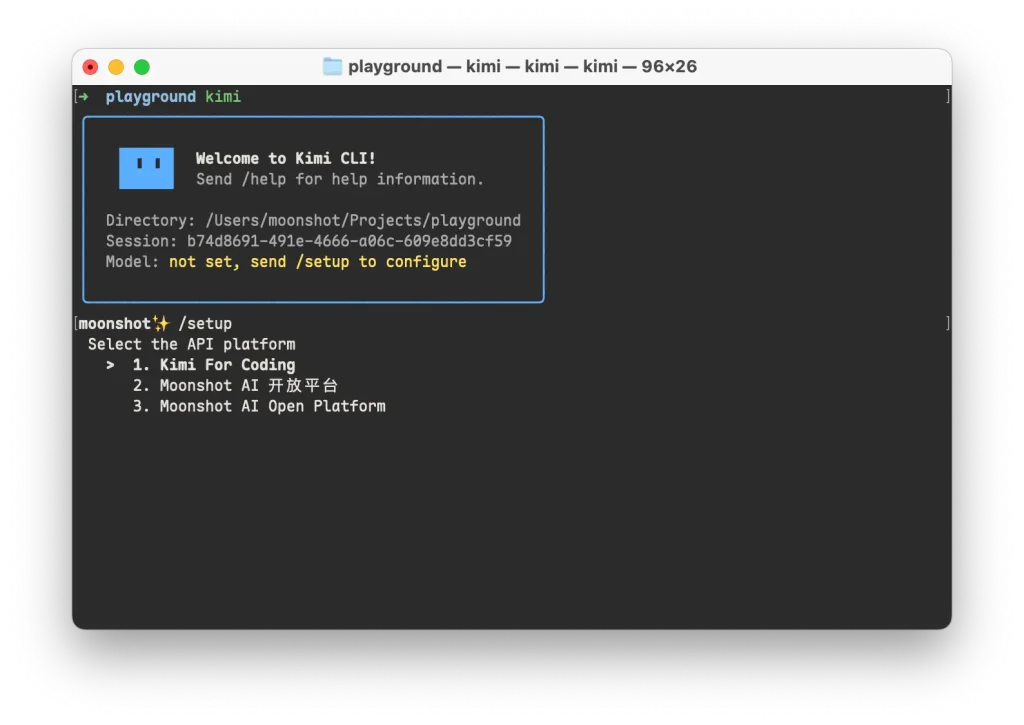
Kimi Code is the CLI — the recommended entry point for coding with Kimi's agentic capability. Launched in January 2026 and now shipping with K2.6 as its default backend (model kimi-for-coding), it's the surface that turns the model's agentic capability into a usable terminal coding tool. Kimi Code wires up tool-calling, file-system access, and the swarm supervisor by default, so the agentic behavior is available out of the box rather than something you assemble yourself.
The relationship is straightforward: K2.6 is the model (the intelligence), Kimi Code is the harness (the agent loop, tool definitions, file access, and coordination that turn the model into a working coding agent). You can use the K2.6 model through other surfaces — the API is OpenAI- and Anthropic-compatible, so it works in Claude Code and other compatible tools — but Kimi Code is the first-party agent surface built specifically for it.
Repo tasks and terminal agent behavior
In a repository, Kimi Code operates like other terminal coding agents: you describe a task, it reads relevant files, proposes and makes changes, runs commands (tests, builds), and iterates. The differentiating angle Moonshot emphasizes is the scale of autonomous operation — long sessions and large agent swarms that decompose a task into parallel sub-tasks across domains. For a builder, this means Kimi Code is oriented toward larger, multi-step repo work (end-to-end feature generation, broad refactors) as much as quick edits, with the swarm capability aimed at parallelizable work.
The terminal agent behavior follows the standard pattern: plan, act, observe, iterate. What varies between agents is the quality of each step and the harness features around them. Kimi Code's distinguishing features are the swarm supervisor and the long-horizon session design.
Kimi Agent vs Generic AI Chat
Agent tasks, tool use, and longer workflows
The core conceptual point: an AI agent is not a chat model. A chat model takes a prompt and returns a response — one turn, no actions in the world. An agent takes a goal and works toward it across many turns, calling tools and taking actions (reading files, running commands, making edits) until the goal is met. This is the difference between "explain how to add JWT auth" (chat) and "add JWT auth to this codebase" (agent).
Kimi Agent is built for the second mode. The model plans, calls tools, observes results, and iterates — the agentic loop. For coding, this is what makes it useful for actual repo work rather than just answering questions about code. The tool use (file operations, shell, search) and the multi-step workflow are what distinguish an agent ai system from a chatbot, and they're what make it capable of completing a task rather than just describing how to do it.
Why coding agents need verification
Here's the critical caveat that applies to every coding agent, Kimi or otherwise: the agent generates and executes, but it doesn't verify correctness. An agent that completes a 12-hour autonomous session has demonstrated endurance and coordination — not that every change it made is correct. The longer and more autonomous the run, the more important verification becomes, because there's more unreviewed output to check.
This is why generated code needs tests and review regardless of how capable or autonomous the agent is. A coding agent's value comes from task execution, tool use, and context management — but the verification (does it pass tests, does the diff match intent, is it safe to merge) remains the developer's responsibility. An impressive agentic run is not a substitute for reviewing what it produced.
Builder Workflows That May Fit
Prototyping and repo exploration
Kimi Agent's strengths suit prototyping: generating a full front-end from a prompt, scaffolding a feature end-to-end, or exploring an unfamiliar codebase by having the agent read and summarize it. For prototyping specifically, the combination of long-horizon operation and the model's open-source availability (you can self-host or use the API) makes it a reasonable choice for builders who want to iterate quickly. The agentic capability handles the multi-step work of going from idea to working prototype.
Repo exploration is another fit: pointing the agent at a codebase and asking it to map the architecture, find where a feature lives, or explain how components connect. This uses the agent's ability to read and reason across files without requiring it to make changes — lower risk than autonomous edits, useful for onboarding to a new codebase.
Alternative model evaluation
For builders evaluating which models to use, Kimi K2.6 is worth including in the consideration set specifically for cost-sensitive, agentic, coding-heavy work. Its open-source availability lowers the barrier to evaluation (you can test it via the API or self-host), and its agentic optimization makes it a relevant comparison point against other coding-focused models. The right way to evaluate it is the same as any model: run it on representative tasks from your actual work and measure the outcomes you care about, rather than relying on benchmark aggregates.
Limits and Risks
Benchmarks need repo-level validation
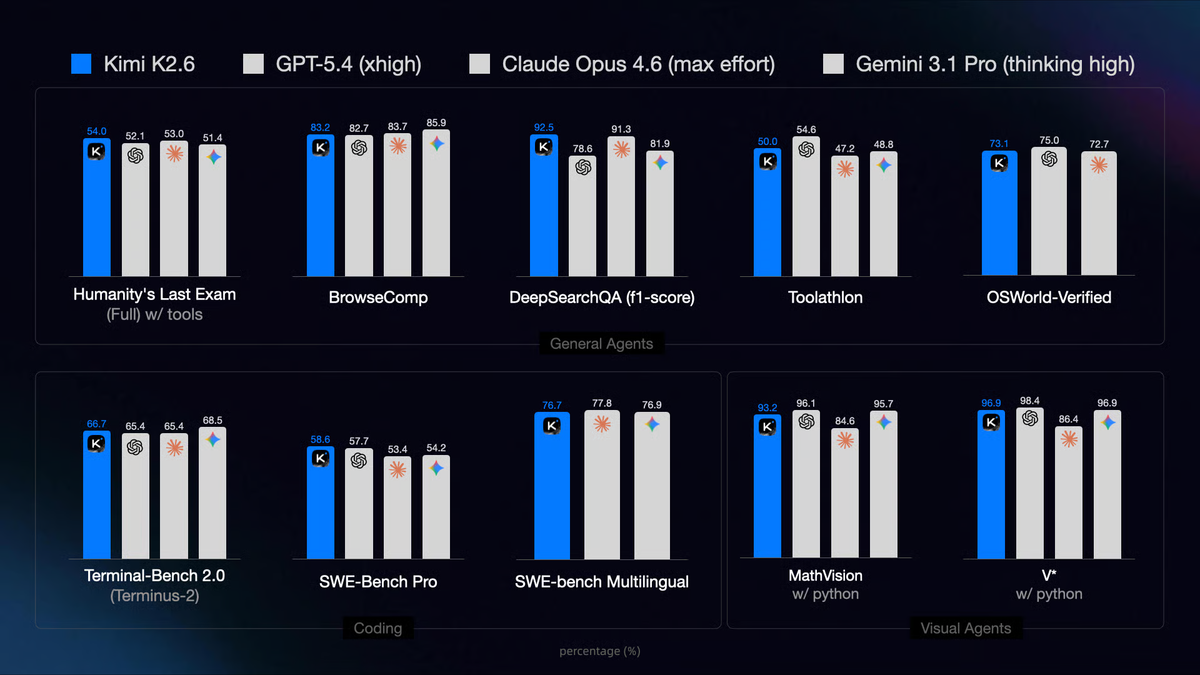
Moonshot reports strong benchmark results for K2.6 across coding and agentic tasks. These are useful for orientation but are vendor-published or source-specific, and the model card itself notes some scores were re-evaluated under K2.6's conditions. Benchmark numbers don't predict performance on your specific codebase, with your conventions, on your actual tasks. Before committing to Kimi Agent for real work, validate at the repo level: run it on a representative sample of your tasks and measure completion, correctness, and cost. The benchmark tells you the model is capable in general; your own evaluation tells you whether it's capable on your work.
Generated code still needs tests and review
The recurring theme for any coding agent: generation is not verification. The more autonomous the agent (and K2.6 is built for highly autonomous, long-horizon operation), the more unreviewed output accumulates, and the more important it is to verify before integrating. Every change a Kimi agent produces needs the same discipline as any AI-generated code — read the diff, run the tests, confirm the behavior. The autonomy that makes the agent powerful is also what makes verification essential: a 12-hour run that produces a large body of changes is a large body of changes to review, not a reason to skip review.
One framing worth keeping clear: Kimi Agent (the model plus its execution capability) operates at the model and execution layer. The workflow layer — how tasks are structured, how parallel agents are coordinated and isolated, how output is verified before integration — is a separate concern. Systems like Verdent, with Plan-First decomposition, multi-agent execution on isolated Git worktrees, and verification gates, operate at that workflow layer, which is distinct from the model and execution layer Kimi Agent represents. A capable agentic model and a structured workflow are complementary, not the same thing.
FAQ
What is Kimi Agent?
Moonshot AI's agentic capability — its Kimi models (currently K2.6) operating autonomously on multi-step tasks rather than just answering questions. In coding: decomposing a task, calling tools, executing steps, and iterating until done. It's surfaced through Kimi Code (the CLI) and built for long-horizon autonomous sessions and agent swarms. Unlike a chat model that answers and stops, an agent plans and acts across many turns.
How is Kimi Code related to Kimi Agent?
Kimi Code is the CLI surface; Kimi Agent is the underlying agentic capability. Put simply: K2.6 is the model, Kimi Code is the harness (agent loop, tool-calling, file access, swarm supervisor) that turns the model's agentic capability into a usable terminal coding tool. Kimi Code ships with K2.6 as its default backend. You can also use the K2.6 model through other surfaces (the API is OpenAI- and Anthropic-compatible), but Kimi Code is the first-party agent entry point for coding.
Can Kimi Agent help with real coding tasks?
Yes, for tasks that suit an agentic workflow: multi-step features, end-to-end prototyping, repo exploration, and parallelizable work that benefits from its swarm capability. It generalizes across languages (Rust, Go, Python) and domains (front-end, DevOps). The caveat is that its output, like any coding agent's, needs verification — tests and review before merge. It's well-suited to prototyping and scoped repo tasks; for production-critical work, treat its output as a draft requiring validation. Test it on your representative tasks to gauge real fit.
Is Kimi Agent enough for production code?
Not on its own. No coding agent is "enough" for production without verification — it generates and executes but doesn't confirm correctness. K2.6's long-horizon autonomy means one run can produce a large body of changes, which makes review more important, not less. The output must pass tests, get diff-reviewed, and meet your standards before merge.
When should builders compare Kimi Agent with other coding agents?
When you're selecting tools for an agentic workflow and cost or open-source availability matters. K2.6's Modified MIT license and competitive pricing make it a relevant option for cost-sensitive, coding-heavy work, especially where long-horizon and swarm capabilities fit. Compare on your actual tasks — completion, correctness, cost per task, workflow integration — rather than benchmark aggregates.
Related Reading