“Ready for release” is a consequential sentence when its only source is an AI-generated summary. Among the risks of using AI in project management, false progress can turn unfinished implementation into a delivery commitment. Software project leads need to inspect what supports the sentence before passing it to stakeholders.
The examples below are illustrative failure scenarios, not a study of how frequently AI systems fail. They follow a fictional feature: letting support staff bulk-archive resolved tickets while preserving the ability to restore them.
How AI Errors Become Software Delivery Risk
An omitted dependency becomes software delivery risk when someone schedules downstream work as though that dependency were complete. An inaccurate summary can have the same effect: a lead announces a release, support prepares instructions, and the team discovers that restoration was never implemented.
The failure crosses three stages: an artifact contains an error, a project claim repeats it, and a person acts on that claim. Verification belongs before that last step.
To assess the return on AI assistance, count review and recovery effort alongside drafting speed. A status update produced quickly offers little value if someone must reconstruct the evidence later or correct a commitment already communicated.
Check the Artifacts Behind Project Claims
Plans With Missing Dependencies
A plan might list an archive button, API endpoint, and tests while omitting the database migration needed to store archive state. That AI planning risk survives even if every listed task has an owner and an estimate.
Trace the user action through the interface, service, database, and release sequence. Ask what must exist before each step can work. A neat task breakdown cannot establish that the dependency chain is complete.
Status Updates That Overstate Progress
“Bulk archive implemented” could mean the button renders, the endpoint works locally, or the complete behavior passed in staging. Those are different states.
To catch AI project status errors, request the tested commit, environment, command or manual procedure, and result. Replace broad completion language with the narrowest supported statement: “The endpoint passes local tests; migration and restoration remain unverified.”
Changes That Drift Beyond the Agreed Scope
An agent could interpret archiving as permission to delete old attachments or alter retention settings. The resulting code might be internally consistent while changing product behavior nobody requested.
Detect AI scope drift by comparing the diff with the approved requirement and explicit exclusions. When extra behavior appears, separate it for a decision. Passing tests for an unapproved feature do not authorize its inclusion.
Reviews That Miss Product Requirements
A reviewer could check error handling and query efficiency without noticing that restored tickets must retain their original assignment. If that requirement is absent from the review context and tests, a clean findings list leaves it unresolved.
Give reviewers the acceptance criteria as well as the patch. Then test the complete user journey. Code-level correctness and fulfillment of a product promise require different evidence.
Match Each Claim to Independent Evidence
Independent evidence must be capable of contradicting the generated claim. Asking another model to paraphrase the same summary adds little. A reproducible test, inspected diff, or comparison with the approved requirement can expose what the summary omitted.
For the illustrative ticket feature, use a claim-to-evidence matrix:
| Incorrect claim | Evidence to inspect | Human action |
|---|---|---|
| “The plan covers implementation.” | Schema changes, API dependencies, and deployment order | Add the missing migration and revise dependent tasks before confirming dates. |
| “Bulk archive is complete.” | Test output tied to the current commit and staging environment | Report only verified behavior; keep restoration visibly unfinished. |
| “Attachment cleanup is part of archiving.” | Approved scope compared with deletion paths in the diff | Remove or separate cleanup until its behavior is explicitly approved. |
| “Review passed, so requirements are met.” | Archive-and-restore checks against original assignment requirements | Run the missing acceptance check and withhold acceptance if it fails. |
Test design matters too. If the implementation and its generated tests share the same mistaken assumption, green results can reinforce the error. Derive expected behavior from approved requirements and inspect whether a test would fail when that requirement is violated.
Keep evidence attached to a version. Later code changes can invalidate earlier results; a report with no commit or environment is difficult to use for a release decision.
What Verdent Review Features Can and Cannot Establish
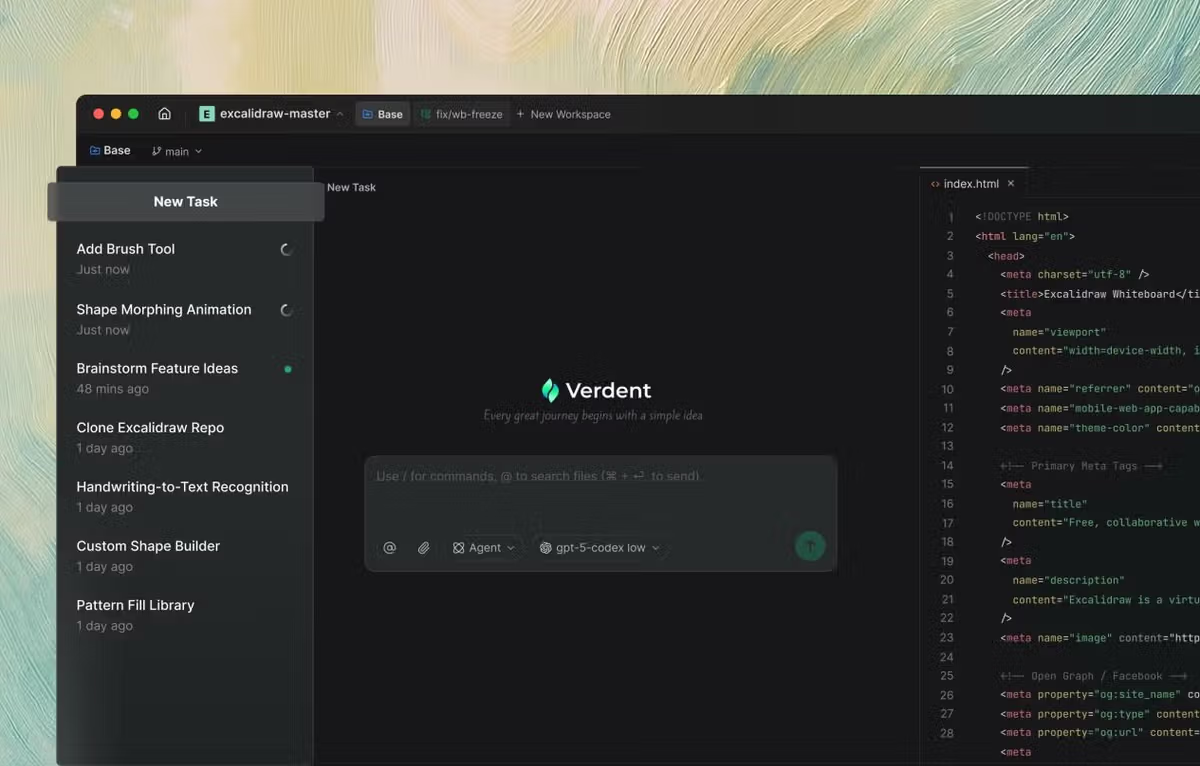
Verdent gathers finished tasks in To Review with outputs and access to diffs or the running app. Treat that queue as a handoff location. It does not establish human acceptance or grant production release permission.
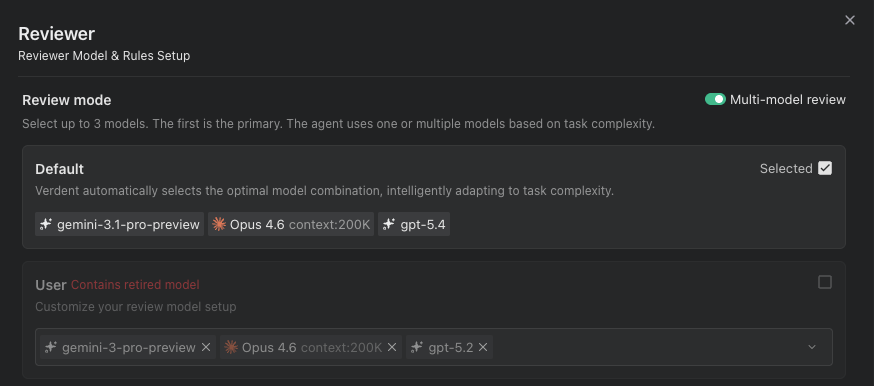
The built-in Reviewer produces findings and supports custom rules and multi-model review. These features can broaden inspection, but no findings list guarantees complete requirement coverage. Multiple models may still miss the same unstated constraint.
Keep four states separate: work awaiting review, AI review results, human acceptance against requirements, and authorization to release. Visible task records help inspect work; they should not be described as a complete compliance audit trail. Product behavior here was checked on September 8, 2026.
FAQ
Can an external issue description contain prompt injection?
Yes. Prompt injection can hide malicious instructions inside content an agent processes. An issue could ask the agent to bypass checks or expose credentials under the guise of troubleshooting. Treat issue text as untrusted input, constrain tool permissions, and verify requested actions against the authorized task.
Does a separate git worktree restrict an agent's network access?
No. Workspace Isolation separates working files, branch checkouts, and staging state. A Git worktree does not itself restrict network access. Check sandbox, network, credential, and tool permissions separately. Tasks within the same Verdent workspace also share files, despite having separate conversation context.
Can a scheduled check be marked as missed rather than failed?
Yes. Verdent distinguishes Missed executions from Failed runs. Scheduled tasks require the app to be active; closing it or switching off the computer can cause a missed run. Missing execution provides no evidence that the software passed. Confirm the task is still appropriate before triggering it manually.
When should delivery checks be repeated after a model update?
Before relying on the updated model for consequential planning, status, or review decisions, rerun representative cases with known omissions and acceptance failures. Compare missed issues, unsupported claims, and review effort. If the updated model changes code, rerun affected delivery checks on that revision. A model update alone does not invalidate an unchanged build's recorded test results.
Can an AI reviewer apply fixes rather than only report findings?
Yes. In Verdent, selecting findings and clicking Fix applies changes. Reviewer may also automatically select and apply fixes it judges low-risk without confirmation. Inspect the resulting diff and rerun affected tests; the previous review covered the earlier code, and “Fix done” does not establish acceptance or release authorization.
Treat Generated Status as a Claim to Verify
When a release summary says “ready,” require it to point to the requirement, the reviewed revision, and the check that supports readiness. If one is missing, change the status before changing anyone's expectations. An unresolved claim should remain visibly unresolved, however polished its wording.